



Use a charged battery to check.
Check the strength of the positive battery cable by hand; tighten the cable if necessary.
Set the ammeter with a measurement range from 0-5 mA to 5 A to the highest measurement limit. Disconnect the ground wire from the battery.
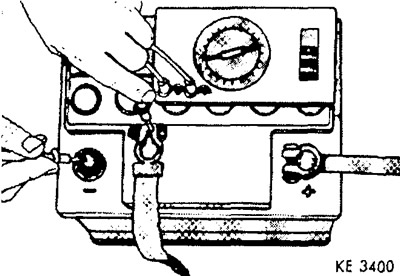
Connect the ammeter between the negative pole of the battery and the ground wire. The positive pole of the ammeter must be connected to the ground wire, and the negative pole to the negative pole of the battery.
Note: The test can also be performed using a test lamp. If the lamp connected between the ground wire and the negative pole of the battery does not light, then an ammeter must be used.
Turn off all electrical consumers, available clocks (and other regular consumers) disconnect, close doors.
Reduce the ammeter measurement range until the reading can be read from the instrument scale (acceptable value is 1-3 mA).
By removing fuses in sequence, open various electrical circuits. If the ammeter needle moves to zero when opening one of the circuits, the fault should be looked for in that circuit. The fault may be caused by corrosion and contamination of contacts, chafing of wires, or an internal short circuit in the unit.
If no fault is detected in the fuse-protected electrical circuits, then it is necessary to disconnect the wires from the unit that is not protected by the fuse. Such a unit may be a generator, starter, ignition system, instrument cluster.
Connect the battery ground (-) cable.
Visitor comments