



For car enthusiasts, there are multi-purpose measuring instruments that are designed specifically for measurements in a car. One such device can measure the crankshaft speed, the angle of the closed state of the breaker contacts and, in addition, voltages up to 20 volts. The measurement range of such a resistance device is limited, as a rule, to the region of kiloohms, that is, 1 - 1000 kOhm. If the device allows the measurement of current, then only in the starter circuit.
In addition, measuring instruments are available for testing electrical and electronic parts. These devices do not have the ability to measure the speed of the crankshaft and the angle of the closed state of the breaker contacts.
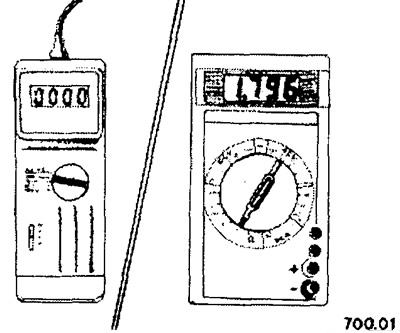
The great advantage of these instruments is that they allow extensive measurements from small resistances in ohms (Ohm) up to very high resistances in megohms (MOhm). Voltage (in volts) can be measured with an accuracy of three decimal places, which is primarily required for electronic parts.
When it is only necessary to check whether there is voltage at all in the circuit, a simple test lamp -A- is suitable for this. First of all, it is only suitable for monitoring electrical circuits that do not contain any electronic parts.
This is due to the fact that electronic components are extremely sensitive to high currents and, under certain circumstances, can fail even when a test lamp is connected. To monitor the electronic components of vehicles, such as, for example, the transistorized ignition system or the electronic control unit for the injection system, a voltage indicator with a high internal resistance -B- is required. It works like a warning lamp, but does not cause damage to the electronic components.
Visitor comments