



Contents: Removal ↓ Removal instruments ↓ Removal the control unit to monitor…↓ Removal the voltage stabilizer ↓ Installation ↓
Note: The picture shows the instrument cluster with an analog clock
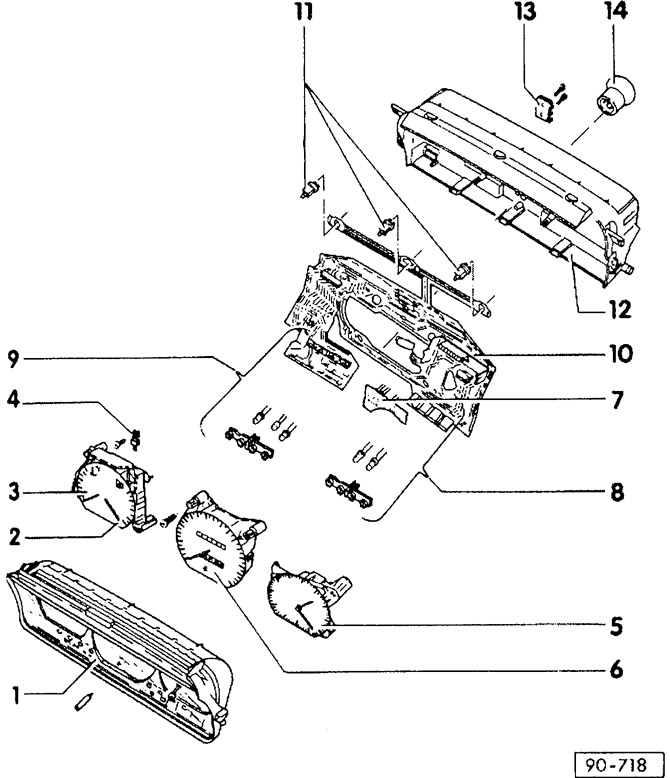
- 1 - protective glass
- 2 — fuel reserve indicator
- 3 - indicating device
For temperature and low coolant level.
- 4 - voltage stabilizer
- 5 - analog clock
- 6 - speedometer
- 7 — control unit
To control oil pressure.
- 8 — right signaling unit
- 9 — left signaling unit
- 10 - printed circuit board
- 11 - incandescent lamps
With socket, for instrument panel lighting; 12V, 1.2W.
- 12 — body
- 13 - contact plate
For Hall sensor or inductive sensor. The Hall sensor or inductive sensor generates a speed signal for various additional equipment. On vehicles with a universal display instrument (MFA) and a speed control system (GRA) and/or a radio with speed-dependent volume control (GALA), a Hall sensor is installed. The inductive sensor is used on vehicles without MFA with GRA and/or GALA. The corresponding sensor is screwed onto the back of the speedometer. Contact with the printed circuit board is made using a contact spring of the sensor.
- 14 — lid
For the speedometer drive shaft.
Note: The figure shows a dashboard with a universal indicator instrument and a tachometer, with 8/90.
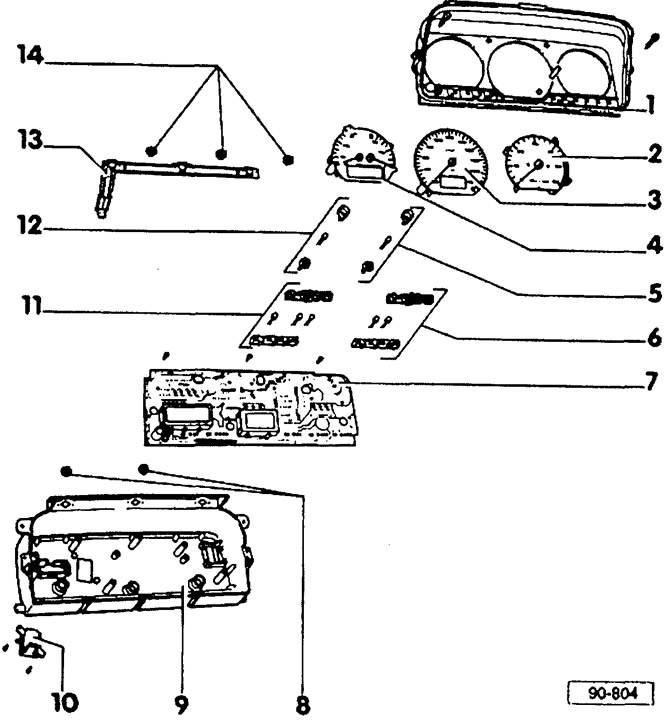
- 1 - protective glass
- 2 - tachometer
- 3 - electronic speedometer
- 4 - indicating device
For coolant temperature and fuel level with cutout for universal indicator (MFA).
- 5 — alarm
For right turn signal light.
- 6 — right signaling unit
- 7 - conductor board
Replace only together with the housing.
- 8 - incandescent lamps
With black socket, for illuminating the universal indicator and daily mileage counter.
- 9 — body
Replace only together with the conductor board.
- 10 - pressure sensor
For MFA.
- 11 — left signaling unit
- 12 — alarm
For left turn signal light.
- 13 - printed circuit board
For instrument panel lighting.
- 14 - incandescent lamps
With blue socket, for instrument panel lighting: 12V, 1.2W.
Removal
Note: All instrument panel components, except the printed circuit board, can be removed separately without dismantling the housing. Operations that must be performed only when removing the housing as a set are marked with ■.
Disconnect the battery ground (-) cable.
Remove the steering wheel, see chapter "Steering".
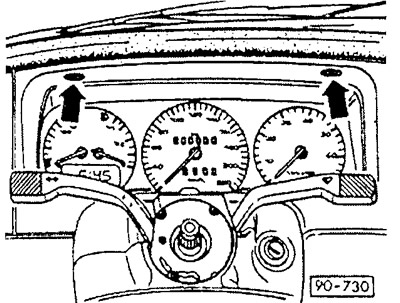
Unscrew the bezel (arrows) and remove it from the instrument panel.
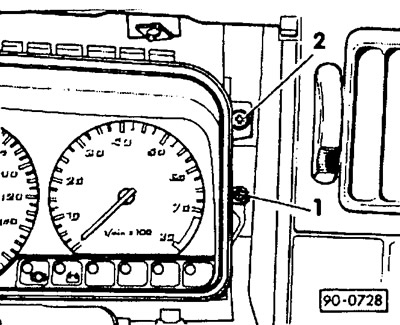
Remove the fastening screws on the left and right "1".
Unfasten the instrument panel and pull it out from the right side.
Disconnect the plug connector from the back of the housing.
Disconnect the hose to the pressure sensor for the MFA.
Loosen the screws securing the protective glass "1".
Turn the handle to return the daily mileage counter to its original position and remove the protective glass from the instrument panel.
Remove the instrument panel.
Note: The tachometer shaft is insert only.
Removal instruments
Up to 7/90:
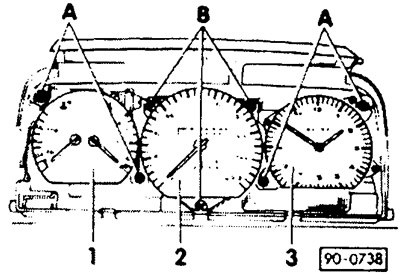
From 8/90:
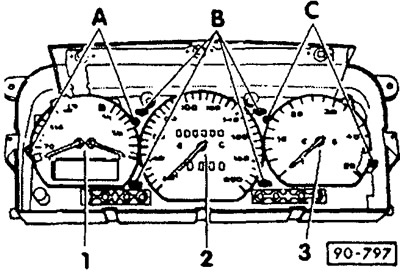
Remove the fuel gauge, temperature gauge and low coolant level gauge "1" (depending on the version, together with a digital clock or MFA). Pre-compress the locking pins "A".
Having previously compressed the locking pins "A", pull out the analog clock "3" or tachometer.
Unscrew the mechanical speedometer at points "B" and pull it out (electronic speedometer is simply inserted).
Removal the control unit to monitor oil pressure
The control unit is located on the wiring board behind the analog clock. On vehicles with a tachometer, it is built into the tachometer.
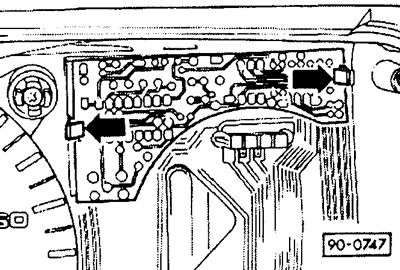
Carefully press the locking tabs in the direction of the arrows and pull the conductor board out of the multi-pin connector on the printed circuit board.
Removal the voltage stabilizer
The voltage stabilizer maintains a constant working voltage supplied to the indicating instruments. It is located in the housing for the fuel reserve, temperature and low coolant level indicators.
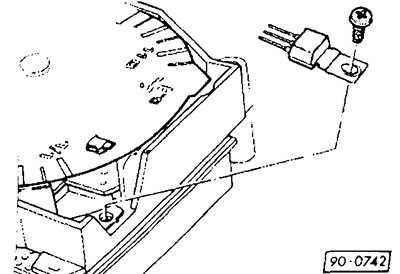
Unscrew the Phillips head screw and remove the voltage stabilizer.
Installation
Insert the voltage stabilizer with three pins into the provided socket and tighten it with a Phillips-head screw.
Note: Heat is removed from the voltage stabilizer through the metal back side, which for this reason must fit tightly to the substrate.
Insert the oil pressure control unit into the multi-pin plug connector, press and secure.
Insert the devices and fix or screw them in place.
Note: The plugs on the back side must be inserted into the plug sockets on the printed circuit board during installation.
Connect the vacuum hose and the multi-pin plug for the MFA.
Insert the instrument panel, put it on the tachometer shaft and screw it on. If necessary, remove the left footwell cover and, when installing the instrument panel, insert the tachometer shaft from below.
Install the protective glass and screw it on.
Insert the rim into the lower clamps and screw it on at the top.
Check the operation of the instrument panel.
Install the steering wheel, see chapter "Steering".
Visitor comments