



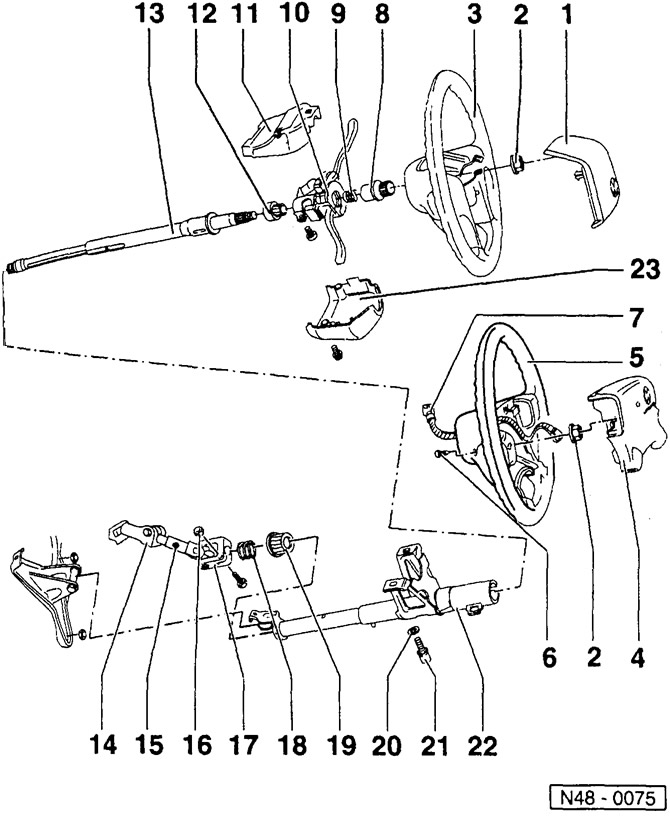
- 1 - lid
- 2 - nut, 50 Nm
For vehicles up to 9/93, together with an additional lining washer.
- 3 - steering wheel
- 4 — airbag assembly
- 5 - steering wheel for airbag
- 6 - Allen bolt
Replace after removal.
- 7 - plug connector
- 8 - splined adapter sleeve
Up to 1/89, a lock washer was installed instead of a bushing, which should always be replaced: removed with pliers, installed with a piece of pipe.
- 9 — spring
- 10 — steering shaft bracket
- 11 - upper cladding
- 12 — support ring
- 13 - steering column
From 1/89 to the present, the diameter has been changed from 20 to 22 mm.
- 14 — bolt, 30 Nm
- 15 - nut, 25 Nm
- 16 - nut, 30 Nm
- 17 - cardan joint with crosspiece
- 18 — spring
- 19 — lower bearing
Knock out with the pipe facing down, insert with a special tool VW-771 and a large washer.
- 20 - washer
- 21 - shear bolt
- 22 — steering column pipe
- 23 - lower cladding
The steering system mainly consists of a steering wheel, a steering column, a steering rack and tie rods. The steering wheel is bolted to the steering column, which transmits the steering wheel movement to the steering gear. The steering wheels turn right or left in accordance with the movement of the steering rack. The tie rods, which are attached to the hinges of the rack, transmit the steering force to the wheels through the hub bearing housings.
The rack and pinion steering system is maintenance-free, but the seals should be checked for perfect condition.
Depending on the model or equipment, steering the wheels is made easier by a hydraulic power steering. The hydraulic power steering helps to ensure that the effort required to turn the steered wheels is as low as possible. The power steering consists of an oil pump, an oil reservoir and pipes. The oil pump is driven by a V-belt. The pump takes oil from the reservoir and supplies it under high pressure to a valve located in the steering gear housing. The valve is mechanically connected to the steering column and directs the oil, depending on the position of the steered wheels, into the appropriate chamber of the working cylinder. The oil presses on the piston of the toothed rack and thereby increases the force exerted by the driver on the steering wheel. At the same time, the piston squeezes oil from the other chamber of the working cylinder through the drain groove of the spool valve into the return pipe and back into the oil reservoir through it.
The optional equipment includes a height adjustment mechanism for the steering wheel. This allows the driver to set the steering wheel to a position that is comfortable for him. The height adjustment of the steering wheel is performed mechanically. After releasing the lever of the mounting unit, the steering column becomes movable relative to the tube that encloses it. Two return springs pull the steering wheel to the upper position, which makes it easier to lift the steering wheel at different positions of the driver's seat. Now the steering wheel can be smoothly adjusted to a position that is comfortable for the driver. The adjustment path is approximately 60 mm.
After adjustment, the lever of the fastening unit must be pressed up again until it stops, so as not to inadvertently change the height of the steering wheel during the trip. The mechanism for adjusting the height of the steering wheel does not require maintenance, the uniform clamping action of the fastening unit is guaranteed for the entire period of operation of the car.
Caution: Always replace the self-locking nuts. Welding and straightening work on steering components is not permitted.
Visitor comments