



Contents: Checking the increase in idle speed ↓ Auxiliary residual quantity…↓ Adjusting screws on the turbodiesel…↓
You won't get much out of a regular "home" tachometer on a diesel engine, because the diesel engine can't produce the required impulses on the ignition coil. A special device is also needed to accurately monitor the idle speed. The driver can, however, vary the speed slightly at will when the engine is running with particularly strong shaking or noise.
Warm up the engine and turn off all electrical consumers.
Fully retract the cold start accelerator rod.
The adjusting screw regulates the system of levers for increasing the speed of rotation.
By turning the screw to the right the number of revolutions increases, by turning the screw to the left it decreases.
The normal idle speed is 900 rpm. Deviations of 30 rpm in either direction are acceptable.
The adjusting screw does not need to be tightened.
Checking the increase in idle speed
If you pull the cold start accelerator rod to the first detent position, the RPM should increase by approximately 60 RPM.
With the cold start accelerator rod fully extended, the number of revolutions should increase to 1050+50 rpm.
If the number of revolutions deviates from this value, loosen the lock nut on the limiting screw located on the right in the direction of travel.
Pull the cold start accelerator rod out completely.
Set the speed limit screw to 1050 rpm.
Tighten the lock nut again.
Auxiliary residual quantity adjustment
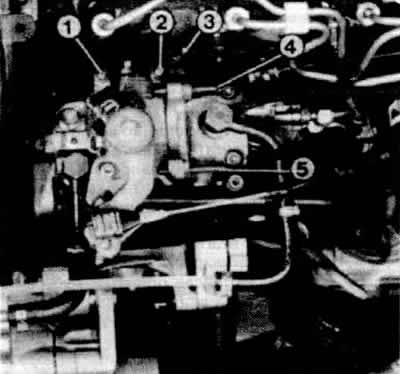
Diesel engine suction adjusting screws:
1 - limit screw for increasing the speed
2 - limit screw for the lower limit of idle speed.
3 - idle speed adjusting screw (cap nut)
4 - residual quantity adjustment screw
5 - full load limit screw
The last two screws are supposed to not be installed under normal circumstances.
Adjusting screws on the turbodiesel fuel injection pump
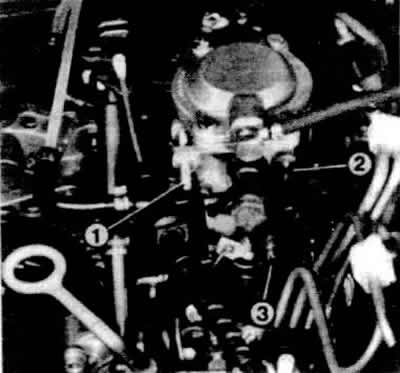
1 - full load limit screw
2 - residual quantity adjustment screw
3 - quantity adjustment screw
These three screws do not normally need to be tightened.
The residual quantity adjustment screw should not rotate. If it is adjusted by mistake (this happens because the injection pump of previous Golf models had an idle speed adjustment screw in this place), then engine operation problems occur. The engine either remains at high speeds (hangs) and does not change speeds or only runs slowly (the screw is tightened). Or the engine responds poorly to gas supply (the screw is unscrewed). In this case, this can be eliminated using the following auxiliary adjustment:
If the RPM is stuck, turn the screw so far that the RPM when releasing the gas pedal becomes normal again (check several times).
From this position, make another half turn back. Tighten the lock nut.
If the engine still does not respond well to the gas, then tighten the screw until the number of revolutions confidently "hangs". Further actions are as described above.
Visitor comments