
English Русский
Български
Беларускі
Український
Српски
Hrvatski
Română
Polski
Slovenský
Magyar
  |  Articles  |  Sitemap  |  Contacts  |    |
Car maintenance Ford Car maintenance Hyundai Car maintenance Chevrolet Car maintenance BMW Car maintenance Audi Car maintenance Opel Car maintenance AvtoVAZ
VWmanual.ru


Main   Passat   Golf   Polo   Touareg   Tiguan   Sharan   Transporter   Others  
Golf 1 (1974-1984, diesel) Golf 1 (1974-1984, petrol) Golf 2 (1984-1993, petrol) Golf 2 (1984-1993) Golf 3 (1991-1997) Golf 4 (1997-2004) Golf 5 (2003-2008)

Nozzles (VW Golf 3)

  • Main
  • Golf
  • Golf 3
  • Diesel engine
  • Diesel injection system
  • Nozzles
            0


Contents: "Nails" ↓ Self-repair of the injection system ↓ Disassembling the injector ↓ Driving with a faulty stopping device ↓
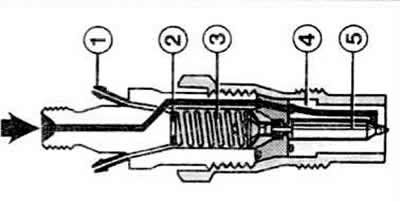
1 - hose nipple

1 - hose nipple
2 - adjusting washer
3 - spray spring
4 - sprayer body
5 - spray needle


To a certain extent, the injectors are the last stage of the engine injection system. Their task is to inject fuel under high pressure and finely atomized into the swirl chamber. Initially, when the fuel pressure exceeds the set injection pressure, the nozzle needle rises from its seat and can enter the swirl chamber. The injection pressure of the nozzle is 130-138 bar for a 47 kW suction diesel engine, and 150-158 bar for a turbodiesel.

However, if the high spring force prevents the spray needle, the ignition pressure returns back to the fuel system. In the case where the needle remains in a "hung" state, the corresponding nozzle attracts attention with an excessively loud knock.

Cooling and lubrication of the spray needle is provided by fuel, since all the incoming fuel can never be injected completely. Then it flows back into the tank through the return line.
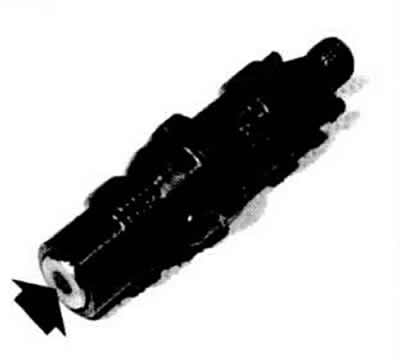


Cooling and lubrication of the spray needle is provided by fuel, since all the incoming fuel can…


The set time between the start of injection and ignition reaches 0.002 sec. Here, even the slightest inaccuracy is a reason for incorrect operation. Irregular and unprofitable fuel supply, poor mixing with air, uncontrolled ignition (in a gasoline engine we can talk about detonation) will be the consequence of this. The driver should notice poor engine performance and/or a harsh engine noise - the so-called "nails".

"Nails"


The typical diesel hard combustion noise, which sounds like hammering nails, is already noticeably reduced in our diesel engine. Only during the cold engine phase can this noise not be eliminated completely. When a warm engine produces "nail-like" sounds, the cause lies mainly in the slowing down of the ignition process, i.e. the time between the start of injection and the spontaneous ignition of the mixture is too long.

There may be the following reasons:
  • Pinched spray needles.
  • Inappropriate diesel fuel, such as summer diesel fuel, which is used at low temperatures and has a tendency to wax (paraffin separation).
  • Too much load at low RPM.
  • Compression pressure too low.

Among the circumstances that can help eliminate this, there may be an "internal cleaning" that uses fuel with a fuel system cleaning additive, which is sold in special stores. A quick drive on the autobahn often helps as well.


Are the injectors faulty?


Some injector defects can be found on a running engine, when the nuts that cover the fuel lines on the injectors are loosened and tightened one after another on all the injectors. If the engine speed remains unchanged when the fuel line on one of the injectors is loosened, then that is the problem.

The following effects may indicate faulty injectors:
  • Defective spark plugs glow continuously or for a short time.
  • Thick black smoke from the exhaust pipe.
  • High fuel consumption.
  • Engine overheating.
  • Loud knocking.
  • Power loss.
  • Uneven engine operation.

Self-repair of the injection system


Below are some types of work that still make sense to do on your own initiative. Naturally, more can be done. We believe that the leakage of the current fuel injection pump, a defect that often occurs in the control lever (the "gas" lever), is best eliminated at the Volkswagen or BOSCH service center.
Below are some types of work that still make sense to do on your own initiative. Naturally, more…


Removal the injector


Buy a new heat-insulated gasket for the injector being removed.

Remove the high pressure fuel line to avoid changing its bent shape.

Remove the return pipe.

Unscrew the injector using a 27 mm open-end wrench or socket.

Remove the heat-insulating pad using a plastic or wire hook.

The text is copied from this portal [VWmanual.ru]

For installation, install a new (!) heat-insulating gasket.

Tighten the injector to 70 Nm, the high pressure pipe to 25 Nm.
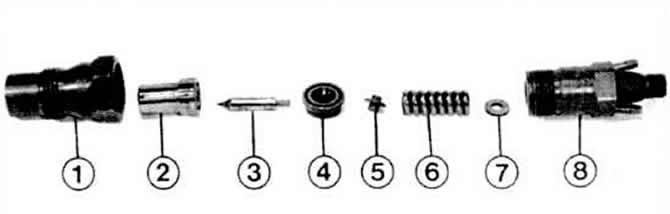
The top part (8.22 mm) is screwed into the bottom (1.27 mm). The following parts are inside

The top part (8.22 mm) is screwed into the bottom (1.27 mm). The following parts are inside
2 - sprayer body
3 - spray needle
4 - needle holder assembly
5 - pressure bolt
6 - spray spring
7 - adjusting washer


Important point when disassembling: the injector should not lie open, but immediately be installed on the engine and it should work for some time. The injector parts are subject to rust. Tightening torque of the upper/lower part of the injector: 70 Nm.

Note: The workshops have a test device with which the injection pressure can be checked. The adjusting washers necessary for adjustment are also available there.


Is the stopping device faulty?


To turn off the engine, the stop device closes the fuel supply to the injectors. If it is faulty or clogged, it should no longer be used. The stop device is suspected when no flashes occur in the engine, despite a working pre-heating system and a sufficiently full tank. Here is the procedure for checking the device:
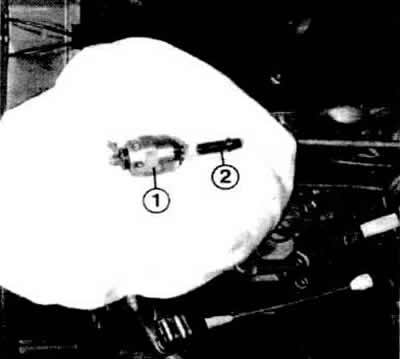
To turn off the engine, the stop device closes the fuel supply to the injectors. If it is faulty or…


Disassembling the injector


Only in exceptional cases (pollution) it is worth disassembling the injector. For independent repair, however, it makes sense to completely replace the injector; accurate testing of the injector or adjustment of the injection pressure cannot be carried out in amateur conditions.

First of all, check if the wire to the stopping device is in good condition.

While the assistant turns the ignition key, listen to the device to see if it makes a distinct click when the ignition is turned on.

If this does not happen, the voltage supply or the engine stop device itself is faulty.

Check the power supply: turn on the ignition and connect the test lamp to the contact of the stop device.

If it lights up, then the ignition cut-off wire to the device is faulty. The fuse has nothing to do with it.

Driving with a faulty stopping device


If the stop device is faulty or there are problems with the voltage supply, you can still continue driving. To do this:
  • Remove the cable from the engine stop device.
  • Remove the stop device from the high-pressure fuel pump.
  • Remove the piston with the valve from the stop device.
  • Tighten the housing back to a torque of 40 Nm.


The engine now starts as usual, but to stop it you need to turn it off with the gear engaged (slow down).

In vehicles with automatic transmission, to stop the engine, you must operate the mechanical stop device installed only on the front side of the injection pump.

This article is available at russian, bulgarian, belarusian, ukrainian, serbian, croatian, romanian, polish, slovak, hungarian
The text has been checked: Medvedeva Elena

Share information:

Previous articles
Fuel injection system on a turbodiesel engine
Fuel injection system of suction diesel engine
Cold start accelerator
High pressure fuel pump
Diesel engine injection system. General information
Next articles
Adjusting the injection timing (start of delivery) of the high-pressure fuel pump
Gas traction
Cold start accelerator rod
Idle speed check
Checking exhaust gases for soot content
What is the air filter for?


Similar articles from other manuals for VW cars:
Removal and installation / adjustment of windshield washer… Passat B3 (1988-1993)
Removal and installation windshield washer nozzles Tiguan 1 (2007-2015)
Adjusting the windshield washer nozzles Transporter T3 (1979-1992)
Adjusting headlight washer nozzles Caddy 3 (2003-2010)
Link to this page in different formats


Visitor comments


No comments yet


How much will 20 + 39 =


Golf 5 
  • General information
  • User manual
  • Maintenance
  • Troubleshooting
  • Power unit
  • Engine repair
  • Cooling and ventilation system
  • Fuel system
  • Ignition system
  • Transmission
  • Clutch
  • Mechanical gearbox
  • Automatic gearbox
  • Chassis
  • Brake system
  • Car suspension
  • Steering
  • Body
  • Interior (internal elements)
  • Exterior (external elements)
  • Doors and covers
  • Electrical equipment
  • Power devices
  • Washers and wipers
  • Lighting and appliances
  • Electrical circuits
Golf 4 
  • General information
  • User manual
  • Weekly checks
  • Maintenance
  • Power unit
  • Petrol engines
  • Diesel engines
  • Cooling system
  • Fuel system (petrol)
  • Control system (petrol)
  • Fuel system (diesel)
  • Exhaust system
  • Transmission
  • Clutch
  • Car gearbox
  • Drive shafts
  • Chassis
  • Car suspension
  • Steering
  • Wheels and tires
  • Brake system
  • Body
  • Exterior (external elements)
  • Interior (internal elements)
  • Ventilation and heating
  • Car doors and sunroof
  • Washers and glass cleaners
  • Electrical equipment
  • Power devices
  • Lighting and appliances
  • Electrical circuits
Golf 3 
  • Petrol engine
  • Engine repair
  • Lubrication system
  • Cooling system
  • Ignition system
  • Diesel engine
  • Engine repair
  • Diesel injection system
  • Pre-glow system
  • Transmission
  • Clutch
  • Gearbox and drive shafts
  • Chassis
  • Steering
  • Wheels and suspension
  • Brake system
  • Electrical equipment
  • Lighting and appliances
  • Electrical circuits
Golf 2 
  • General information
  • Introduction to guide
  • User manual
  • Petrol engines 1.3 l
  • Engine repair
  • Lubrication system
  • Cooling system
  • Carburetors
  • Supply system
  • Ignition system
  • Petrol engines 1.6/1.8 l
  • Engine repair
  • Supply system
  • Ignition system
  • Diesel engines
  • Engine repair
  • Lubrication system
  • Cooling system
  • Power and exhaust system
  • Transmission
  • Clutch
  • 4-speed gearbox 084
  • 5-speed gearbox 085
  • 4-speed gearbox 020/4R
  • 5-speed gearbox 020/4T
  • Automatic gearbox
  • Drive shafts
  • Chassis
  • Steering
  • Car suspension
  • Brake system
  • Body
  • Body elements
  • Doors, locks and windows
  • Electrical equipment
  • Equipment and devices
  • Power devices
Golf 2 (petrol) 
  • General information
  • Characteristics
  • Car care
  • Maintenance
  • Power unit
  • Engine repair
  • Engine 1.05/1.30
  • Engine 1.60/1.80
  • Cooling and lubrication system
  • Power and exhaust system
  • Transmission
  • Clutch
  • Car gearbox
  • Drive shafts
  • Chassis
  • Brake system
  • Steering
  • Suspension
  • Body
  • Body and equipment
  • Electrical equipment
  • Lighting and appliances
  • Electrical circuits
Golf 1 (petrol) 
  • General information
  • Characteristics
  • User manual
  • Maintenance
  • Power unit
  • Engine adjustment
  • Engine 1.1/1.3
  • Engine 1.5/1.6/1.8
  • Engine electrical equipment
  • Cooling system
  • Fuel system
  • Transmission
  • Clutch and manual gearbox
  • Automatic gearbox
  • Chassis
  • Steering
  • Front suspension
  • Rear suspension
  • Brake system
  • Electrical equipment
  • Lighting and appliances
  • Electrical circuits
  • Body
  • Body and equipment
  • Optional equipment
Golf 1 (diesel) 
  • General information
  • Specifications
  • Maintenance
  • Power unit
  • Engine repair
  • Exhaust and turbocharger
  • Cooling system
  • Fuel system
  • Fuel injection system
  • Transmission
  • Clutch and drive shafts
  • Car gearbox
  • Chassis
  • Suspension and wheels
  • Steering
  • Brake system
  • Wheels and tires
  • Body
  • Heating and ventilation
  • Exterior (external elements)
  • Interior (internal elements)
  • Doors and windows
  • Electrical equipment
  • Equipment and devices
  • Lighting system
  • Power devices
  • Electrical circuits
VWmanual.ru © 2016-2026 | Mobile version | News and articles | Sitemap: EN BG BY UA RS HR RO PL SK HU | Write message | Site search
Passat B2 • Passat B3 • Passat B4 • Passat B5 • Passat B6 • Golf 1, diesel • Golf 1, petrol • Golf 2, petrol • Golf 2 • Golf 3 • Golf 4 • Golf 5 • Polo 3 • Polo 4 • Touareg 1 • Tiguan 1 • Sharan 1 • Transporter T3 • Transporter T4 • LT 28 • LT 2D • Beetle • Caddy 3 •
Our website uses cookies to ensure functionality and convenience.