
English Русский
Български
Беларускі
Український
Српски
Hrvatski
Română
Polski
Slovenský
Magyar
  |  Articles  |  Sitemap  |  Contacts  |    |
Car maintenance Ford Car maintenance Hyundai Car maintenance Chevrolet Car maintenance BMW Car maintenance Audi Car maintenance Opel Car maintenance AvtoVAZ
VWmanual.ru


Main   Passat   Golf   Polo   Touareg   Tiguan   Sharan   Transporter   Others  
Golf 1 (1974-1984, diesel) Golf 1 (1974-1984, petrol) Golf 2 (1984-1993, petrol) Golf 2 (1984-1993) Golf 3 (1991-1997) Golf 4 (1997-2004) Golf 5 (2003-2008)

Checking and replacing rear brake pads (VW Golf 2)

  • Main
  • Golf
  • Golf 2
  • Chassis
  • Brake system
  • Checking and replacing rear brake pads
            0


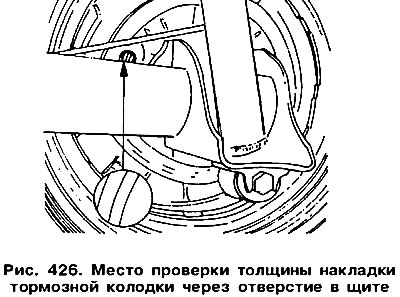
The rear brakes are designed to allow the thickness of the brake shoe linings to be checked through holes in the brake shield. Figure 426 shows such a hole closed with a plug. If during the inspection (using a portable lamp) it was confirmed that the thickness of the lining reached 2.5 mm, it is necessary to replace the entire set of brake pads (on both wheels).

The rear brakes are designed to allow the thickness of the brake shoe linings to be checked through…


Raise the rear of the vehicle and place it on stands. Place wheel chocks under the front wheels. Loosen the brake shoe wear compensation mechanism, as the shoes may be holding the drum. To do this, insert a screwdriver through the threaded hole in the drum until it stops against the extended arm of the spacer bar 16 (figure 427) and moves it upward. The compensation mechanism is installed on the left side of the upper part of the brake drum.
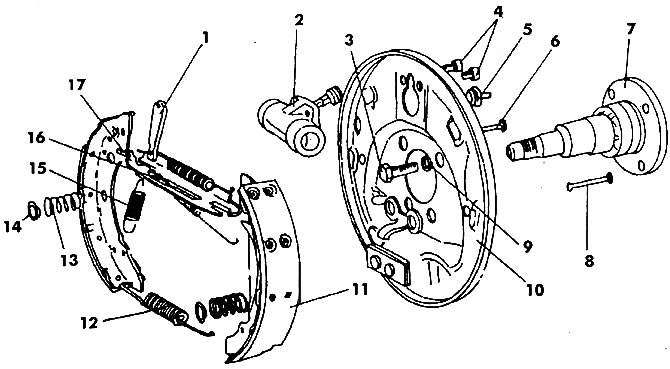
Figure 427. Components of the rear brake mechanism: 1 - lever; 2 - brake cylinder; 3 - bolt (6 Nm);…

Figure 427. Components of the rear brake mechanism: 1 - lever; 2 - brake cylinder; 3 - bolt (6 Nm); 4 - cylinder mounting bolts; 5 - plug; 6, 8 - guides of the clamps; 7 - hub journal; 9 - spring washer; 10 - brake shield; 11 - brake shoe; 12 - lower tension spring; 13 - retainer spring; 14 - retainer washer; 15 - spring of the adjusting device; 16 - lower tension spring; 17 - spacer bar


Carefully remove the hub cap with a screwdriver. Remove the brake drum. Disconnect the shoe retainer by pressing the retainer guide with your finger, grab the retainer washer from the front with pliers, press it and, after turning, remove the washer from the retainer guide. Remove the guide with the spring. Perform these actions for both shoes.

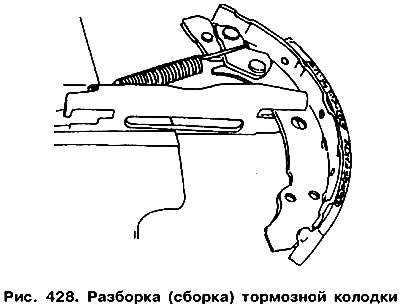
Grasp one shoe from below and pull it out from the lower guide. Disconnect the released tension spring. Disconnect the parking brake cable from the shoe. Disconnect the parking brake actuator spring and the upper tension spring with pliers. Remove both shoes with the parking brake actuator spacer bar. Secure the shoe with the spacer bar in a vice and disconnect the bar, then the spring (figure 428). Extend your extended shoulder, paying attention to its position.
Grasp one shoe from below and pull it out from the lower guide. Disconnect the released tension…


Clean all parts thoroughly. Check the condition of the rubber boots of the working cylinder carefully. If there are signs of leakage, the working cylinder must be repaired or replaced. Re-secure the brake shoe in a vice (see figure 428).

Attach the spring and insert the spacer bar into the shoe, slightly stretching the spring.


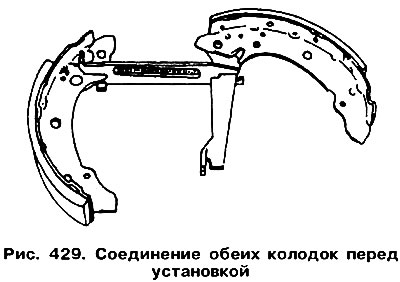
Install the spacer bar back in place and connect both pads as shown in Figure 429.
Install the spacer bar back in place and connect both pads as shown in Figure 429.


Place the shoes on the brake shield and attach the upper tension spring. Attach the parking brake cable to the lever. Spread the shoes from above and carefully insert the pistons into the brake cylinder without damaging the seals.

Install the lower tension spring and insert the left shoe into the guide.

Install the adjuster spring and the second shoe into the spacer bar, using a screwdriver. Install the shoe retainers.

Install the brake drum and adjust the bearing clearance.

Press the brake pedal several times to activate the brake pad wear compensation mechanism.

Once the brake pads and slave cylinder have been removed, the brake shield can be replaced. To do this, unscrew the four bolts securing the shield to the journal flange (see figure 427). These bolts also hold the trunnion and are tightened to a torque of 60 Nm. Spring washers should be placed under the bolt heads.

In early production cars, it was possible to repair the working brake cylinder after its dismantling (figure 430). When ordering a repair kit, it was necessary to specify the car model, since not all cylinders had the same internal diameter. Now the manufacturer recommends replacing the leaky cylinder as a whole.
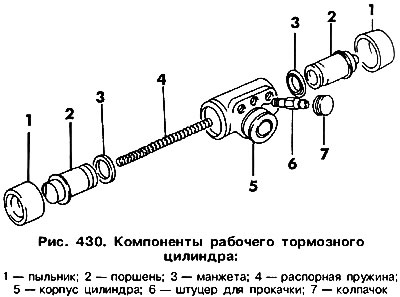
In early production cars, it was possible to repair the working brake cylinder after its…

This article is available at russian, bulgarian, belarusian, ukrainian, serbian, croatian, romanian, polish, slovak, hungarian
The text has been checked: Kolesnikov Artem

Share information:

Previous articles
Front brake disc repair
Repair of front brake calipers
Replacing the front brake pads
General description of the braking system
Next articles
Master Brake Cylinder — Design Description
Replacing the master brake cylinder (MBC)
Vacuum brake booster — design description
Pressure regulator — removal and installation
Bleeding the brake system, replacing the brake fluid
Parking brake — design description


Similar articles from other manuals for VW cars:
Checking the rear brake pads Passat B5 (1996-2005)
Removal and installation rear disc brake pads Polo 4 (2001-2009)
Checking the oil level in the rear main gear Touareg 1 (2002-2006)
Removal and installation rear brake pads CII41 Tiguan 1 (2007-2015)
Checking the thickness of the rear brake pads Sharan 1 (1995-2000)
Checking the thickness of the brake pads of a disc brake Transporter T3 (1979-1992)
Checking the thickness of disc brake pads Caddy 3 (2003-2010)
Link to this page in different formats


Visitor comments


No comments yet


How much will 48 + 39 =


Golf 5 
  • General information
  • User manual
  • Maintenance
  • Troubleshooting
  • Power unit
  • Engine repair
  • Cooling and ventilation system
  • Fuel system
  • Ignition system
  • Transmission
  • Clutch
  • Mechanical gearbox
  • Automatic gearbox
  • Chassis
  • Brake system
  • Car suspension
  • Steering
  • Body
  • Interior (internal elements)
  • Exterior (external elements)
  • Doors and covers
  • Electrical equipment
  • Power devices
  • Washers and wipers
  • Lighting and appliances
  • Electrical circuits
Golf 4 
  • General information
  • User manual
  • Weekly checks
  • Maintenance
  • Power unit
  • Petrol engines
  • Diesel engines
  • Cooling system
  • Fuel system (petrol)
  • Control system (petrol)
  • Fuel system (diesel)
  • Exhaust system
  • Transmission
  • Clutch
  • Car gearbox
  • Drive shafts
  • Chassis
  • Car suspension
  • Steering
  • Wheels and tires
  • Brake system
  • Body
  • Exterior (external elements)
  • Interior (internal elements)
  • Ventilation and heating
  • Car doors and sunroof
  • Washers and glass cleaners
  • Electrical equipment
  • Power devices
  • Lighting and appliances
  • Electrical circuits
Golf 3 
  • Petrol engine
  • Engine repair
  • Lubrication system
  • Cooling system
  • Ignition system
  • Diesel engine
  • Engine repair
  • Diesel injection system
  • Pre-glow system
  • Transmission
  • Clutch
  • Gearbox and drive shafts
  • Chassis
  • Steering
  • Wheels and suspension
  • Brake system
  • Electrical equipment
  • Lighting and appliances
  • Electrical circuits
Golf 2 
  • General information
  • Introduction to guide
  • User manual
  • Petrol engines 1.3 l
  • Engine repair
  • Lubrication system
  • Cooling system
  • Carburetors
  • Supply system
  • Ignition system
  • Petrol engines 1.6/1.8 l
  • Engine repair
  • Supply system
  • Ignition system
  • Diesel engines
  • Engine repair
  • Lubrication system
  • Cooling system
  • Power and exhaust system
  • Transmission
  • Clutch
  • 4-speed gearbox 084
  • 5-speed gearbox 085
  • 4-speed gearbox 020/4R
  • 5-speed gearbox 020/4T
  • Automatic gearbox
  • Drive shafts
  • Chassis
  • Steering
  • Car suspension
  • Brake system
  • Body
  • Body elements
  • Doors, locks and windows
  • Electrical equipment
  • Equipment and devices
  • Power devices
Golf 2 (petrol) 
  • General information
  • Characteristics
  • Car care
  • Maintenance
  • Power unit
  • Engine repair
  • Engine 1.05/1.30
  • Engine 1.60/1.80
  • Cooling and lubrication system
  • Power and exhaust system
  • Transmission
  • Clutch
  • Car gearbox
  • Drive shafts
  • Chassis
  • Brake system
  • Steering
  • Suspension
  • Body
  • Body and equipment
  • Electrical equipment
  • Lighting and appliances
  • Electrical circuits
Golf 1 (petrol) 
  • General information
  • Characteristics
  • User manual
  • Maintenance
  • Power unit
  • Engine adjustment
  • Engine 1.1/1.3
  • Engine 1.5/1.6/1.8
  • Engine electrical equipment
  • Cooling system
  • Fuel system
  • Transmission
  • Clutch and manual gearbox
  • Automatic gearbox
  • Chassis
  • Steering
  • Front suspension
  • Rear suspension
  • Brake system
  • Electrical equipment
  • Lighting and appliances
  • Electrical circuits
  • Body
  • Body and equipment
  • Optional equipment
Golf 1 (diesel) 
  • General information
  • Specifications
  • Maintenance
  • Power unit
  • Engine repair
  • Exhaust and turbocharger
  • Cooling system
  • Fuel system
  • Fuel injection system
  • Transmission
  • Clutch and drive shafts
  • Car gearbox
  • Chassis
  • Suspension and wheels
  • Steering
  • Brake system
  • Wheels and tires
  • Body
  • Heating and ventilation
  • Exterior (external elements)
  • Interior (internal elements)
  • Doors and windows
  • Electrical equipment
  • Equipment and devices
  • Lighting system
  • Power devices
  • Electrical circuits
VWmanual.ru © 2016-2026 | Mobile version | News and articles | Sitemap: EN BG BY UA RS HR RO PL SK HU | Write message | Site search
Passat B2 • Passat B3 • Passat B4 • Passat B5 • Passat B6 • Golf 1, diesel • Golf 1, petrol • Golf 2, petrol • Golf 2 • Golf 3 • Golf 4 • Golf 5 • Polo 3 • Polo 4 • Touareg 1 • Tiguan 1 • Sharan 1 • Transporter T3 • Transporter T4 • LT 28 • LT 2D • Beetle • Caddy 3 •
Our website uses cookies to ensure functionality and convenience.