



2. Valve clearances can be checked and adjusted if necessary during normal seasonal inspection or with the engine head removed (before installation).
The adjustment data have different clearance values for a cold and warm (coolant temperature above 35°C) engine
Engine 1.1 l
Cold:
Inlet valve 0.15 mm
Exhaust valve 0.25 mm
Hot:
Inlet valve 0.20 mm
Exhaust valve 0.30 mm
Engine 1.3 l
Cold:
Inlet valve 0.10 mm
Exhaust valve 0.20 mm
Hot:
Inlet valve 0.15 mm
Exhaust valve 0.25 mm
Engines 1.6, 1.8 l and 1.6D
Cold:
Inlet valve 0.20 mm
Exhaust valve 0.40 mm
Hot:
Inlet valve 0.20 mm
Exhaust valve 0.45 mm
3. The engine installed in the car must be warmed up to normal operating temperature, then turned off and the valve cover removed.
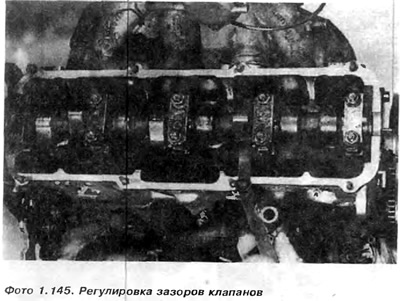
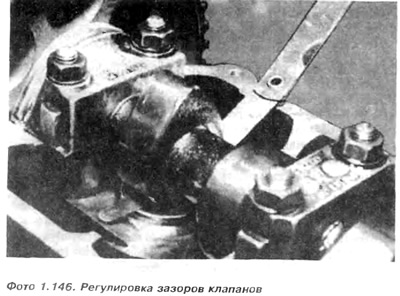
4. Check the clearance of each valve by rotating the crankshaft so that the convexity of the cam of the valve being checked is set upward, and the cylindrical surface of the cam is on the side of the adjusting plate. With this setting, the valve is completely closed and, inserting a feeler gauge between the cylindrical part of the cam and the adjusting plate of the valve tappet, we measure the clearance at this moment. If the engine is completely assembled, it will rotate more easily when we remove the spark plugs. Do not rotate the engine with the camshaft gear, because this puts a lot of strain on the timing belt. To rotate the crankshaft, you can roll the car with the fourth gear engaged or lift the crankshaft.
Caution: Do not rotate the crankshaft with the adjusting plate removed, as the camshaft may damage the top edge of the tappet.
5. Repeat this measurement for all valves in turn, and then compare the results with the adjustment data.
6. Measure the thickness of the gaps at this moment and calculate the error in relation to the gaps above.
Let's assume that the clearance measured on the exhaust valve #1 is 0.15 mm. and should be 0.45 mm. This is 0.3 mm less than necessary. In order for the clearance to be normal, it is necessary to replace the adjusting plate with a 0.3 mm thinner one. Since the difference in the thickness of the adjusting plates is 0.05 mm, the required plate can be selected from the set if the thickness of the current plate is known. If the head was previously disassembled, it is necessary to know the thickness of all the plates.
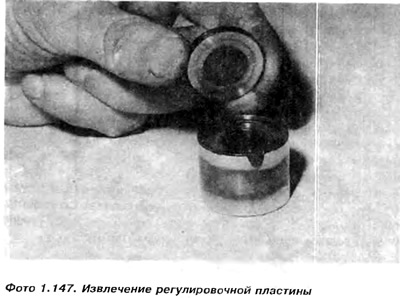
As you know, the thickness of the adjusting plate is etched on the underside of the plate. If the head has not been disassembled, it is necessary to remove the plate to check its thickness. Special equipment is used for this, but the same operation can be performed using a screwdriver and a flat key of the appropriate size, suitable for pressing the pusher down without pressing the adjusting plate (this means we press only on the edge of the pusher). The cam should be turned with the convex side facing up to provide as much room as possible for removing the plate.
Caution: If the key slips while removing the plate, the plate may suddenly pop up. When removing the plate, the piston in the corresponding cylinder must be returned from the TDC position so that the valve can tilt.
7. Once the dimensions of all the plates are known, a table can be made and the thickness of the new adjusting plates required can be calculated. Returning to the example, when the plate marked 3.60 is removed, a plate of 3.30 is needed. The tappet plates are available in 26 different thicknesses, every 0.05 mm from 3.00 to 4.25 mm.
8. Before adjusting valve clearances, you must have a set of adjusting plates.
If there is no kit, you need to prepare to remove the plates twice. First, remove the plate to check its thickness, then insert it back so that you can turn the camshaft and check the thickness of all the plates compared to the measured clearances of the corresponding valves. It is possible to buy a set of exactly matching plates to replace the old ones. After replacing the plates with new ones, you need to turn the crankshaft several times using the starter (so that the plates settle down) and measure the valve clearance again with a feeler gauge. The feeler gauge should enter between the cylindrical part of the cam and move with a noticeable force.
9. When placing the plates, ensure that the etched thickness markings are at the bottom.
10. After repairing the engine head, the valve clearances must be checked on a hot engine after 1000 km of running. Under normal conditions, the valve clearances must be checked for the first time after the preliminary grinding period, i.e. after 5000 km. Then we carry out adjustment every 30,000 km.
11. After adjusting the valve clearances, screw in the spark plugs and put on the valve cover (engine in a car).
12. Last tip: Keep notes on the thickness of the tappet adjusting plates currently installed. This will help avoid removing the plates twice during the next adjustment.
Visitor comments