



Contents: Disassembly ↓ Repair ↓
Disassembly
If the head is removed from the engine while it is in the vehicle, it is best to remove it together with the drive and outlet manifolds. The manifolds can be disconnected after the head is removed. Special equipment will be required to disconnect (and then connect) spring clamps that secure the exhaust pipe to the manifold. A special key will be needed to loosen and tighten the engine head bolts.
1. Disconnect the battery ground wire. Drain the liquid from the cooling system, then disconnect the elastic hoses of the cooling system and heater from the engine head.
2. Disconnect the wires from the oil temperature and pressure sensor.
3. On carburetor models, remove the air filter assembly.
4. Unscrew the generator from the brackets securing the engine head and remove the V-belt.
5. Loosen and remove the drive and exhaust manifolds, although it is possible to disconnect the manifolds after removing the engine head. When removing the manifolds together with the engine head, disconnect the elastic vacuum hose (low blood pressure) from the drive manifold, as well as the gas cable (and the starting equipment flap cable, if any) from the carburetor.
6. Remove the distributor cap together with the ignition wires.
Note: For models equipped with fuel injection, it is additionally necessary:
7. Disconnect the injector pipes from the engine head, as well as their mounting clamps, and move them to the side so that they do not interfere.
8. Disconnect the flexible drive pipe from the throttle body.
9. Disconnect the low-pressure flexible hoses from the throttle body. Set the hoses aside so they don't get in the way.
10. Disconnect the additional air valve pipe from the lower part of the drive manifold and the elastic pipe of the additional air valve from the elastic pipe on the throttle valve body.
11. Disconnect the low pressure flexible hose from the green connector on the throttle body.
12. If the vehicle is equipped with air conditioning, disconnect the elastic hoses from the additional air valve and the fixed hose connections.
13. Disconnect the elastic hose of the vacuum gauge.
14. Disconnect the cube from the cold engine start valve (in winter).
15. Remove the timing cover and valve cover, then remove the timing belt from the camshaft gear.
16. Remove the camshaft.
17. The next step is to unscrew the bolts and the engine head. To unscrew them, you need to use a special key. If you use a hex key, there is a high probability that the socket in the bolt head will be destroyed and then it will be impossible to unscrew the bolt unless you drill it.
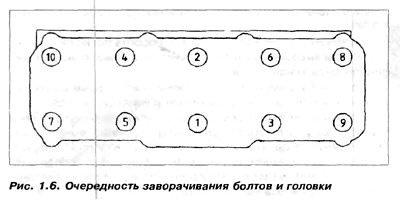
18. The engine head bolts must be unscrewed gradually in the reverse order to that shown in Figure 1.6. First, all bolts must be loosened by half a turn, and then unscrewed.
19. After removing all 10 bolts, remove the head from the cylinder block. If it is stuck to the block, you need to tap it lightly with a hammer and a wooden mallet.
Under no circumstances should any tool be driven between the head and the cylinder bolt, as this may damage the surface of the head or cylinder block.
Any scratches or dents that appear will make it impossible to seal the head and it will be necessary to polish the damaged surface at a specialized enterprise. You can also pull hard on the manifolds and tear off the head.
20. Remove the gasket from the cylinder block.
Usually part of the gasket sticks to the block and head. It is necessary to carefully clean the piston surfaces and the smooth surface of the block.
Repair
21. Clean the piston bottoms from carbon deposits. Unscrew the spark plugs. Then, using a metal brush and scraper, remove carbon deposits from the combustion chambers and valve surfaces. Rinse the head cleaned of carbon deposits with water and blow it out with compressed air.
22. The valves can only be easily removed with the appropriate valve spring compressor. Since the conical retaining rings and the upper spring plates are set quite deep in the head, disassembling the valves without a tool is almost impossible. If such equipment is not available, it is necessary to find a short metal tube of approximately 25 mm in diameter and press the valve spring plate down. for example, using a drill press stand. The length of the tube will depend on the size of the compressor. Cut two rectangular holes, approximately 25 mm long and 16 mm wide, on opposite sides of the tube. Insert the conical retainers through the holes. This tube can then be used together with the compressor when removing the retainers from the next valve stems.
The valve, springs, safety catches and plates should be kept together with the tappet in one container to avoid mistakes during assembly. It is best to number the containers from 1 to 8, maintaining the order, remembering that valve No.1 is closest to the timing belt.
23. Actions to be performed in order to verify and repair the head.
24. Before installing the engine head, check the condition of the camshaft.
25. Once we have verified all the parts, the head, valves, springs, guides, seals and camshaft, we can begin installing the head.
Installation
Insert the valve into the correct guide. Before installing, the valve stem must be lubricated with oil. Assemble the spring compressor with the prepared tube and compress the valve spring so that the conical guards can be inserted into the groove of the valve stem. If this is difficult to do manually, you can put a little grease on the guard and use a small screwdriver or tweezers to insert it through the hole in the tube onto the valve stem. Put on the other half of the guard and, holding it, carefully release the spring compressor until the plate presses the conical half rings to the grooves. Remove the spring compressor, put a rag on the valve stem and hit the stem several times with a hammer. This way we will check whether the guard is seated in the groove well. If it is not properly seated in the groove, it will come out when hit. It is necessary to remember that the valve we are going to hit with a hammer is free, not supported by anything and moves freely in the guide. These actions must be repeated for all eight valves.
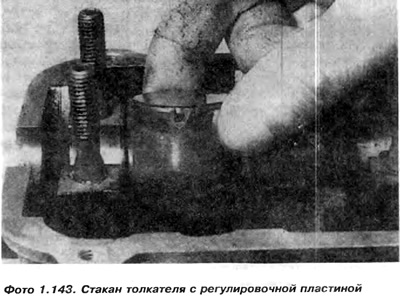
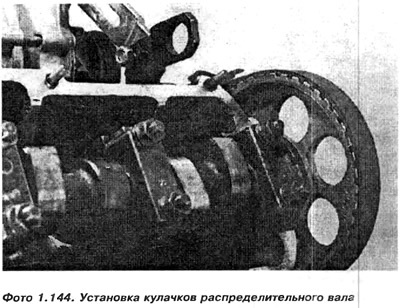
26. Insert the oil-coated tappets into the holes from which they were removed together with the adjusting washers (photo 1.143), then lubricate the surfaces of the camshaft bearings and secure the camshaft so that the cam lobes of the first cylinder are positioned upwards (photo 1. 144)
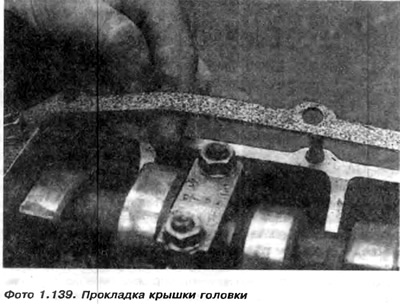
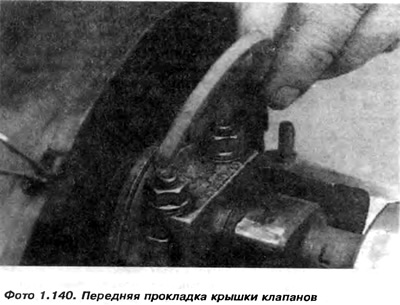
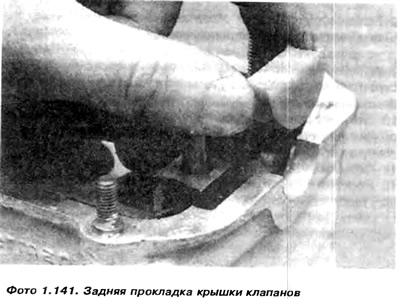
27. Install a new seal on the timing gear side. Lubricate the shaft journals, as well as No.2 and No.4 (photo 1. 142). Then install the remaining bearing caps, checking that they are properly seated (according to the dot marking made during dismantling) and tighten the nuts of all the covers to the appropriate torque. Put on a new set of head cover gaskets (photo 1.139, 1. 140 1.141).
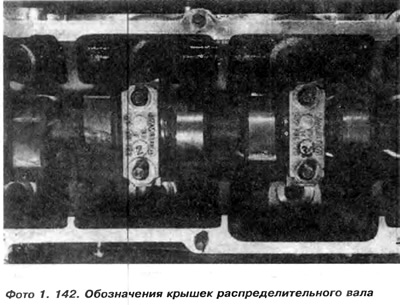
Note: Press the camshaft caps evenly to avoid causing very strong stresses in the shaft, which could bend it. The caps closest to the valves, which the shaft should bend during pressing, should be pressed first.
28. Adjust valve clearances.
Installing the head on the engine
29. Mounting the head on the engine.
Visitor comments