



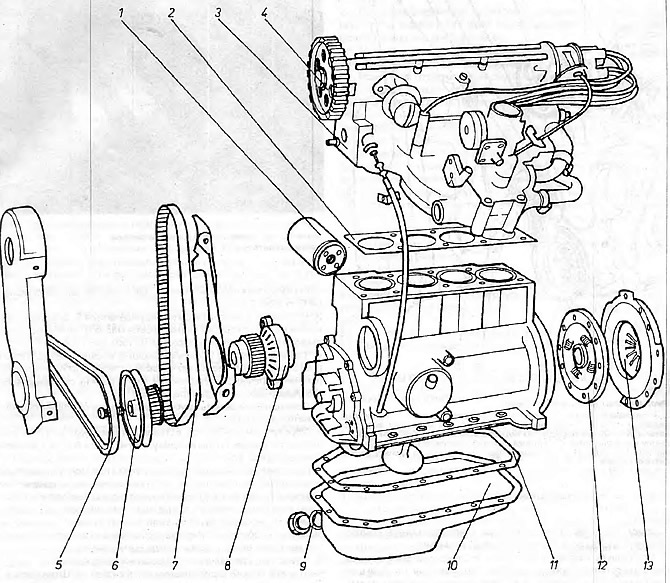
Engine 1.1 and 1.3
1 - oil filter; 2 - head gasket; 3 - engine head; 4 - timing gear; 5 - V-belt; 6 - pulley; 7 - toothed belt; 8 - water pump; 9 - Oil drain plug gasket; 10 — oil pan; 11 — oil pan gasket; 12 — clutch disc; 13 — clutch compression.
1. Disconnect the negative battery cable.
2. Remove the engine hood and place it in a safe place to avoid scratches.
3. Drain the coolant from the engine and remove the radiator, together with the cooling fan kit.
4. Remove the air filter housing.
5. Loosen the clamp and disconnect the upper elastic wire from the thermostat housing.
6. Place a suitable container under the engine, then unscrew the drain plug from the oil pan and drain the oil. After finishing, clean the drain plug and gasket and screw it back.
7. Disconnect the flexible fuel lines from the fuel pump, as well as the return line from the carburetor (returnable) excess fuel returns from the carburetor to the fuel tank through the pipe. Clamp or plug the flexible pipes to prevent fuel from leaking out of the tank.
8. Loosen the clamp and disconnect the lower elastic coolant hose at the rear of the engine.
9. Disconnect the gas cable and the cable that controls the flap of the starting equipment throats in the carburetor.
10. Disconnect the heater wires from the thermostat housing and wire 12 (see figure 2.4).
11. Disconnect the flexible hoses from the following equipment, marking each hose during disconnection to avoid mistakes during reconnection:
- a) Oil pressure sensor at the end of the cylinder head (from the carburetor side)
- b) Mixture heater in the drive manifold
- c) Radiator fan thermal switch
- d) Ignition device (low and high voltage wires)
- d) Starter
- e) Temperature sensor (thermostat housing)
- g) Idle speed control solenoid valve in the carburetor
- c) Ground wire at the gearbox
12. Remove the bundle of wires attached to the lower elastic wire from the block and hang it up.
13. Loosen the clamps and disconnect the pipes with rarefied air from the ignition unit and the drive manifold (if necessary)
14. Disconnect the clutch cable.
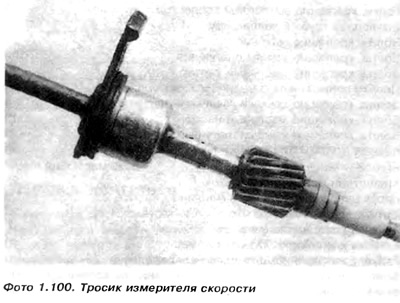
15. Disconnect the speedometer cable from the gearbox and hang it on its side.
17. Apply the handbrake, then lift the front of the car and place it on supports.
18. Unscrew the bolt from the disconnection of the longitudinal rod of the gear shift lever and transfer the connection to the rods (photo 1.101). The bolt threads are coated with a liquid locking agent and it may be necessary to heat the joint with a blowtorch. In this case, remember the precautions.
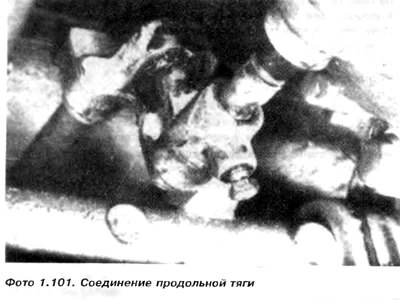
19. It is necessary to pay attention to the position of the connector in relation to the rod or mark it (which will make installation easier) and then extend the connecting longitudinal rod. The correct position of the connector relative to the rod will ensure correct gear engagement.
20. Loosen the exhaust pipe bracket bolt to disconnect it from the lower pipe, as well as the clutch housing and starter.
21. Disconnect the reverse light switch wiring.
22. Disconnect the drive axle shafts from the drive flanges (section 7), tie them with wire and protect the joint from contamination by wrapping it with foil.
23. Using a winch or a lift with a lifting capacity of at least 250, hang the engine on the brackets intended for this purpose, screwed to the head on the carburetor side.
24. Unscrew the three bolts of the engine mount bracket from above (below the carburetor).
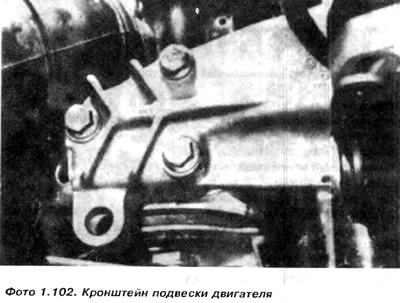
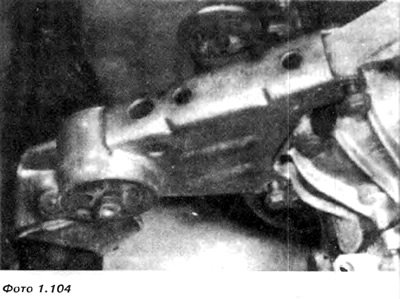
25. Loosen and remove the engine mount bracket bolt, then. Loosen the bolts securing the bracket to the engine. Pull out the bracket (photo 1.104).
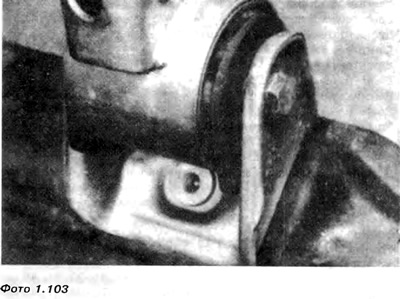
27. Removing the engine and gearbox as a set requires the assistance of a second person who will prevent damage to the elements surrounding the engine during removal.
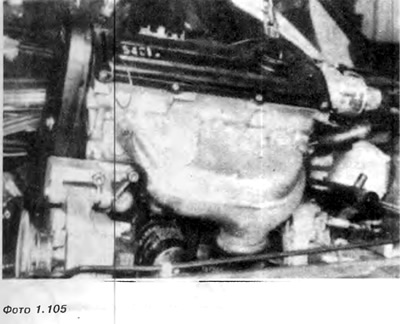
28 Remove the engine and gearbox as a set from the engine chamber (photo 1.105), rotating it if necessary so as not to touch other elements. When removing the engine, it is necessary to check whether all electrical wires, cables and elastic hoses are disconnected.
29. Move the car back
30. Place the unit on the frame or on boards lying on the floor.
Visitor comments