



Warning: If a tire is flat, move the vehicle to the side of the road at a safe distance. Turn off the engine, turn on the hazard warning lights and use other warning devices.
There should be no passengers in the vehicle while it is being jacked up.
Before you begin changing a tire, make sure the ground your car is on is level and firm. If necessary, place a board under the jack.
To prevent unintentional movement of the vehicle and possible slippage from the jack, set the parking brake and block the wheel diagonally opposite the wheel being replaced. After lifting one front wheel off the ground, setting the automatic transmission selector to the "P" (park) position or setting the manual transmission to gear will not prevent the vehicle from unintentional movement.
Stage 1
- Remove the jack, tools and spare tire from the luggage compartment.
Stage 2
Wheel with small protective caps
- Using a screwdriver, unscrew the small protective caps of the hub and the wheel mounting bolts.
Wheel with decorative cap
- Unscrew the small Allen screw and remove the decorative cap.
Stage 3
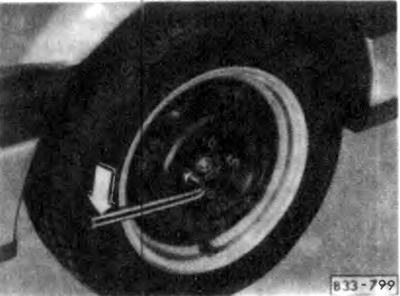
- Place the wrench with the handle on the wheel mounting bolt, without removing it, turn it to the left, holding the finger of the wrench handle - see the figure.
If the bolt is difficult to unscrew, hit the end of the wrench handle while maintaining a stable position, using the car for support.
Loosen all mounting bolts approximately one turn. Do not completely remove the bolts at this stage.
Note: If your vehicle is equipped with BBS wheels made of light alloy (unified wheels) do not under any circumstances loosen the bolts that secure the two wheel components together to avoid air escaping from the tire.
This may result in loss of control of the vehicle while driving and injury to passengers!
Stage 4
Installing a jack under a car
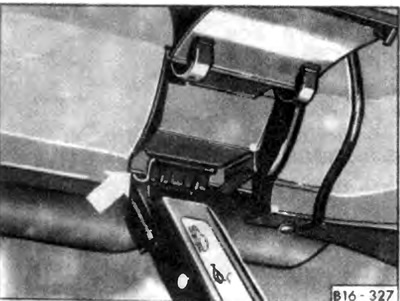
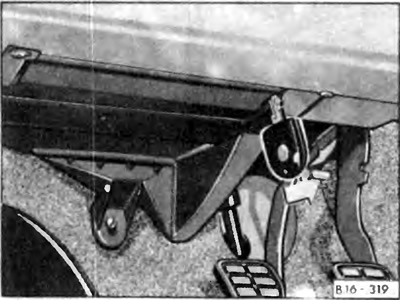
There are two flaps in the side element of the decorative panel. After opening the flaps, the vertical edge of the side element will be visible. This is the place where the jack must be installed.
Caution: Installing the jack in any other location may result in damage to the vehicle and personal injury.
An unstable support surface under the jack may cause the car to slip off. The jack must be installed on a solid support. If necessary, place a board under it.
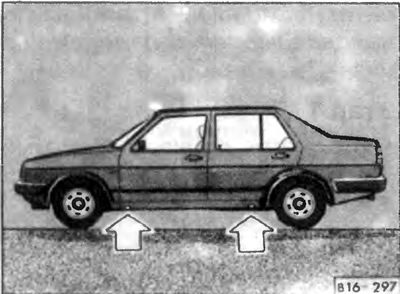
- Position the jack properly under the vehicle at the jacking point mentioned above, closest to the wheel being changed.
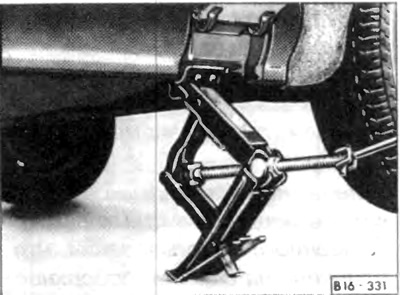
- Manually rotate the T-shaped element of the jack until the pointed protrusion of the jack firmly engages the vertical rib (indicated by the arrow) on the side member to prevent the jack from slipping out when the vehicle is raised - see figure.
- After making sure that the jack is in a stable position, install the jack handle (included in the tool kit) on the T-shaped element.
Stage 5
Caution: Do not raise the vehicle until you are sure that the jack is firmly engaged with the vehicle.
There should be no passengers in the vehicle while it is being jacked up.
To lift the car, turn the handle clockwise.
- The vehicle must be lifted to a minimum height that allows for unhindered wheel replacement.
Stage 6
- Unscrew the wheel mounting bolts completely and remove the wheel.
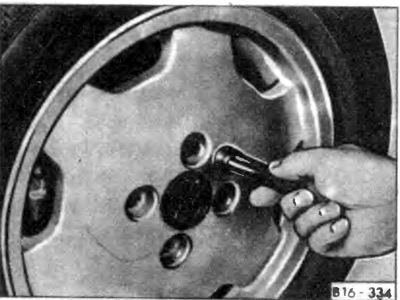
Note:The screwdriver handle from the tool kit has a hexagonal cavity at the end. After unscrewing the wheel mounting bolts, use this handle to remove and then install the mounting bolts. It will be more convenient to use this handle if you first remove the screwdriver blade from it.
- Before installing a new wheel, remove any dirt or corrosion from the mounting surface of the wheel or vehicle. Position the spare wheel against the hub so that the bolt holes in the wheel align with the threaded holes in the hub.
- Insert the mounting bolts. Before lowering the car, tighten them slightly in a crisscross pattern. The mounting bolts should be easy to tighten and clean - never apply grease or oil to the bolts.
Stage 7
- To lower the vehicle, turn the handle counterclockwise until the jack is completely disengaged from the vehicle.
Stage 8
- Then, using a spanner with a handle, completely tighten the wheel mounting bolts in a cross pattern.
Correct tightening of the mounting bolts is of great importance.
Bolts tightened properly should have a tightening torque of 110 Nm. This torque can be achieved by tightening the bolts with a spanner with a handle by any person of average strength. If you are unsure of the exact torque value, check it using a spanner with a torque setting available from your dealer or service station. If you find that the bolts are corroded and difficult to tighten, replace them.
Stage 9
Reinstall the protective caps on the mounting bolts.
(The original can be viewed on the portal VWManual)
Stage 10
- Lower the vehicle completely and remove the jack.
- Check the pressure value of the installed wheel chamber. Air pressure in the spare wheel chamber (in a cold state) should be 4.2 bar.
- Place the damaged wheel, hubcap, jack and tools in the luggage compartment and secure them securely.
- Have the damaged wheel repaired and reinstalled as quickly as possible.
Remember that the compact spare tire is intended for temporary use only!
Visitor comments