



The floor jack must use the same lifting points as those shown in the illustrations when using a lift. To avoid damage to the lower frame or chassis, a rubber pad must be installed between the floor jack and the lifting points on the vehicle.
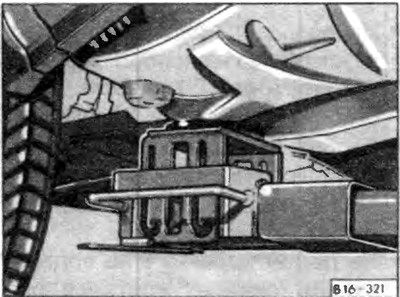
Raising a car using a lift and a floor jack
Before raising the vehicle on lifts, make sure there is sufficient clearance between the pads and the vehicle, especially if the vehicle has a large front panel or spoiler.
To lift the vehicle, use only the lifting points shown in the illustrations. Do not lift the vehicle with a floor jack or lift using the side trim panel as a support surface.
Caution: When removing components such as the engine block, transmission case, fuel tank, front or rear axle, wheels, secure the vehicle with a lift or add weights of appropriate weight to maintain the center of gravity. Otherwise, the vehicle may become too tight or slide out of the lift, resulting in serious damage to the vehicle or possible injury.
To reduce the risk of serious injury or damage to the vehicle, lift the vehicle only with a special lift or floor jack, using the lifting points shown in the illustrations. Using other lifting points may cause the vehicle to tilt or fall sharply when removing heavy components such as the engine block or transmission due to changes in vehicle weight and imbalance.
If you need to work underneath a vehicle that has been raised using a floor jack, make sure that the additional axle stands are installed.
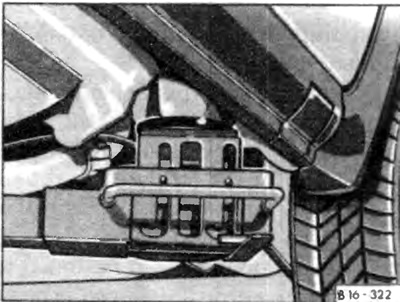
Lifting points
The front lifting points are located on the underbody where the door pillar is welded to the chassis frame - see Figure B16-321. The rear lifting points are located on the side beam between the underbody and the rear axle support (see figure B16-322) Make sure that the parking brake cable is not pinched.
Work carefully to avoid damaging very important parts and components that are located near lifting points. This is especially true for the electric fuel pump or water separator (for diesel engines only).
Visitor comments