
English Русский
Български
Беларускі
Український
Српски
Hrvatski
Română
Polski
Slovenský
Magyar
  |  Articles  |  Sitemap  |  Contacts  |    |
Car maintenance Ford Car maintenance Hyundai Car maintenance Chevrolet Car maintenance BMW Car maintenance Audi Car maintenance Opel Car maintenance AvtoVAZ
VWmanual.ru


Main   Passat   Golf   Polo   Touareg   Tiguan   Sharan   Transporter   Others  
Golf 1 (1974-1984, diesel) Golf 1 (1974-1984, petrol) Golf 2 (1984-1993, petrol) Golf 2 (1984-1993) Golf 3 (1991-1997) Golf 4 (1997-2004) Golf 5 (2003-2008)

Emergency start (VW Golf 2)

  • Main
  • Golf
  • Golf 2
  • General information
  • Maintenance
  • Emergency start
            0


Contents: Launch from a tugboat ↓ Starting using jumper cables ↓

Launch from a tugboat


A vehicle with an automatic transmission cannot be tow-started. A vehicle with a manual transmission cannot be tow-started to avoid damage to the catalytic converter and other parts of the vehicle.

Starting using jumper cables


Caution: When working with the battery, always protect your eyes and, if possible, avoid leaning over it.

Avoid contact of electrolyte with eyes and skin, and if this happens, wash it off immediately with plenty of water.

Incorrect use of a booster battery to start a vehicle may result in an explosion.

Gases produced by car batteries are explosive. Do not light open fires near the battery, do not smoke, do not create conditions for sparking.

Do not attempt to jump start a vehicle with another battery that has a low electrolyte level.

The maximum permissible voltage of the booster battery must also be 12 V. The capacity (A/h) of the booster battery must not be lower than the capacity of the discharged battery. Using batteries with a different maximum permissible voltage or significantly different capacity (A/h) can lead to an explosion and personal injury.

Never attempt to charge a frozen battery to avoid the risk of an explosion of gas in the ice. Allow the battery to thaw first.

  • Using a booster battery with a higher voltage may additionally cause damage to expensive sensitive electronic components such as glow plugs, relays, radios, etc.

A car with a dead battery:


  • Turn off the lights and additional devices, move the switch to the "N" or "P" position (automatic transmission) or to a neutral position (manual transmission) and set the car to the parking brake.

Rules for using connecting cables


Caution: To avoid serious injury or damage to your vehicle, strictly follow all safety and jumper cable operating instructions recommended by the manufacturer. If in doubt, contact your local roadside service.

The connecting cables must be long enough to avoid contact between the two vehicles.

When connecting the jumper cables, make sure that they do not come into contact with any moving parts in the engine compartment.

Incorrect connection of the connecting cables can damage the generator. Always make connections as follows:

Positive (+) to positive (+) and negative (-) to ground on the engine block (x).
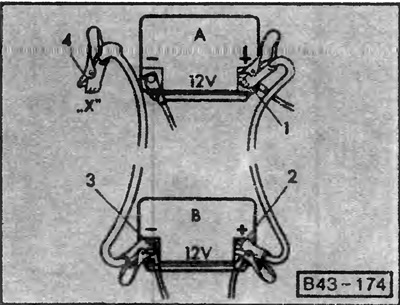

Connecting cables
Connecting cables

A - discharged battery;
B — booster battery;
X - to ground on the engine block


1. Connect the cable clamp (+) to the positive (+) terminal (1) of the discharged battery.

2. Connect the other end of the cable to the positive (+) terminal (2) of the booster battery.


3. Connect the cable clamp (-) to the negative (-) terminal (3) of the booster battery.

4. Connect the other end of the cable (4) to a stripped metal section bolted to the engine block or directly to the engine block of the vehicle with the discharged battery. The clamp connection point should be as far away from the battery as possible!

5. Start the car engine with the booster battery. The engine speed should be in the middle range.

6. Start the engine with a discharged battery in the usual way. If the engine does not start, contact the nearest service station.

[The article is posted on this website: VWmanual.ru]
7. After starting the engine and while it is running, disconnect the cables from both vehicles in the exact reverse order: points 4-1.

This article is available at russian, bulgarian, belarusian, ukrainian, serbian, croatian, romanian, polish, slovak, hungarian
The text has been checked: Semenova Anna

Share information:

Previous articles
Installation and replacement of radio
Headlight beam adjustment
Replacing lamps
Fuses
Wheel replacement
Spare wheel
Next articles
Emergency towing of vehicles by a technical assistance vehicle
Lifting a car


Similar articles from other manuals for VW cars:
Checking the automatic device for enriching the combustible… Passat B3 (1988-1993)
Glow plugs, fuel shut-off valve, injection start valve (since… Polo 3 (1995-2003)
Emergency alarm system Touareg 1 (2002-2006)
Emergency release of the selector Tiguan 1 (2007-2015)
Emergency engine start Transporter T3 (1979-1992)
Automatic start — general description Beetle (1960-1986)
Link to this page in different formats


Visitor comments


No comments yet


How much will 48 + 49 =


Golf 5 
  • General information
  • User manual
  • Maintenance
  • Troubleshooting
  • Power unit
  • Engine repair
  • Cooling and ventilation system
  • Fuel system
  • Ignition system
  • Transmission
  • Clutch
  • Mechanical gearbox
  • Automatic gearbox
  • Chassis
  • Brake system
  • Car suspension
  • Steering
  • Body
  • Interior (internal elements)
  • Exterior (external elements)
  • Doors and covers
  • Electrical equipment
  • Power devices
  • Washers and wipers
  • Lighting and appliances
  • Electrical circuits
Golf 4 
  • General information
  • User manual
  • Weekly checks
  • Maintenance
  • Power unit
  • Petrol engines
  • Diesel engines
  • Cooling system
  • Fuel system (petrol)
  • Control system (petrol)
  • Fuel system (diesel)
  • Exhaust system
  • Transmission
  • Clutch
  • Car gearbox
  • Drive shafts
  • Chassis
  • Car suspension
  • Steering
  • Wheels and tires
  • Brake system
  • Body
  • Exterior (external elements)
  • Interior (internal elements)
  • Ventilation and heating
  • Car doors and sunroof
  • Washers and glass cleaners
  • Electrical equipment
  • Power devices
  • Lighting and appliances
  • Electrical circuits
Golf 3 
  • Petrol engine
  • Engine repair
  • Lubrication system
  • Cooling system
  • Ignition system
  • Diesel engine
  • Engine repair
  • Diesel injection system
  • Pre-glow system
  • Transmission
  • Clutch
  • Gearbox and drive shafts
  • Chassis
  • Steering
  • Wheels and suspension
  • Brake system
  • Electrical equipment
  • Lighting and appliances
  • Electrical circuits
Golf 2 
  • General information
  • Introduction to guide
  • User manual
  • Petrol engines 1.3 l
  • Engine repair
  • Lubrication system
  • Cooling system
  • Carburetors
  • Supply system
  • Ignition system
  • Petrol engines 1.6/1.8 l
  • Engine repair
  • Supply system
  • Ignition system
  • Diesel engines
  • Engine repair
  • Lubrication system
  • Cooling system
  • Power and exhaust system
  • Transmission
  • Clutch
  • 4-speed gearbox 084
  • 5-speed gearbox 085
  • 4-speed gearbox 020/4R
  • 5-speed gearbox 020/4T
  • Automatic gearbox
  • Drive shafts
  • Chassis
  • Steering
  • Car suspension
  • Brake system
  • Body
  • Body elements
  • Doors, locks and windows
  • Electrical equipment
  • Equipment and devices
  • Power devices
Golf 2 (petrol) 
  • General information
  • Characteristics
  • Car care
  • Maintenance
  • Power unit
  • Engine repair
  • Engine 1.05/1.30
  • Engine 1.60/1.80
  • Cooling and lubrication system
  • Power and exhaust system
  • Transmission
  • Clutch
  • Car gearbox
  • Drive shafts
  • Chassis
  • Brake system
  • Steering
  • Suspension
  • Body
  • Body and equipment
  • Electrical equipment
  • Lighting and appliances
  • Electrical circuits
Golf 1 (petrol) 
  • General information
  • Characteristics
  • User manual
  • Maintenance
  • Power unit
  • Engine adjustment
  • Engine 1.1/1.3
  • Engine 1.5/1.6/1.8
  • Engine electrical equipment
  • Cooling system
  • Fuel system
  • Transmission
  • Clutch and manual gearbox
  • Automatic gearbox
  • Chassis
  • Steering
  • Front suspension
  • Rear suspension
  • Brake system
  • Electrical equipment
  • Lighting and appliances
  • Electrical circuits
  • Body
  • Body and equipment
  • Optional equipment
Golf 1 (diesel) 
  • General information
  • Specifications
  • Maintenance
  • Power unit
  • Engine repair
  • Exhaust and turbocharger
  • Cooling system
  • Fuel system
  • Fuel injection system
  • Transmission
  • Clutch and drive shafts
  • Car gearbox
  • Chassis
  • Suspension and wheels
  • Steering
  • Brake system
  • Wheels and tires
  • Body
  • Heating and ventilation
  • Exterior (external elements)
  • Interior (internal elements)
  • Doors and windows
  • Electrical equipment
  • Equipment and devices
  • Lighting system
  • Power devices
  • Electrical circuits
VWmanual.ru © 2016-2026 | Mobile version | News and articles | Sitemap: EN BG BY UA RS HR RO PL SK HU | Write message | Site search
Passat B2 • Passat B3 • Passat B4 • Passat B5 • Passat B6 • Golf 1, diesel • Golf 1, petrol • Golf 2, petrol • Golf 2 • Golf 3 • Golf 4 • Golf 5 • Polo 3 • Polo 4 • Touareg 1 • Tiguan 1 • Sharan 1 • Transporter T3 • Transporter T4 • LT 28 • LT 2D • Beetle • Caddy 3 •
Our website uses cookies to ensure functionality and convenience.