



The cross-section of the emergency cable for an Otto engine with a capacity of up to approximately 2.5 liters must be at least 16 mm² (diameter about 5 mm). For diesel engines and Otto motors with a capacity of over 2.5 liters, the cross-section must be at least 25 sq. mm. In this case, you need to focus on a car with a discharged battery.
Both batteries must have a nominal voltage of 12 volts.
A discharged battery can freeze at -12 degrees C. Before connecting the emergency cable, the frozen battery must be warmed up.
The discharged battery must be properly connected to the vehicle's electrical system.
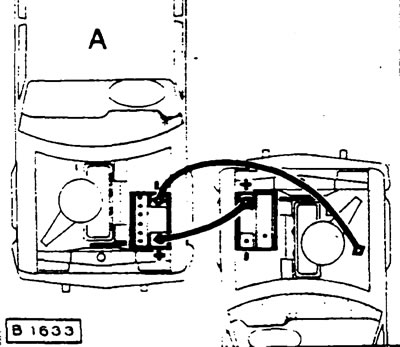
(In 1633) the cars should be placed in such a way that there is no galvanic contact between them. Otherwise, a current may arise when the positive poles are connected.
Put both cars on the handbrake. Shift the manual gearbox to neutral, the automatic gearbox to position "P" - "Parking".
Turn off all power consumers.
Start the engine of the feeder vehicle A at idle speed.
Connect the emergency cable in the following order: 1. Connect the red cable to the positive terminal of the discharged battery. 2. Connect the other end of the red cable to the positive terminal of the supply battery. 3. Connect the black cable to the negative terminal of the supply battery. 4. Connect the other end to a reliable "ground", for example, to the engine block of the receiving vehicle. When connecting the cable to the negative terminal of the discharged battery, under unfavorable conditions, due to sparking and the release of detonating gas, the battery may explode.
Check the reliability of the pole clamps again. Pay attention to the fact that the cable does not pass near rotating parts.
Caution! The terminals of the emergency cable must not be connected to each other, for example, the positive terminals must not touch metal parts.
Start the engine of a car with a discharged battery. When starting, do not operate the starter for more than 15 seconds, since the terminals and cable heat up due to high current consumption. Therefore, it is necessary to provide "cooling" pauses of at least 1 minute.
The engine of the power vehicle should run mostly at idle speed. This prevents possible damage to the generator during current surges. However, if the speed drops significantly, you can give it gas.
During an emergency start, there should be no open fire near the battery, as flammable gas may escape from it.
After an emergency start, disconnect the cable in the reverse order.
Warning! If the prescribed connection order is not strictly followed, there is a risk of acid leaking from the battery. In addition, damage and injury may occur if the battery explodes. In addition, malfunctions of the electrical systems of both vehicles may occur.
Visitor comments