
English Русский
Български
Беларускі
Український
Српски
Hrvatski
Română
Polski
Slovenský
Magyar
  |  Articles  |  Sitemap  |  Contacts  |    |
Car maintenance Ford Car maintenance Hyundai Car maintenance Chevrolet Car maintenance BMW Car maintenance Audi Car maintenance Opel Car maintenance AvtoVAZ
VWmanual.ru


Main   Passat   Golf   Polo   Touareg   Tiguan   Sharan   Transporter   Others  
Golf 1 (1974-1984, diesel) Golf 1 (1974-1984, petrol) Golf 2 (1984-1993, petrol) Golf 2 (1984-1993) Golf 3 (1991-1997) Golf 4 (1997-2004) Golf 5 (2003-2008)

How does a clutch work? (VW Golf 1)

  • Main
  • Golf
  • Golf 1
  • Transmission
  • Clutch and drive shafts
  • How does a clutch work?
            0


Contents: Clutch life ↓ Is it necessary to disengage the…↓
The pairs of gears of individual gears cannot be shifted while they are rotating under load from the engine. Therefore, the connection between the engine and gearbox must be briefly interrupted. Then the desired gear can be engaged. Then the engine and gearbox must be connected again. The clutch disconnects and connects the engine and gearbox.

Clutch operation: When the clutch pedal is pressed, the release clutch in the gearbox moves the…

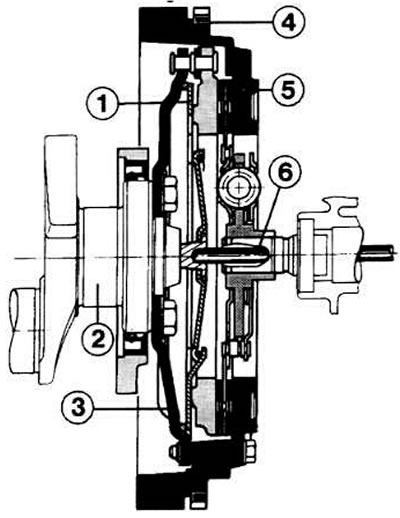
Clutch operation: When the clutch pedal is pressed, the release clutch in the gearbox moves the clutch pusher (6) to the left, in the direction of the crankshaft (2). Due to this, the thrust disk is pressed against the disc spring (1). This spring, located in the pressure plate (3), bends, releasing the leading disk (5) of the clutch, as a result of which the disk can rotate freely together with the gearbox shaft. There is now no connection between the flywheel (4), connected to the crankshaft and the pressure plate, fixed to the gearbox shaft. When the clutch pedal is released, the disengaging disk returns back together with the working rod. The disc spring in the pressure plate again presses the leading disk against the flywheel. Now the crankshaft and the gearbox shaft are again connected


Power is transferred from the engine to the gearbox using friction. The rubbing parts in this case are:
  • flywheel as a friction surface:
  • clutch pressure plate, which is the second friction surface; the pressure plate presses on the flywheel;
  • the clutch drive disc, it also participates in friction and is located on the drive shaft of the gearbox;
  • clutch release sleeve.

When the clutch pedal is pressed, force is transmitted through the clutch rod and the release lever rotates on the shaft. The pusher transmits this movement through the release clutch, which is located in the gearbox. The pusher moves in the hole in the drive shaft and presses the spring of the pressure plate through the thrust disk. The release clutch takes the force of the spring, the pressure plate is unloaded and moves back when the pedal is fully depressed. Now the drive clutch disk can rotate freely together with the gearbox shaft. The clutch is disengaged.

When the clutch is engaged, the disc spring of the pressure plate presses the drive disc again towards the engine flywheel. This must happen slowly to ensure smooth transmission of force. The friction surfaces therefore slide against each other for a certain time before the friction becomes so great again that the engine power is fully transmitted to the gearbox.

This generates heat. At low speeds and short-term clutch engagement, less heat is generated than at high speeds and slow clutch pedal pressing. The duration of contact and heat generation determine the service life of the linings on the clutch master disc.


Clutch life


There are drivers who replace the old clutch assembly with a new one after 15,000 km. Others replace it after 100,000 km. The clutch has a greater durability if the car mainly travels long distances and the clutch is treated with care. If the driver is forced to drive his car mainly in the city (and the clutch pedal is pressed more often than usual), it is unlikely that he will be able to maintain first grip for long.

As mentioned in the previous section, each time the clutch engages, the linings of the drive disc contact the surface of the opposite part. As a result, the parts heat up. Wear is particularly promoted by starting off at high engine speeds, starting off in 2nd gear, driving at intersections in 2nd or 3rd gear with the clutch pedal partially depressed, and "balancing" on a slope using the clutch pedal and the accelerator pedal.

Is it necessary to disengage the clutch at an intersection when stopping?


A very common bad habit is to wait for a traffic light with 1st gear engaged and the clutch pedal depressed. Some drivers are afraid that they will not be able to quickly engage a particular gear when the green light comes on. Even if there is no immediate, noticeable damage, disengaging the clutch still puts a load on the disengaging clutch and causes wear. The more often and for longer this mistake is made in front of many traffic lights, the sooner the clutch wears out.

This article is available at russian, bulgarian, belarusian, ukrainian, serbian, croatian, romanian, polish, slovak, hungarian
The text has been checked: Medvedeva Elena

Share information:

Previous articles
Next articles
Checking the clutch
Free play of the clutch pedal
Driving with a broken clutch cable
Replacing the clutch rod
Clutch installation and removal
Clutch unit faults and troubleshooting methods


Similar articles from other manuals for VW cars:
Clutch device Passat B3 (1988-1993)
Clutch drive Polo 3 (1995-2003)
Work in the engine compartment Touareg 1 (2002-2006)
Clutch pedal assembly Tiguan 1 (2007-2015)
Conditions of work and tools used Sharan 1 (1995-2000)
Machine maintenance work Transporter T4 (1990-2003)
Frequency of maintenance work Caddy 3 (2003-2010)
Link to this page in different formats


Visitor comments


No comments yet


How much will 25 + 38 =


Golf 5 
  • General information
  • User manual
  • Maintenance
  • Troubleshooting
  • Power unit
  • Engine repair
  • Cooling and ventilation system
  • Fuel system
  • Ignition system
  • Transmission
  • Clutch
  • Mechanical gearbox
  • Automatic gearbox
  • Chassis
  • Brake system
  • Car suspension
  • Steering
  • Body
  • Interior (internal elements)
  • Exterior (external elements)
  • Doors and covers
  • Electrical equipment
  • Power devices
  • Washers and wipers
  • Lighting and appliances
  • Electrical circuits
Golf 4 
  • General information
  • User manual
  • Weekly checks
  • Maintenance
  • Power unit
  • Petrol engines
  • Diesel engines
  • Cooling system
  • Fuel system (petrol)
  • Control system (petrol)
  • Fuel system (diesel)
  • Exhaust system
  • Transmission
  • Clutch
  • Car gearbox
  • Drive shafts
  • Chassis
  • Car suspension
  • Steering
  • Wheels and tires
  • Brake system
  • Body
  • Exterior (external elements)
  • Interior (internal elements)
  • Ventilation and heating
  • Car doors and sunroof
  • Washers and glass cleaners
  • Electrical equipment
  • Power devices
  • Lighting and appliances
  • Electrical circuits
Golf 3 
  • Petrol engine
  • Engine repair
  • Lubrication system
  • Cooling system
  • Ignition system
  • Diesel engine
  • Engine repair
  • Diesel injection system
  • Pre-glow system
  • Transmission
  • Clutch
  • Gearbox and drive shafts
  • Chassis
  • Steering
  • Wheels and suspension
  • Brake system
  • Electrical equipment
  • Lighting and appliances
  • Electrical circuits
Golf 2 
  • General information
  • Introduction to guide
  • User manual
  • Petrol engines 1.3 l
  • Engine repair
  • Lubrication system
  • Cooling system
  • Carburetors
  • Supply system
  • Ignition system
  • Petrol engines 1.6/1.8 l
  • Engine repair
  • Supply system
  • Ignition system
  • Diesel engines
  • Engine repair
  • Lubrication system
  • Cooling system
  • Power and exhaust system
  • Transmission
  • Clutch
  • 4-speed gearbox 084
  • 5-speed gearbox 085
  • 4-speed gearbox 020/4R
  • 5-speed gearbox 020/4T
  • Automatic gearbox
  • Drive shafts
  • Chassis
  • Steering
  • Car suspension
  • Brake system
  • Body
  • Body elements
  • Doors, locks and windows
  • Electrical equipment
  • Equipment and devices
  • Power devices
Golf 2 (petrol) 
  • General information
  • Characteristics
  • Car care
  • Maintenance
  • Power unit
  • Engine repair
  • Engine 1.05/1.30
  • Engine 1.60/1.80
  • Cooling and lubrication system
  • Power and exhaust system
  • Transmission
  • Clutch
  • Car gearbox
  • Drive shafts
  • Chassis
  • Brake system
  • Steering
  • Suspension
  • Body
  • Body and equipment
  • Electrical equipment
  • Lighting and appliances
  • Electrical circuits
Golf 1 (petrol) 
  • General information
  • Characteristics
  • User manual
  • Maintenance
  • Power unit
  • Engine adjustment
  • Engine 1.1/1.3
  • Engine 1.5/1.6/1.8
  • Engine electrical equipment
  • Cooling system
  • Fuel system
  • Transmission
  • Clutch and manual gearbox
  • Automatic gearbox
  • Chassis
  • Steering
  • Front suspension
  • Rear suspension
  • Brake system
  • Electrical equipment
  • Lighting and appliances
  • Electrical circuits
  • Body
  • Body and equipment
  • Optional equipment
Golf 1 (diesel) 
  • General information
  • Specifications
  • Maintenance
  • Power unit
  • Engine repair
  • Exhaust and turbocharger
  • Cooling system
  • Fuel system
  • Fuel injection system
  • Transmission
  • Clutch and drive shafts
  • Car gearbox
  • Chassis
  • Suspension and wheels
  • Steering
  • Brake system
  • Wheels and tires
  • Body
  • Heating and ventilation
  • Exterior (external elements)
  • Interior (internal elements)
  • Doors and windows
  • Electrical equipment
  • Equipment and devices
  • Lighting system
  • Power devices
  • Electrical circuits
VWmanual.ru © 2016-2026 | Mobile version | News and articles | Sitemap: EN BG BY UA RS HR RO PL SK HU | Write message | Site search
Passat B2 • Passat B3 • Passat B4 • Passat B5 • Passat B6 • Golf 1, diesel • Golf 1, petrol • Golf 2, petrol • Golf 2 • Golf 3 • Golf 4 • Golf 5 • Polo 3 • Polo 4 • Touareg 1 • Tiguan 1 • Sharan 1 • Transporter T3 • Transporter T4 • LT 28 • LT 2D • Beetle • Caddy 3 •
Our website uses cookies to ensure functionality and convenience.