



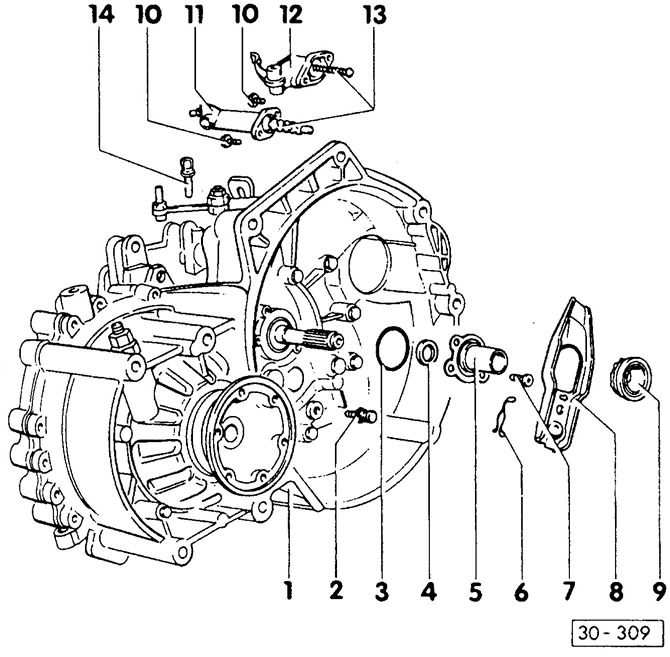
- 1 - gearbox
- 2 - ball pin, 25 Nm
Treat with MoS grease2
- 3 - sealing ring
Always replace.
- 4 - sealing ring of the drive shaft
Drive to the limit.
- 5 - guide clip
- 6 - retaining spring
- 7 - bolt, 20 Nm
- 8 - clutch release lever
- 9 - clutch release bearing
Do not wash the bearing, just wipe it.
- 10 - bolt, 20 Nm
- 11 - clutch slave cylinder
Before dismantling, remove the gearshift lever from the gearbox, do not let go of the gearshift cable.
- 12 - mechanical clutch drive
Only in some vehicles with an engine having a working volume of 1.6 liters, in other cases, a hydraulic drive is installed.
- 13 - pusher
Lubricate the end of the pusher.
- 14 - mounting pin
The clutch performs 2 tasks in the car: when the gear is engaged, it breaks the power circuit between the engine and the gearbox, and when the car is moving, it provides smooth power engagement.
The clutch consists of a pressure plate, a clutch disc and a clutch release bearing.
The clutch pressure plate is firmly mounted on the flywheel, which, in turn, is attached to the engine crankshaft. Between the pressure plate and the flywheel is a driven disk, which is pressed against the flywheel by a pressure plate. The driven disk is centered on the splines of the transmission drive shaft associated with it.
When you press the clutch pedal (disengaging the clutch) the force through a hydraulic or mechanical drive and through the lever is transmitted to the clutch release bearing, which is pressed against the diaphragm spring of the pressure plate and moves it somewhat. Due to this, the clutch disc moves away from the flywheel and no longer presses the driven disc against it, while the power engagement between the engine and gearbox is broken.
Attention: In some vehicles equipped with engines with a displacement of 1.8 liters, the clutch is actuated by means of a cable pull. On other car models, a hydraulic clutch drive is installed: the piston of the working cylinder of the hydraulic system is adjacent to the pressure lever.
When the clutch pedal is depressed, pressure is created in the slave cylinder located in the footwell, which is transmitted through the hydraulic pipeline to the slave cylinder mounted on the clutch housing. The piston of the working cylinder through the clutch release fork presses the bearing against the diaphragm spring of the pressure plate and moves it slightly.
The hydraulic system uses brake fluid from a common brake fluid reservoir.
If the clutch pedal is released (clutch engaged), the pressure plate presses the driven disc against the flywheel, and the power circuit closes again, since the pressed driven disc is firmly connected through the splines to the gearbox input shaft.
Each time the clutch is engaged and disengaged, the friction linings of the driven disc wear out as a result of slight slippage. Thus, the clutch disc is a wear part, the service life of which, however, is over 100,000 km. The intensity of wear depends mainly on the load (operation of a vehicle with a trailer) and driving mode. The clutch does not require maintenance, as it has automatic adjustment.
Visitor comments