



Contents: Electrical engineering is simple ↓ Voltage measurement. Control lamp ↓ Measuring instrument with diodes ↓ Voltmeter ↓ Measuring the current value ↓ Measuring resistance ↓ Basic concepts of electronics ↓ Semiconductors ↓ Other structural elements ↓
Unfortunately, electricity cannot be seen, so some people find it difficult to understand the processes that occur. We would like to explain this with one example.
Electrical engineering is simple
The processes that occur with electric current can be most easily explained using a water pipe. A certain amount of water flows through such a pipe under pressure.
- Water pressure can be compared to voltage, measured in Volts (V)
- The amount of water flowing over a given time can be compared to an electric current measured in Amperes (A)
- If you multiply voltage by current, you get electrical power, measured in Watts (W)
- And we get a completely different value when we divide the voltage by the current. The result of the division is resistance, measured in Ohms (Ω).
Resistance can be compared to a shut-off valve in a water pipe. When the valve is open, the resistance is zero, and the water flows freely. When the valve is closed, the resistance increases to infinity (∞), and the flow stops.
Every consumer of electricity is a kind of resistance that must receive enough electric current to function properly. Therefore, a small control lamp only needs a thin wire; a powerful starter, on the contrary, requires a particularly thick wire.
Voltage measurement. Control lamp
The test lamp has a needle contact, with the help of which the needle can simply pierce the insulation of the cable being tested. The terminal of the lamp cable is clamped somewhere near the uninsulated metal, at the so-called "mass" of the car. First of all, the lamp indicates whether there is voltage at all. The brightness of the light from the lamp can be used to judge the magnitude of the voltage.
Measuring instrument with diodes
Using a normal!! test lamp, you should not take measurements in electronic structural parts. Such a test lamp takes too much power, and this can cause damage to electronic parts. If someone wants to take measurements in electronic devices, they should buy a measuring device with LEDs.
Voltmeter
Using a voltmeter or a multi-function device with a corresponding measurement range, you can, for example, measure the battery voltage. If the device shows only 10.4 volts, then one of the battery cells has a short circuit. It is also interesting to measure the battery voltage when the starter is running. If in this case the voltage is less than 8 volts, then the battery is in bad shape.
To measure, the wire marked "-" is connected to the negative terminal of the battery or to the "ground". The wire marked "+" of the measuring device is connected to the wire being tested or to the positive terminal of the battery.
Measuring the current value
Using an ammeter or a multi-function device with the appropriate measurement range, you can determine whether the current is flowing to the consumer or not. To do this, the current circuit must be open, and the measuring device must be connected in the gap. In a car, for this purpose, you can remove one of the connectors and then connect the measuring device between the connector and the contact tongue.
For example, electric current is measured if there is a suspicion that a current consumer somewhere in the on-board network has "emptied" the battery overnight. To find this place, you need to remove the "ground" wire of the battery and connect an ammeter between the battery pole and the "ground" wire. If the device shows that current is flowing, a specific current circuit is established. To do this, remove one fuse after another in the niche with fuses and connect the ammeter clamps to the contact tabs instead. In this way, you can determine in which circuit there are current leaks. Using the fuse table, you can then determine which consumers are included in this current circuit; then check them one by one.
Measuring resistance
Measuring resistance makes it possible, for example, to find out whether current is flowing through a given wire (then the measured resistance value is zero) or the current circuit is broken somewhere (then the resistance is equal to infinity). To measure resistance, the measuring instrument must have its own power supply.
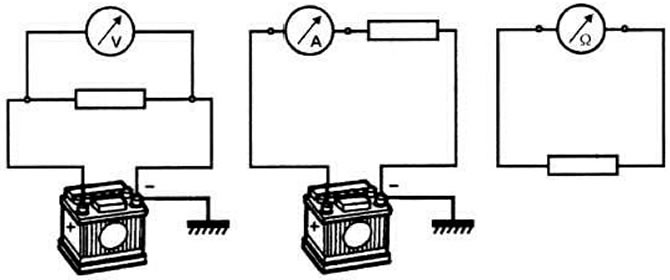
1 - Consumer. The drawings schematically illustrate how to connect the appropriate measuring device to measure voltage, current and resistance (from left to right). The circle with the arrow is a measuring device. Consumers are, for example, a lamp, an electric motor, etc.
Basic concepts of electronics
The word "electronics" itself means that this industry is based on the use of electrons. Electrons are extremely small particles, of which a small atom is partially composed. In all electrically conductive materials (special term: conductors) electrons ensure the flow of current. In this case, electrons in a conductor move from atom to atom. Non-conductive materials also have electrons. But they are strongly bound to the nucleus of the atom and cannot move further. Therefore, the current does not flow.
The third group of materials are the so-called semiconductors. These are crystals (in most cases germanium or silicon), which are processed in such a way that their structure either lacks electrons or has an excess of them. This is what causes the desired effect: electric current can flow through the crystal plates only under certain conditions. If the conditions are not met, the current flow stops. Then a blocking layer is formed. This property is used in diodes and transistors. In the electrical equipment of cars, semiconductor structural elements are rarely found in single quantities. As a rule, they are available in large quantities in complete circuits, for example, in the generator regulator.
Semiconductors
The transistor only lets current through when there is voltage at the third transistor junction. If this voltage is high, a lot of current flows. If the voltage is low, there is correspondingly less current. This can be compared to a water tap. The more the valve is open, the more water flows.
A diode only conducts electricity in one direction. If electricity flows in the opposite direction, the diode blocks it from passing. It's like a tire valve, so air can be pumped in, but no more air comes out.
Light emitting diode: A semiconductor crystal emits light as long as a voltage is applied. It is similar in concept to an incandescent light bulb, but there is no filament.
Other structural elements
The function of resistance (rheostat) is to stop the flow of electric current and reduce its magnitude.
The capacitor acts like a small battery; it can accumulate electrical energy for a certain period of time. The capacitor is used to smooth out voltage fluctuations and dampen voltage peaks.
If a time delay is desired in a circuit, a capacitor with resistance is connected to the time-regulating link.
Visitor comments