



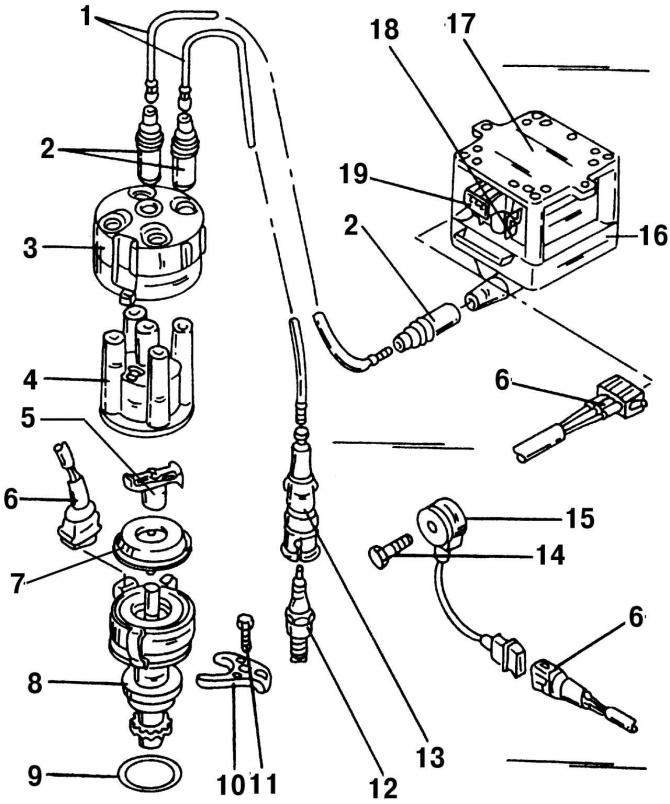
Fig. 210. Elements of the ignition system on a 2.0-liter engine (with Simos injection system): 1 - high voltage wire, to the spark plug; 2 - radio interference suppression plug; 3 - protective cover; 4 - distributor cap; 5 - distributor runner; 6 - three-pin plug connector; 7 - dust cover; 8 - ignition distributor with Hall sensor; 9 - O-ring seal; 10 - pressure bar; 11 - bolt, 25 Nm; 12 - spark plug, 30 Nm; 13 - High voltage wire tip, to spark plug; 14 - bolt, 20 Nm; 15 - knock sensor (G61); 16 - high voltage transformer (N 152); 17 - output stage of high voltage transformer (N157); 18 - terminal "15"; 19 - terminal "1"
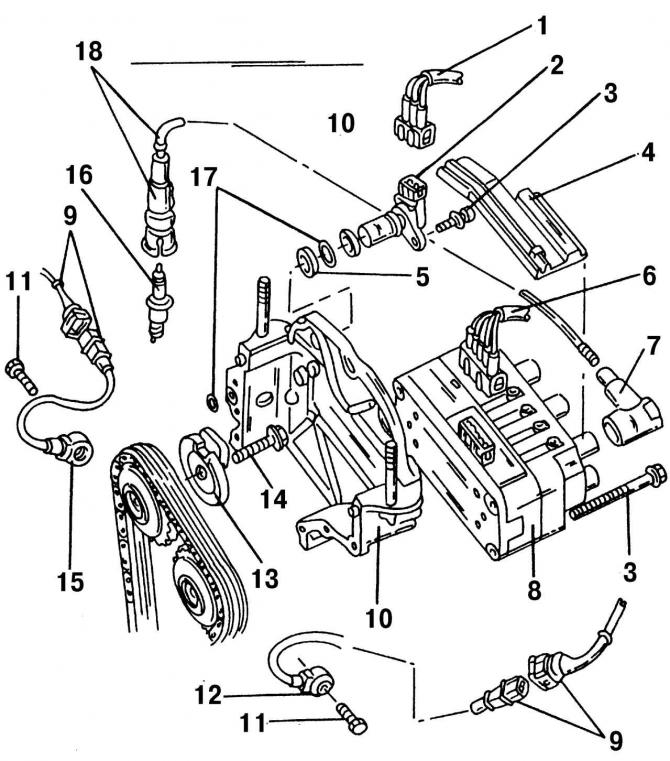
Fig. 211. Elements of the ignition system on the VR6 engine (with Motronic injection system): 1 - three-pin plug connector (black color), for Hall sensor; 2 - Hall sensor; 3 - bolt, 10 Nm; 4 - HV wire guide to the high voltage transformer; 5 - spacer ring; 6 - five-pin plug-in connector, to high voltage transformer; 7 - radio interference suppression plug; 8 - high voltage transformer; 9 - detonation sensor plug connector; 10 - camshaft drive mechanism cover; 11 - bolt, 20 Nm; 12 - knock sensor II, on the intake side; 13 - Hall sensor disk; 14 - bolt, 100 Nm; 15 - knock sensor l, on the exhaust side; 16 - spark plug, 25 Nm; 17 - O-ring; 18 - spark plug tip
In the 2.0-liter engine, the ignition system (Fig. 210) is part of the combined Simos injection and ignition system, and in the VR6 engine, the ignition system (Fig. 211) is part of the combined Motronic system.
The original article is available at [vwmanual.ru]
Combining the injection and ignition systems into a single electronic system has the following advantages:
- combining the functions of units and sensors allows to reduce their number;
- ignition and mixture formation processes are optimized together, thereby improving torque characteristics, fuel consumption, exhaust gas composition, and facilitating cold engine starting and warming up;
- great opportunities open up for performing other functions:
- automatic transmission control;
- traction control system;
- anti-lock braking system control;
- control of air conditioning, anti-theft device, etc.
Ignition systems have no moving parts and therefore do not require maintenance. They have no adjustments, since ignition control is completely electronic and is carried out by the ECU, using information about the engine operating mode received from the sensors of the engine management system.
Visitor comments