



Replacement
Check the exhaust system periodically for corrosion and exhaust leaks. Golf, Jetta and Scirocco models have a three-piece exhaust system mounted on rubber mounts (figure B:50). When ordering exhaust system parts, it is important to correctly specify the vehicle identification number and engine code so that the part fits a specific model.
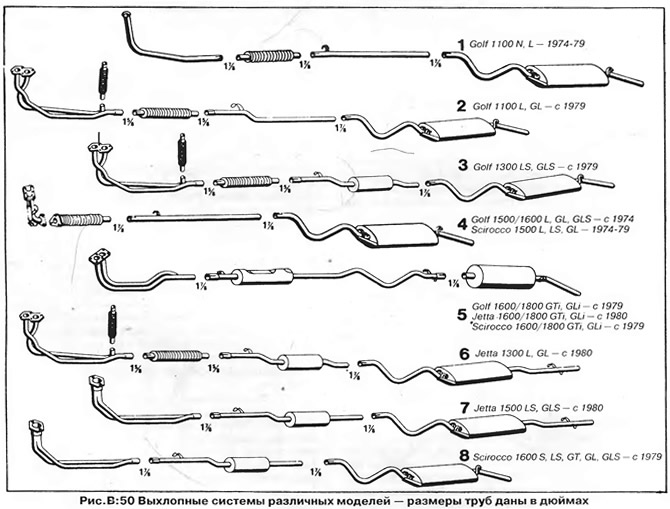
NOTE: On some models, a flexible hose is installed between the exhaust downpipe and the center section, which is attached to the rest of the system with two couplings.
The exhaust systems of the different Golf, Jetta and Scirocco models are shown in Figure B.50.
Remember that a vehicle raised off the ground must be securely supported before any work is carried out underneath it (see chapter "Basic rules for carrying out work").
The exhaust system is relatively easy to remove. Loosen the clamps and disconnect the flange connections that hold the sections of the system together, then remove the rubber hangers that attach the system to the body and remove the exhaust system. The sections of the exhaust system can be replaced individually, but in this case, you should inspect the entire system for corrosion and assess the expected service life of the remaining sections to avoid unnecessary work later. Assess the strength of the pipe and muffler box by tapping it with a hammer, while a very thin (due to corrosion) the section can easily be crushed or broken through. The exhaust system is subject to corrosion mainly from the inside, since the exhaust gases aggressively affect the inner surface of the pipes, so the described method of checking is the best, even if there is no visible damage from the outside.
Rusted sections of the exhaust system can be difficult to separate because the couplings sometimes fuse together. If this happens, clean the couplings with a wire brush and lubricate them generously with oil; sometimes it is necessary to heat the joint with a blowtorch and separate the sections from each other by tapping with a hammer through a wooden lining on the end of the nearest muffler box. In extreme cases, you can bend the coupling with a chisel and pull off the outer pipe of the joint. If only one of the separated sections is replaced, be careful not to deform the end of the remaining section.
Apply a small amount of grease to the inner pipe of the joint and connect the new sections together. Align both sections so that there is at least 25 mm of clearance between any part of the system and the underbody of the car. Avoid excessive stress on the joints and rubber suspensions.
Tighten the clamps around the connections. Make sure that self-locking nuts are used or spring washers are placed under the nuts. Do not overtighten the nuts - this can lead to deformation of the pipes and leakage of exhaust gases.
Always install new gaskets when assembling flange connections.
Replace rubber suspensions that show signs of wear or cracking, as well as heavily rusted bolts, since otherwise there is a risk of separation of part of the exhaust system from the body while driving.
Start the engine and check for exhaust leaks at the connections by placing a gloved hand over the exhaust pipe - this will make the leaks more visible. Remember that minor leaks at the connections often stop on their own due to the accumulation of soot inside the pipe.
Finally, check the exhaust system by taking it for a test drive. Make sure there are no knocking sounds when the exhaust system contacts the underbody of the car.
(The original article is available at: «www.VWManual.ru»)
Visitor comments