



Toe-in is measured on the wheel rims at the height of the hubs and can be expressed as a difference in distances (in millimeters) between the front and rear points of the rims of the right and left wheels, or in the form of an angle (in degrees), by which each wheel deviates from the longitudinal plane of the vehicle during rectilinear motion (drawing L:6). If the wheels are "looking" inward (the distance between the front points of the rims is less than between the rear ones), then the convergence is considered positive, if outward - negative.
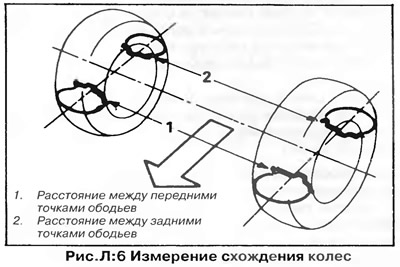
Check the front wheel alignment after any repairs that involve removing or changing the position of front suspension and steering components, and after a severe front wheel impact, such as hitting a curb even at low speed.
The front wheel alignment angles can be determined by the tire tread wear pattern. The presence of a "sawtooth" tread wear pattern indicates incorrect adjustment of the front wheel toe-in. If the sharp edges are located on the outside of the tread pattern, this indicates excessive negative toe-in, if on the inside, this indicates excessive positive toe-in (see chapter "Technical inspection").
It is recommended that the fine adjustment of the front wheels be left to a VW dealer or other specialist with the necessary specialized equipment. However, as a temporary measure, the front wheel alignment can be adjusted using a telescopic ruler as described below.
Prerequisites
Before checking or adjusting the front wheels, do the following:
- a) Check the steering and front suspension joints, bushings and mounts, as well as the wheel hub bearings for wear and play.
- b) Check that the steering gear is adjusted correctly (see section "Steering gear").
- c) Check the tire pressure.
- d) The vehicle must be in a loaded, unladen condition (the spare tire is in place, the trunk is empty, etc.).
- d) Place the vehicle on a level horizontal surface.
- e) Rock the car several times at each corner to eliminate residual stress in the suspension. After this, do not change the position of the suspension by lifting the car or getting into it.
- g) Set the wheels straight ahead, roll the car forward a few meters and stop it without using the brakes. After this, do not move the car backwards.
Checking and adjusting the alignment
By adjusting the front wheel alignment using a telescopic ruler, with great care, precise adjustment can be achieved.
The telescopic ruler is a sliding rod with a pair of stands, installed between the rims of the front wheels at the desired height. The length of the ruler is adjustable and can be fixed with a wing nut (it is best to borrow a telescopic ruler somewhere for temporary use).
1. Place a telescopic ruler behind the front wheel axle and adjust its length so that the ends of the ruler touch the wheel rims at the height of the hub. Mark the readings on the ruler scale.
2. Take a second measurement of the distance between the front wheel rims, this time in front of the axle.
3. Difference (in millimeters) between two measurements will give the convergence value. The normal convergence value is given in the section "Technical data".
4. Move the car forward so that the wheels turn 180° and repeat the measurements. Take the average of the two results.
5. Adjust the toe-in with the right steering rod only (even if an adjustable rod is installed on the left side).
6. To adjust, loosen the clamp on the outer end of the steering gear boot. Loosen the lock nut at the tie rod end, while holding the end body with a second wrench. If you try to loosen the lock nut with only one wrench, the ball pin will most likely be torn out of the joint. Turn the tie rod with a gas wrench until the required wheel alignment is achieved.
7. Tighten the lock nut at the tie rod end. Also tighten the steering gear boot clamp.
8. If the steering wheel spokes are not horizontal when the wheels are in the straight position, remove the steering wheel and reposition it on the splines of the steering column shaft.
Visitor comments