



Contents: Verification condition ↓ Checking the functionality and power…↓ The LED is on (the power supply is…↓ No break in the electrical circuit…↓
Verification condition
The fuses must be in good condition.
The battery voltage must be at least 11.5 V.
All electrical consumers, such as headlights and rear window heating, must be switched off.
Checking the functionality and power supply
Remove the rear seat.
Remove the fuel delivery module cover.
Turn on the ignition. The fuel pump should start to operate audibly within 2 seconds.
Turn off the ignition.
If the fuel pump does not turn on, disconnect the 5-pin connector from the fuel delivery module flange.
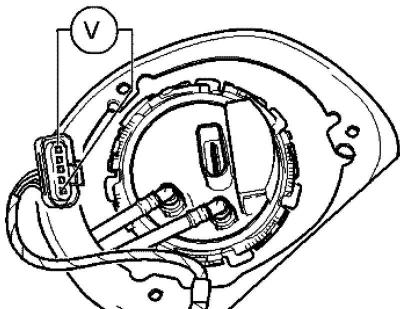
Fig. 2.339. Fuel pump plug
Connect the voltage indicator using the auxiliary leads from the auxiliary measuring kit to the outer contacts of the plug (fig. 2.339).
Turn on the ignition, the LED should light for about 2 seconds.
Turn off the ignition.
If the LED does not light, check the fuel pump relay setting and cables for opens or shorts.
The LED is on (the power supply is working properly)
Remove the fuel delivery module.
Check the connections and absence of damage to the electrical cables between the flange and the fuel pump.
No break in the electrical circuit was detected
Replace the fuel delivery module.
Check the current consumption of the fuel pump
Disconnect the 5-pin connector from the fuel delivery module flange.
Set the multimeter to the 20 A measurement range and connect it in series using the auxiliary leads from the auxiliary measuring kit between contacts 1 of the plug and the fuel pump.
Note: You can also connect a multimeter current clamp to the auxiliary wire between pins 1 of the plug and the fuel pump.
Connect contacts 5 of the plug and the fuel pump using the auxiliary wire from the auxiliary measuring kit.
Start the engine and let it idle.
Measure the current consumption of the fuel pump, the nominal value is 7.5 A.
If the measured value is outside the standard value, replace the fuel delivery module.
Visitor comments