



Removal
Mark the brake pads if they are to be reused. They must be installed back in their original positions, otherwise uneven distribution of braking forces between the wheels will occur.
Remove the wheels.
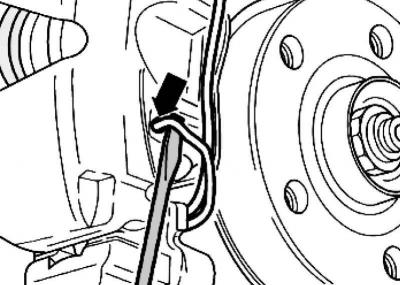
Fig. 6.13. Removing the retaining spring
Pry and remove the brake pad retaining springs from the brake caliper using a screwdriver (Fig. 6.13).
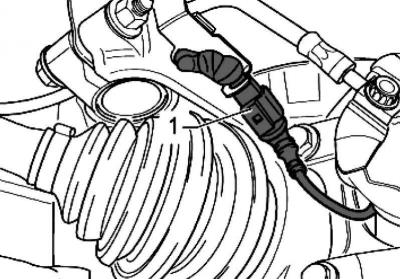
Fig. 6.14. Plug connection
Disconnect plug connection 1 of the brake pad wear indicator (Fig. 6.14).
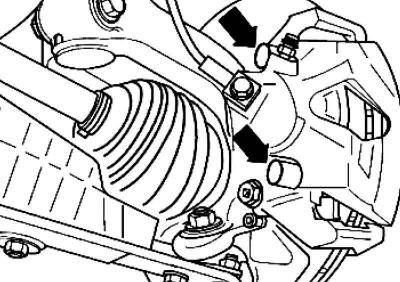
Fig. 6.15. Caps
Remove the caps (Fig. 6.15).
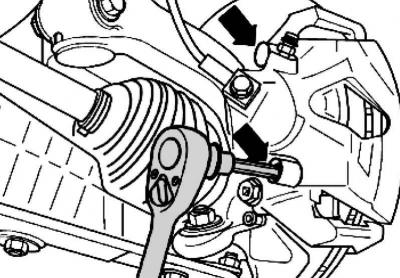
Fig. 6.16. Unscrewing the guide bolts
Unscrew both guide bolts and remove from the brake caliper (Fig. 6.16).
Remove the brake caliper and secure it with wire so that its weight does not press on the brake hose and damage it.
Remove the brake pad from the brake caliper or remove it from the retainer bracket.
[The original can be seen on the portal: VWManual.ru]
Caution: Do not blow out the brake system with compressed air. This creates harmful dust.
Clean the bearing surface of the brake pads on the bracket, remove corrosion.
Clean the brake calipers.
Use only alcohol to clean the brake caliper.
Installation
Before pressing the piston into the cylinder using a special device, it is necessary to pump out the brake fluid from the reservoir. Otherwise, if you add fluid, it may leak out and cause damage.
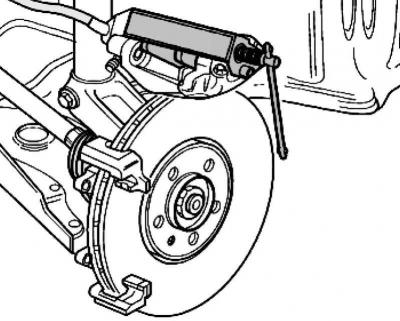
Fig. 6.17. Removing the piston
Press the piston (Fig. 6.17).
Install the outer brake shoe into the retainer bracket.
Insert the inner brake shoe with the retaining spring into the brake caliper (piston).
Secure the brake caliper with two guide bolts to the bracket (Fig. 6.16).
Install both caps.
Install the retaining spring into the brake caliper.
Connect the plug connection of the brake pad wear indicator.
Install the wheels.
Note: After each replacement of brake pads, press the brake pedal hard several times. This is necessary to ensure that the brake pads take their working position.
Note: After replacing the pads, check the brake fluid level.
Tightening torque
Guide bolt to the retaining bracket: 30 Nm.
Visitor comments