



Contents: Checking and adjusting engine idle…↓ Adjusting the throttle opening ↓ Checking the fuel pressure in the…↓ Checking and adjusting the idle and…↓ Checking the coolant temperature…↓ Checking the intake air temperature…↓ Checking the Idle Speed Control…↓ Checking the injectors ↓ Checking the oxygen sensor in the…↓ Checking the CO adjustment…↓ Checking the adsorber shut-off valve ↓ Checking the operation of the…↓ Checking the electrical circuits of…↓
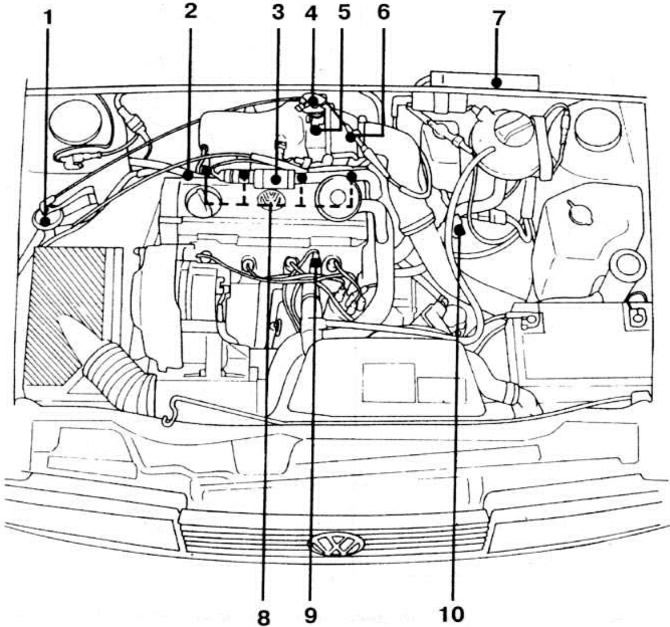
Fig. 1. Placement of elements of the fuel injection control subsystem KSUD "Digifant G60" in the engine compartment: 1 — Evaporative canister shut-off valve: 2 — Fuel pressure regulator: 3 — Idle speed stabilization electromagnetic valve: 4 — Idle speed and full load switches: 5 — Throttle body: 6 — Boost pressure control bypass valve body: 7 — Controller: 8 — Injectors: 9 — Coolant temperature sensor: 10 — CO adjustment potentiometer.
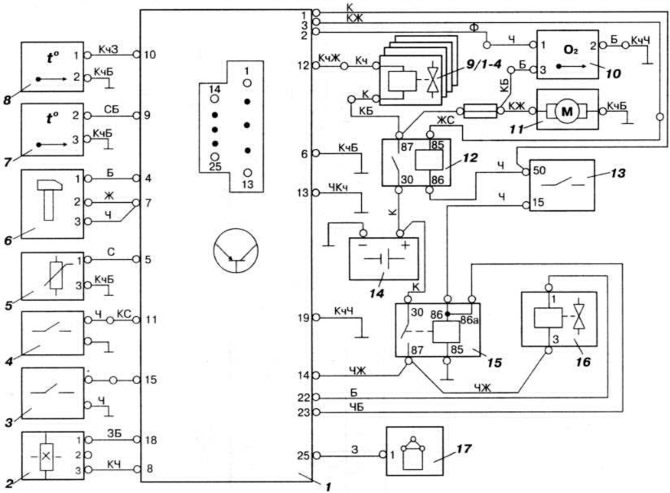
Fig. 2. Connection diagram of the KSUD "Digifant G60" engine "1N" of the car "Passat GT 1.8 G60 Syncro": 1 — controller; 2 — Hall sensor of the ignition system: 3 — full load switch; 4 — idle switch: 5 — exhaust gas CO adjustment potentiometer: 6 — knock sensor: 7 — intake air temperature sensor: 8 — coolant temperature sensor; 9/1-4 — injectors; 10 - exhaust gas oxygen concentration sensor; 11 - fuel pump; 12 — injection system power supply relay; 13 - ignition switch: 14 - battery; 15 — controller power relay; 16 — electromagnetic valve for idle speed stabilization; 17 — ignition coil.
NOTE: When working with the fuel injection control subsystem KSUD "Digifant G60" the same precautions should be taken as when working on a central fuel injection system "Mono-Jetronic", see the relevant subsection.
Checking and adjusting engine idle speed
Before adjusting and checking the engine idle speed, the following must be done:
- warm up the engine (oil temperature not less than 80°C);
- turn off electrical consumers, including the air conditioner, if installed;
- make sure that the ignition timing and spark plug gap are set correctly;
- make sure that the idle speed stabilization electromagnetic valve is working properly; when the ignition is turned on, the valve should vibrate and hum.
The electric fan of the cooling system should not turn on during testing.
Connect the control tachometer according to the operating instructions, connect the gas analyzer to the tube (see the corresponding figure for the "RV" engine) for measuring the content of carbon monoxide (CO) in the exhaust gases.
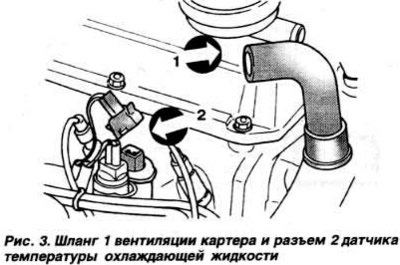
Disconnect the crankcase ventilation hose 1 (Fig. 3) and unfold the hose so that fresh air enters its opening. Start the engine at idle speed and let it run for about 1 minute. Then disconnect the blue connector 2 (Fig. 3) of the coolant temperature sensor, then increase the crankshaft speed three times to a value above 3000 rpm and leave the engine running at idle speed.
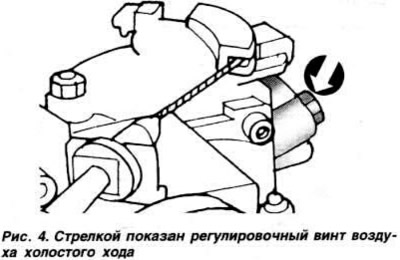
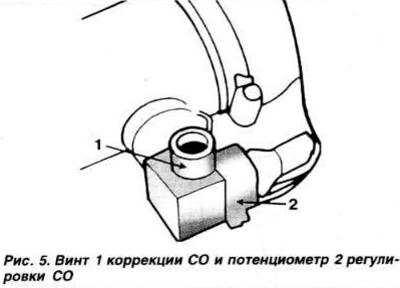
Check the idle speed and the CO content in the exhaust gases, which should be within 750-850 rpm and 0.3-1.1%, respectively. If the obtained values do not fit within the specified limits, remove the plugs from the idle adjustment screws and alternately rotate the idle air screw (to adjust the idle speed) and the CO correction screw (fig. 4 and 5), achieve the required values.
Connect the coolant temperature sensor connector. Press the accelerator pedal three times and check the exhaust gas CO content again. If it has changed, check the exhaust gas oxygen sensor as described below. Replace the faulty sensor if necessary and check the idle speed and CO content again. If the engine idle speed is adjusted correctly, connect the crankcase ventilation hose to the cylinder head cover pipe. In this case, the exhaust gas CO content may increase, which, however, does not indicate incorrect CO content adjustment, but the presence of a certain amount of gasoline in the engine oil. In order to return the CO value to the specified limits, in this case it is necessary to drive several kilometers at high speed or change the engine oil.
Adjusting the throttle opening
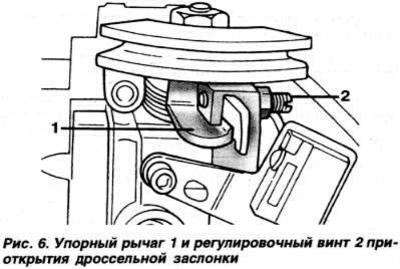
The throttle opening is set at the factory and does not require adjustment during operation. If the position of the throttle opening limit screw is accidentally changed, the adjustment can be restored as described below.
Loosen the lock nut, unscrew the adjusting screw 2 (Fig. 6) for opening the throttle valve until there is some clearance between the screw and the stop lever 1 of the throttle valve. Tighten the adjusting screw until it touches the stop lever. The moment of contact is determined by clamping a sheet of tissue paper, previously inserted between the screw and the lever. After this, tighten the adjusting screw for opening the throttle valve another half turn. Check the operation of the idle switch. Check and, if necessary, adjust the engine idle speed.
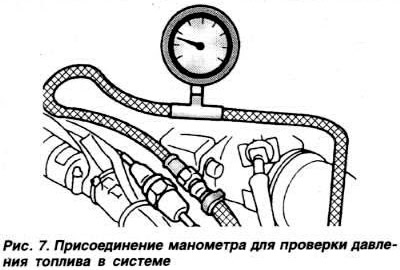
Checking the fuel pressure in the system
Disconnect the fuel supply line from the fuel line and connect a pressure gauge to the line opening and the fuel line branch pipe using an adapter (Fig. 7). Start the engine at idle speed and check the fuel pressure using the pressure gauge, which should be about 2.5 kgf/cm². Disconnect the vacuum hose of the fuel pressure regulator from the throttle valve inlet line. In this case, the pressure on the pressure gauge should increase to about 3 kgf/cm². Turn off the ignition. After 10 minutes, check the residual fuel pressure, which should be at least 2 kgf/cm². Tightly pinch the blue fuel drain hose. If the fuel pressure does not decrease, the fuel pressure regulator is faulty.
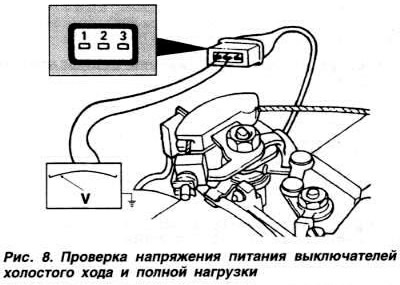
Checking the supply voltage of the no-load and full load switches
Disconnect the switch connector (Fig. 8), connect the voltmeter first to terminals "1" and "2", then to terminals "2" and "3" of the plug part of the connector, turn on the ignition and check the supply voltage of the switches, which in both cases should be about 5 V. If the measured voltage does not correspond to this, connect the switch connector, identify and eliminate the cause of the circuit integrity violation. If the circuit is not broken, replace the controller.
Checking and adjusting the idle and full load switches
Disconnect the idle and full load switches. Connect an ohmmeter to terminals "1" and "2" (Fig. 9) of the switch block. The resistance on the ohmmeter should be 0 Ohm. Attach a protractor disk with an arrow to the throttle valve axis (Fig. 9).
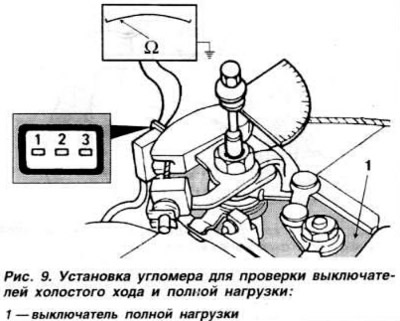
Open the throttle valve to an angle of 10° using the protractor, then slowly close the throttle valve until the idle speed switch operates. At an angle of 1.0±0.5 between the throttle valve control lever and the idle speed stop, the resistance according to the ohmmeter should be 0 ohms. If the resistance value is lower, loosen the idle speed switch mounting screws and, by moving the switch, achieve zero resistance at a given angle between the throttle valve control lever and the idle speed stop, then tighten the switch mounting screws.
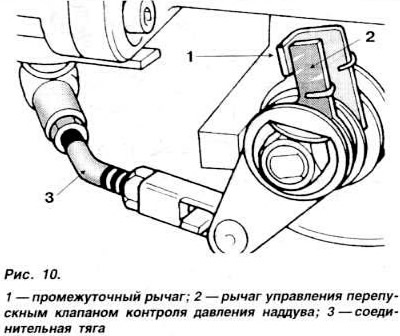
Connect an ohmmeter to terminals "2" and "3" of the switch block. The resistance on the ohmmeter should be 0 ohms. Use a screwdriver to open the throttle valve so that intermediate lever 1 (Fig. 10) barely moves away from lever 2 of the boost pressure control bypass valve. In this position, set the goniometer needle to zero. Close the throttle valve by approximately 10° on the goniometer. In this case, the full load switch should operate at an angle of 4±1° on the goniometer. If this does not happen, loosen the switch mounting screws and move it until the switch operates at this deviation of the goniometer needle, then tighten the switch mounting screws.
Checking the coolant temperature sensor
It is produced in the same way as on the engines "RV" and "2E" (see the relevant subsection). The resistance of the sensor at a coolant temperature of 0°C is 5.0-6.5 kOhm, at 20°C - 2.0-3.0, at 40°C - 1.0-1.5. at 60°C - 0.525-0.650. at 80°C - 0.275-0.375 and at 100°C - 0.175-0.225 kOhm.
Checking the intake air temperature sensor
Disconnect the connector of potentiometer 2 (Fig. 5) for adjusting the CO. Connect an ohmmeter to terminals "2" and "3" of the potentiometer block and measure the resistance of the sensor, which at an intake air temperature of 0°C should be within 5.0-6.5 kOhm, at 20°C - 2.0-3.0, at 40°C - 1.0-1.5. at 60°C - 0.525-0.650, at 80°C - 0.275-0.375 and at 100°C - 0.175-0.225 kOhm.
Checking the Idle Speed Control Solenoid Valve
The operability of the idle speed stabilization electromagnetic valve is checked on a warmed-up engine (oil temperature no higher than 80°C), with the engine idle speed correctly adjusted, with a working coolant temperature sensor of the fuel injection control subsystem, in the absence of air leaks in the engine intake tract.
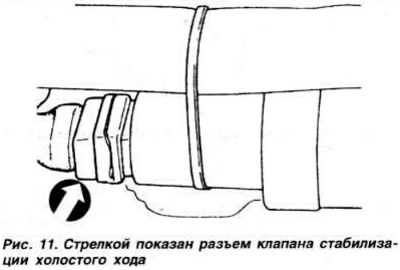
Turn on the ignition. If the idle speed stabilization valve is in good condition, it should vibrate and hum. If this does not happen, disconnect the connector (Fig. 11) of the valve and measure the resistance of the valve winding by connecting an ohmmeter to the terminals of the valve block, which should be within 2-10 Ohms. If the obtained value does not correspond to this, the valve must be replaced.
Check the integrity of the circuit between the valve and the controller by connecting an ohmmeter to the terminals of the junction block. If the circuit is damaged, replace the controller.
Checking the injectors
It is produced in the same way as on the engines "RV" and "2E" (see the relevant subsection). The resistance of the injector winding is 10-20 Ohm.
Checking the oxygen sensor in the exhaust gases
Warm up the engine to a temperature of at least 80°C, check that the idle speed corresponds to the required value, make sure that the exhaust system is tight, make sure that the coolant temperature sensor connector is securely connected and that the supply voltage of the exhaust oxygen sensor is equal to the battery voltage. Connect the gas analyzer to the CO measurement tube.
Let the engine idle for at least 2 minutes and check the carbon monoxide (CO) content in the exhaust gases.
Disconnect the fuel pressure regulator vacuum hose from the intake manifold. The CO content in the exhaust gases should first increase briefly, then decrease again to normal.
If the CO content in the exhaust gases does not decrease, disconnect the connector of the oxygen content sensor in the exhaust gases, which is located next to the idle speed stabilization electromagnetic valve.
Connect the sensor connector terminal, to which the green wire is connected, alternately to the battery "plus" and to the "ground", monitor the change in the CO content in the exhaust gases. If the CO content increases and then decreases, replace the oxygen content sensor in the exhaust gases.
Checking the CO adjustment potentiometer
Disconnect the potentiometer connector. Connect an ohmmeter to terminals "1" and "3" of the potentiometer and measure the resistance, which should be within 0-2000 Ohm.
Checking the adsorber shut-off valve
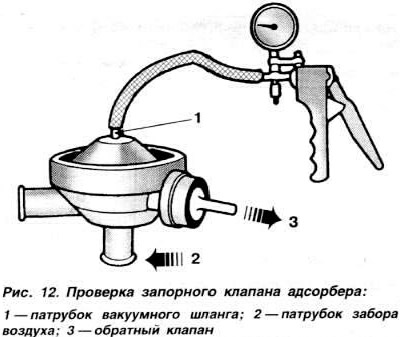
Disconnect the vacuum hose from the branch pipe 1 (Fig. 12) at the top of the shut-off valve and connect the vacuum pump hose to it. Make sure that air enters through the opening of the branch pipe 2. Create a vacuum in the valve using the vacuum pump and make sure that the valve closes. In this case, air should not enter through the branch pipe 2, and the check valve should pass air only in the direction shown by the arrow in Fig. 12.
Checking the operation of the subsystem in full load and forced idle modes
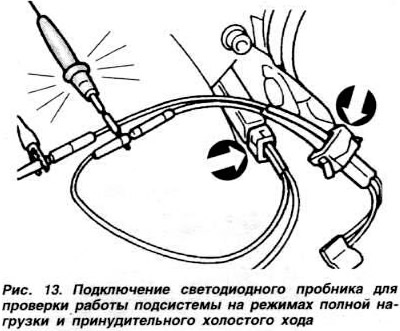
Start the engine at idle speed. Move the full load switch 1 (Fig. 9) manually. The idle speed should first increase and then begin to fluctuate. If this does not happen, check the full load switch as described above. Warm up the engine to normal operating temperature. Disconnect the connector located at the bottom of the throttle body (Fig. 13). Connect both parts of the connector with adapters and connect an LED tester to them, as shown in Fig. 13. When the engine is idling, the LED tester should light. Increase the engine speed to approximately 3000 rpm and release the accelerator pedal. If the subsystem is operating normally in the forced idle mode, the LED tester should go out briefly.
Checking the electrical circuits of the KSUD
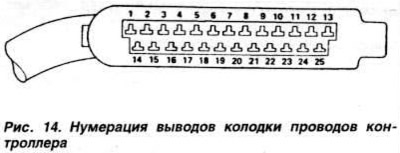
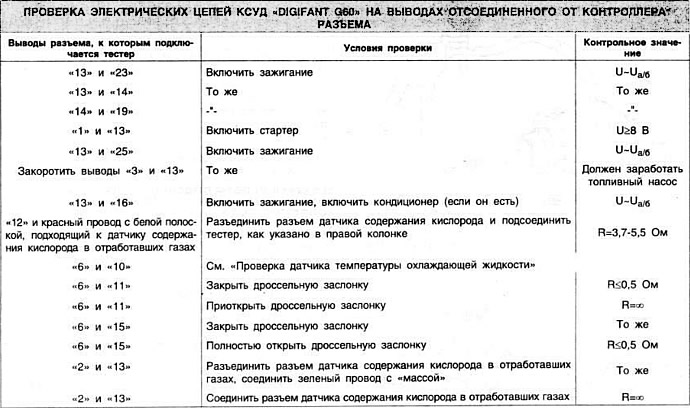
Check the battery charge level. Make sure fuse No.18 is in good condition. Fuel pump and subsystem relay, as well as the integrity and reliability of the ground wire connections. Make sure the ignition is off and disconnect the controller connector. Connect a digital tester to the terminals of the connector disconnected from the controller (in voltmeter and ohmmeter mode), check that its readings correspond to those indicated in the table. The numbering of the controller wiring block terminals is shown in Fig. 14.
Visitor comments