



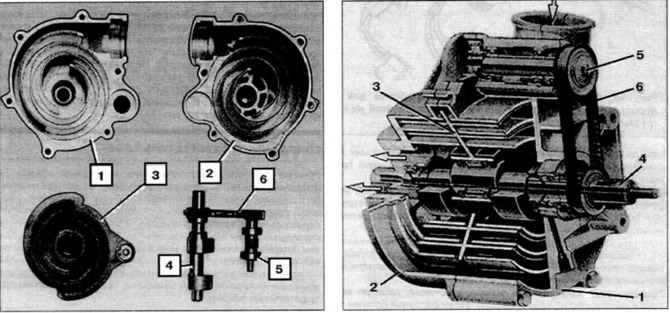
Fig. 15. Supercharger "G60": 1, 2 - halves of the supercharger body with spiral channels; 3 - movable displacer; 4 - eccentric drive shaft; 5 — eccentric shaft of plane-parallel motion: 6 — toothed belt.
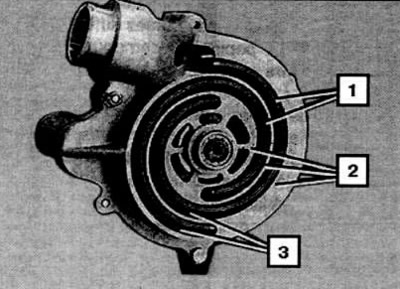
Fig. 16. Section in the middle plane of the supercharger: 1 - spiral displacers; 2 — body; 3 - channels with variable volumes.
The principle of operation of this volumetric supercharger is based on changing the volume of a spirally twisted rectangular channel running from the periphery to the center. The displacer (piston) is also a spiral, moves flat-parallel in a circle, rolling around the spiral of the displacer along the spiral line of the channel, touching the wall of the channel. Thus, the spiral of the displacer at the point of contact divides the spiral channel into two volumes:
- in front of the line of contact between the displacer and the channel, as the line of contact moves, the air is compressed due to a decrease in the cross-sectional area of the channel;
- behind the line of contact between the displacer and the channel, as the line of contact moves, a vacuum is created and air is sucked into the channel.
After the return of the rolling spiral of the displacer to its original position, the cycles of injection in front of the contact line and suction behind the contact line are repeated.
The accumulator body consists of two symmetrical halves, each of which contains two spiral channels. One spiral channel is twisted by 360°, and the second by 540°. Between the two fixed channels of each half of the body there are two movable spiral displacers, which enter the spiral channels of each half of the body with their spirals. The spirals of the displacers of one half of the body are separated from the spirals of the displacers of the other half of the body by a partition. Each spiral of the displacer is twisted by 360° and the spirals of the displacers, separated by a partition, are turned relative to each other by 180°.
To prevent the displacers from rotating around their axis, a hole is made on the peripheral section of the partition, into which an eccentric with the same eccentricity as the eccentric of the displacer drive shaft enters. The eccentrics are arranged symmetrically and connected by a toothed belt. The eccentric shafts are parallel to each other.
The drive shaft has one eccentric for each displacer, separated by a partition. The eccentrics rotate in the central holes of the displacers on needle bearings. To eliminate the imbalance of the displacers, two counterweights are installed on the drive shaft.
The amount of air pumped depends on the rotation speed of the drive shaft, which can reach 10,000 rpm. The ratio of pressure at the inlet and outlet of the supercharger depends on the profile of the spirals. Pulsations of the flow of pumped air are small. The supercharger is low-noise, the efficiency is 65%.
Checking the boost pressure
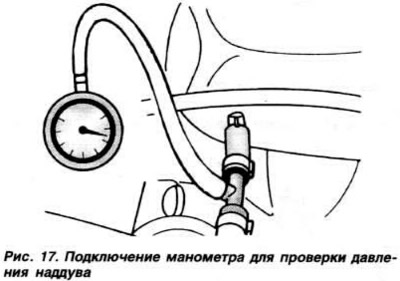
Disconnect the vacuum hose from the intake manifold that goes to the fuel pressure regulator and, using a T-shaped adapter, connect a pressure gauge to the hose opening and the intake manifold branch pipe (Fig. 17). Warm up the engine to normal operating temperature and let it idle. Disconnect the wire blocks from the CO adjustment potentiometer and the coolant temperature sensor (blue connector). Press the accelerator pedal sharply all the way down (under no circumstances should you hold the accelerator pedal down for more than 10 seconds, to avoid damaging the supercharger). As soon as the minimum boost pressure of 0.6 kgf/cm² is reached on the pressure gauge, the engine crankshaft speed should increase. If this does not happen, check the tightness of the intake tract and the adjustment of the boost pressure control bypass valve (see below). If there is no air leakage and the valve is installed correctly, the supercharger must be replaced.
(The original information is posted on the website: VWmanual.ru)
Adjusting the Boost Pressure Control Bypass Valve
The position of the boost pressure control bypass valve is adjusted at the factory and should not be changed during operation. If it is accidentally disturbed, do the following:
- install the protractor on the throttle axis (fig. 9);
- open the throttle valve fully and set the protractor needle to zero;
- slowly close the throttle valve until it touches lever 2 (fig. 10) control of the boost pressure control bypass valve with intermediate lever 1. The protractor should show 10°±1°. If not, achieve the correct reading by changing the length of connecting rod 3;
- adjust the full load switch as above.
Visitor comments