



On vehicles with a "2E" engine, disconnect the fuel supply line from the starting injector. On vehicles with an "RV" engine, connect a pressure gauge with a scale from 0 to 5 kgf/cm² to the open threaded hole in the end of the distribution line using an adapter (fig. 2-109). On vehicles with a "2E" engine, connect a pressure gauge to the fuel supply line to the fuel injector (fig. 2-110).
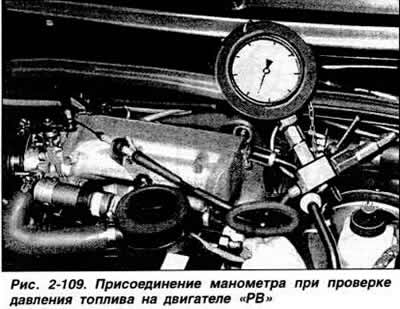
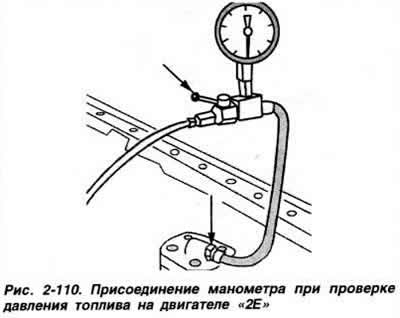
Close the pressure gauge valve, placing it in a position perpendicular to the direction of fuel flow through the pressure gauge. Start the engine at idle speed and check the fuel pressure on the pressure gauge, which should be about 2.5 kgf/cm². Disconnect the vacuum hose of the fuel pressure regulator from the throttle body pipe. In this case, the pressure on the pressure gauge should increase to about 3 kgf/cm². Turn off the ignition. After 10 minutes, check the residual fuel pressure, which should be at least 2 kgf/cm².
(The text is copied from this portal: vwmanual.ru)
If the residual pressure is below the specified limit, perform the following operations:
- start the engine and let it run until the fuel pressure exceeds 2 kgf/cm²;
- stop the engine and tightly pinch the blue fuel drain hose. If this does not reduce the fuel pressure. The fuel pressure regulator is faulty;
- if the fuel pressure again becomes less than 2 kgf/cm², check the tightness of the fuel lines and their connections, fuel line sealing rings, injectors, fuel pump check valve, and the tightness of the control pressure gauge.
Note: Before removing the pressure gauge, drain the fuel from it.
Visitor comments