
English Русский
Български
Беларускі
Український
Српски
Hrvatski
Română
Polski
Slovenský
Magyar
  |  Articles  |  Sitemap  |  Contacts  |    |
Car maintenance Ford Car maintenance Hyundai Car maintenance Chevrolet Car maintenance BMW Car maintenance Audi Car maintenance Opel Car maintenance AvtoVAZ
VWmanual.ru


Main   Passat   Golf   Polo   Touareg   Tiguan   Sharan   Transporter   Others  
Polo 3 (1995-2003) Polo 4 (2001-2009)

Checking the fuel pressure regulator and holding pressure (VW Polo 3)

  • Main
  • Polo
  • Polo 3
  • Power unit
  • Petrol engines 1.4 and 1.6
  • Checking the fuel pressure regulator and holding pressure
            0


Warning! The fuel system is under high pressure. Before disconnecting any of the fuel system components, it is recommended to place rags around the connection. Then relieve the pressure by carefully loosening the connection.


1. Disconnect the fuel line (white) 1 from the fuel delivery line 2 (Fig. 3.30). Connect the VAG 1318 pressure gauge using the 1318/10 adapter to the fuel line and using the 1318/11 and 1318/16 adapters to the fuel delivery line.
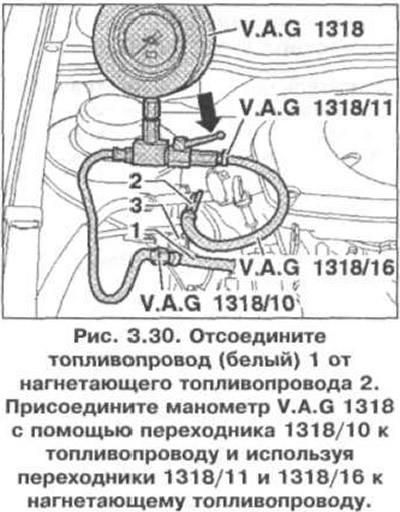
1. Disconnect the fuel line (white) 1 from the fuel delivery line 2 (Fig. 3.30). Connect the VAG…


2. Open the pressure gauge valve (the handle should point in the direction of the arrow).

3. Start the engine and let it idle.

4. Measure the fuel pressure. It should be approximately 2-5 bar.

5. Disconnect the vacuum pipe of the fuel pressure regulator 1 from the inlet adapter 2 (Fig. 3.31). The fuel pressure should increase to approximately 3.0 bar. Switch off the ignition. Check for leaks and the holding pressure by observing the pressure drop on the pressure gauge. After 10 minutes it should be at least 2 bar.
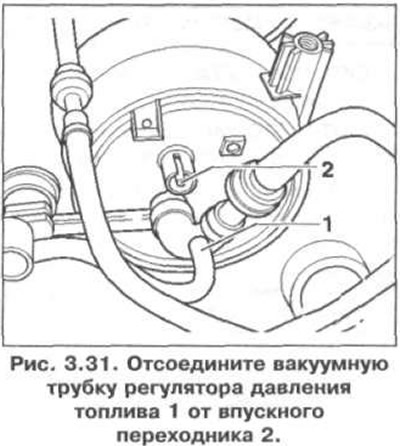
5. Disconnect the vacuum pipe of the fuel pressure regulator 1 from the inlet adapter 2 (Fig.…


6. If the holding pressure is less than 2 bar: start the engine and let the engine idle.


7. Turn off the ignition after the pressure has increased. After a while, close the pressure gauge valve (the handle should point in the direction of the arrow) (Fig. 3.32).
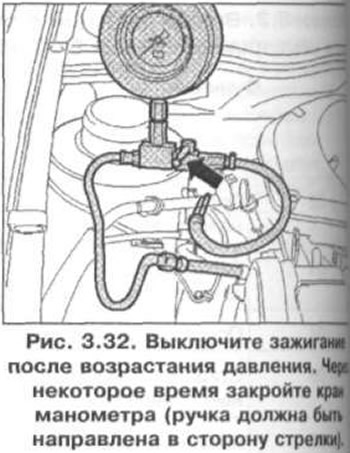
7. Turn off the ignition after the pressure has increased. After a while, close the pressure gauge…


8. Observe the pressure drop on the pressure gauge.

9. If the pressure does not drop: check the pressure gauge valve.

10. If the pressure drops again: open the pressure gauge valve (handle in the direction of the arrow) (Fig. 3.30).

11. Start the engine and let it idle.

12. Turn off the ignition after the pressure has increased. After a while, close the fuel drain line (with blue markings) 3.

13. If the pressure does not drop: use a fuel pressure regulator.

14. If the pressure drops again, check the fuel line connections, the sealing rings on the high-pressure fuel line and the injectors. Check the pressure gauge for fuel leaks.

This article is available at russian, bulgarian, belarusian, ukrainian, serbian, croatian, romanian, polish, slovak, hungarian
The text has been checked: Kolesnikov Artem

Share information:

Previous articles
Reading the measured value block and basic settings
Checking and clearing fault memory
Connecting the VAG 1551 fault code reader
Self-diagnosis of the injection system
Fuel injection and ignition control system
Exhaust gas system
Next articles
Checking the engine operating modes
Checking the intake manifold pressure sensor
Checking the coolant temperature sensor
Checking the inlet air temperature sensor
Checking the oxygen sensor (lambda probe)
Checking the oxygen sensor heater


Similar articles from other manuals for VW cars:
Checking the fuel pressure regulator Passat B4 (1988-1996)
Brake pressure regulator Golf 1 (1974-1984, petrol)
Checking the fuel pressure regulator and residual pressure… Touareg 1 (2002-2006)
Checking the fuel pressure regulator N276 Tiguan 1 (2007-2015)
Fuel pressure regulator Sharan 1 (1995-2000)
Checking the air pressure in the tires Transporter T4 (1990-2003)
Checking the fuel pressure regulator and holding pressure LT 2D (1996-2003)
Link to this page in different formats


Visitor comments


No comments yet


How much will 39 + 33 =


Polo 4 
  • General information
  • User manual
  • Maintenance
  • Power unit
  • Engine repair
  • Cooling and lubrication system
  • Control system
  • Injection system (diesel)
  • Supply system
  • Exhaust system
  • Chassis
  • Front suspension
  • Rear suspension
  • Steering
  • Wheels and tires
  • Brake system
  • Body
  • Interior
  • Exterior
  • Electrical equipment
  • Equipment and devices
  • Wiper system
  • Lighting system
  • Electrical circuits
Polo 3 
  • General information
  • User manual
  • Maintenance
  • Power unit
  • Petrol engines 1.4 and 1.6
  • Petrol engines 1.4 (V16)
  • Petrol engines 1.6 and 1.8
  • Diesel engines 1.7 and 1.9
  • Diesel engines 1.9 D and TD
  • Transmission
  • Mechanical gearbox 085
  • Mechanical gearbox 020/02K
  • Chassis
  • Front suspension
  • Rear suspension
  • Steering
  • Brake system
  • Body
  • Exterior
  • Interior
  • Electrical equipment
  • Equipment and instruments (until 2000)
  • Equipment and instruments (after 2000)
  • Electrical circuits
  • Wiring diagrams (petrol)
  • Wiring diagrams (diesel)
VWmanual.ru © 2016-2026 | Mobile version | News and articles | Sitemap: EN BG BY UA RS HR RO PL SK HU | Write message | Site search
Passat B2 • Passat B3 • Passat B4 • Passat B5 • Passat B6 • Golf 1, diesel • Golf 1, petrol • Golf 2, petrol • Golf 2 • Golf 3 • Golf 4 • Golf 5 • Polo 3 • Polo 4 • Touareg 1 • Tiguan 1 • Sharan 1 • Transporter T3 • Transporter T4 • LT 28 • LT 2D • Beetle • Caddy 3 •
Our website uses cookies to ensure functionality and convenience.