



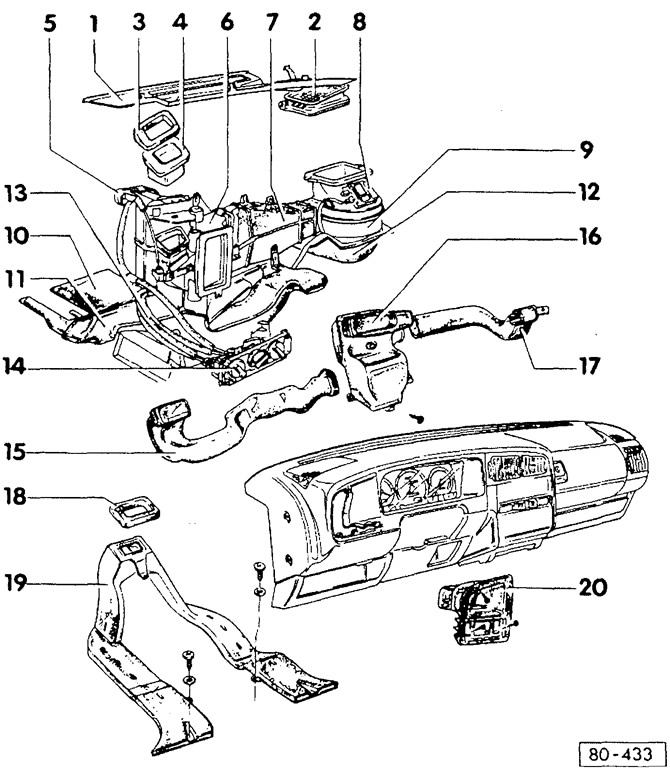
- 1 - drainage casing
- 2 - suction pipe
- 3 - sealing gasket
- 4 - intermediate element
To replace, remove the instrument panel and heating system.
- 5 - heat exchanger
- 6 - air distributor housing
- 7 - air channel, main shut-off valve
- 8 - additional resistance
To replace, remove the glove box and shelf.
- 9 - fresh air fan
To replace, remove the lower shelf.
- 10 - pedal cover
- 11 - blower space for legs
To replace, remove the center console, instrument panel bracket and pedal cover.
- 12 - casing of the air channel
- 13 - pull the heating system
- 14 - heating system control panel
- 15 - air duct left
- 16 - air distributor
To replace, remove the center console, bracket and instrument panel, heating control and pedal cover.
- 17 - air duct right
- 18 - sealing gasket for the air supply channel to the footwell behind the front seats
- 19 - air supply channel to the footwell behind the front seats
- 20 - blower
Fresh air for heating the car interior is supplied by the heater fan. In this case, the air passes through the heater housing and is directed to the respective air nozzles by means of various valves. If the heating system is on («warm»), the cold air is directed through the heat exchanger. The heat exchanger is located in the heater housing and is heated by the hot liquid of the engine cooling system. The flowing air is heated from the hot heat exchanger plates and then fed into the interior of the car. The heating efficiency is determined by the temperature of the incoming air. The air temperature, in turn, is controlled by the ratio of mixing quantities of cold and hot air, which is determined by the temperature control valve.
An increase in the power of the heating system is provided by a four-mode fresh air fan. In order for the fan to rotate at different speeds in each mode, additional resistances are included. The resistors are located in the fan connector. If a defect occurs, the connecting connector must be replaced as a set.
Additional equipment: electronic control of the heating system (Thermotronic)
As additional equipment, electronic control of the heating system can be installed. In this case, the temperature inside the passenger compartment can be set, which is then quickly reached and kept constant thanks to the electronic control of the temperature control valve. Two interior air temperature sensors (at the roof between the sun visors and in the driver's footwell), as well as an outdoor temperature sensor (in the intake air pipe) transmit signals to the control unit, which is located behind the actuator of the heating system. In accordance with these signals, the control unit controls the temperature control valve via the actuator motor.
Air conditioning system with manual or automatic control (Climatronic)
The air conditioning system can lower the interior temperature below the outside temperature. In addition, if the air conditioning system is running, the humidity in the cabin is reduced. The air conditioning compressor is driven by a V-belt from the engine crankshaft.
Attention: Repairs to the electronic control of the heating and air conditioning system must be carried out by a VW repair shop.
Visitor comments