



Contents: Removal ↓ Installation ↓ Cars with 1.4-/1.6-liter FSI petrol…↓ Cars with 1.6 liter petrol engine…↓ Cars with 2.0 liter TFSI petrol…↓ Cars with air conditioning ↓
Removal
Attention! This chapter covers engines with a capacity of 1.4 liters BCA, 2.0 liters AXW/BLR/BLX/BLY, diesel 2.0 liters BDK (see illustration 6.0). Differences specific to other engine types are listed separately at the end of this chapter.
1. Set the upper front cross member to the service position, see the relevant chapter.
2. Drain the coolant.
3. Remove the radiator fan, see the corresponding chapter.
4. Disconnect the circulation and coolant hoses from the radiator. Before disconnecting, loosen the hose clamps and move them onto the hoses. If necessary, loosen the hoses by removing the clamps.
5. Unscrew the radiator mounting bolts on the left and right sides.
6. Tilt the radiator back slightly and then remove it by pushing it upwards.
Installation
The radiator is installed in the reverse order of removal. The radiator support mounting bolts on the upper front crossmember are tightened with a force of 5 Nm.
Cars with 1.4-/1.6-liter FSI petrol and diesel engines
7. Disconnect the plug of the thermal switch and radiator fan.
8. Remove the radiator together with the fan by lowering them down.
Cars with 1.6 liter petrol engine BGU/BSE/BSF
9. Remove the front bumper, see the relevant chapter.
10. Unscrew the radiator mounting bolts on the right and left sides through the holes in the bumper panel and remove the bumper from the engine compartment by lifting it up.
(The original can be found at: «VWManual»)
11. Disconnect the plug from the radiator fan.
12. Remove the radiator together with the fan by pushing them upwards.
Cars with 2.0 liter TFSI petrol engine AXH
13. Disconnect the boost air hoses from below.
14. Remove the radiator by lowering it down.
Cars with air conditioning
Warning! Do not open the air conditioner refrigerant circulation system. Contact with the coolant on the skin causes frostbite. If the refrigerant comes into contact with the skin, rinse the skin with cold water immediately for at least 15 minutes. The refrigerant is colorless, odorless, and heavier than air. If the refrigerant leaks, people in the area of the floor on which the vehicle is installed or in rooms located below the leak may suffocate.
To avoid damage to the compressor, as well as the air conditioning pipes and hoses, they must not be stretched, bent or twisted.
15. Remove the air conditioner pipe clamps.
16. Disconnect the compressor from the radiator and secure it to the upper front cross member with wire.
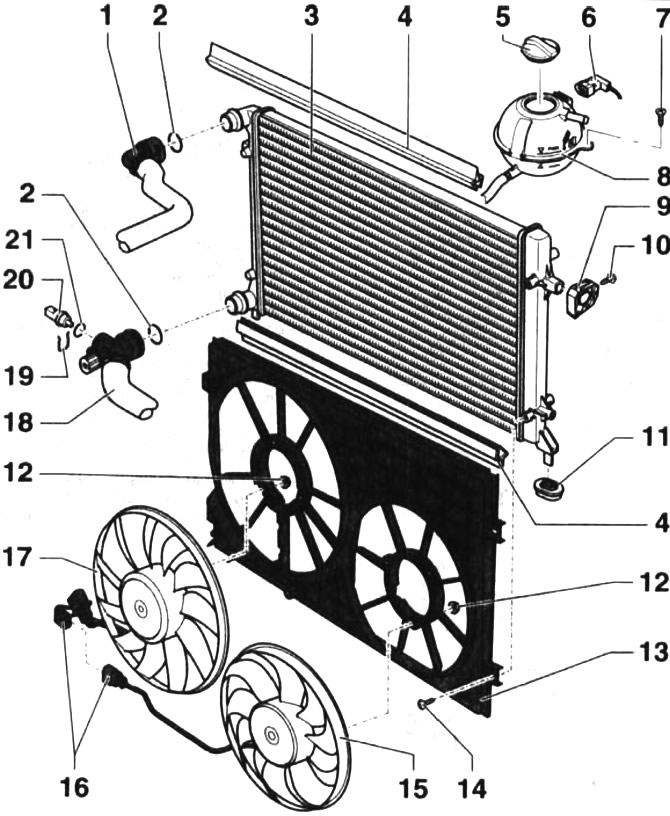
Radiator. Cars with petrol engine and diesel engine with a capacity of 2.0 liters BDK
1 - Upper radiator hose. Attached to the radiator pipe with a clamp. When installing, make sure the clamp is securely seated
2 - O-ring. Should be replaced if damaged
3 - radiator
4 - sealing gasket. Not available on all models
5 - expansion tank cap with coolant. Pressure in the tank 1.4-1.6 bar
6 - plug
7 - bolt. Tightening torque 5 Nm
8 - expansion tank for coolant
9 - radiator mounting support
10 - bolt. Tightening torque 5 Nm
11 - Fastening the lower radiator support
12 - nut. Tightening torque 10 Nm
13 - diffuser
14 - bolt. Tightening torque 5 Nm
15 - Fan 2
16 - plug
17 - Fan 1 with control unit
18 - lower radiator hose. Connects to the outlet pipe, which contains the thermostat. The hose is attached to the pipes with a clamp, the fit of which should be checked
19 - Clamp, The tightness of the fit should be checked
20 - coolant temperature gauge sensor. Located on the radiator inlet pipe
21 - O-ring. To be replaced at each dismantling
Visitor comments