
English Русский
Български
Беларускі
Український
Српски
Hrvatski
Română
Polski
Slovenský
Magyar
  |  Articles  |  Sitemap  |  Contacts  |    |
Car maintenance Ford Car maintenance Hyundai Car maintenance Chevrolet Car maintenance BMW Car maintenance Audi Car maintenance Opel Car maintenance AvtoVAZ
VWmanual.ru


Main   Passat   Golf   Polo   Touareg   Tiguan   Sharan   Transporter   Others  
Golf 1 (1974-1984, diesel) Golf 1 (1974-1984, petrol) Golf 2 (1984-1993, petrol) Golf 2 (1984-1993) Golf 3 (1991-1997) Golf 4 (1997-2004) Golf 5 (2003-2008)

Heater and air conditioner (VW Golf 5)

  • Main
  • Golf
  • Golf 5
  • Power unit
  • Cooling and ventilation system
  • Heater and air conditioner
            0


The interior is heated by air sucked in from outside. Outside air is drawn in by an electric fan and passes through a dust filter (air purifier) before entering the salon.

The air for heating the passenger compartment is heated by a heater or air conditioner.

Hot coolant constantly passes through the heater radiator, which quickly heats up the air supplied to the passenger compartment. Air is supplied to the passenger compartment by a fan operating at different intensities (speeds) (see illustration 8.0).
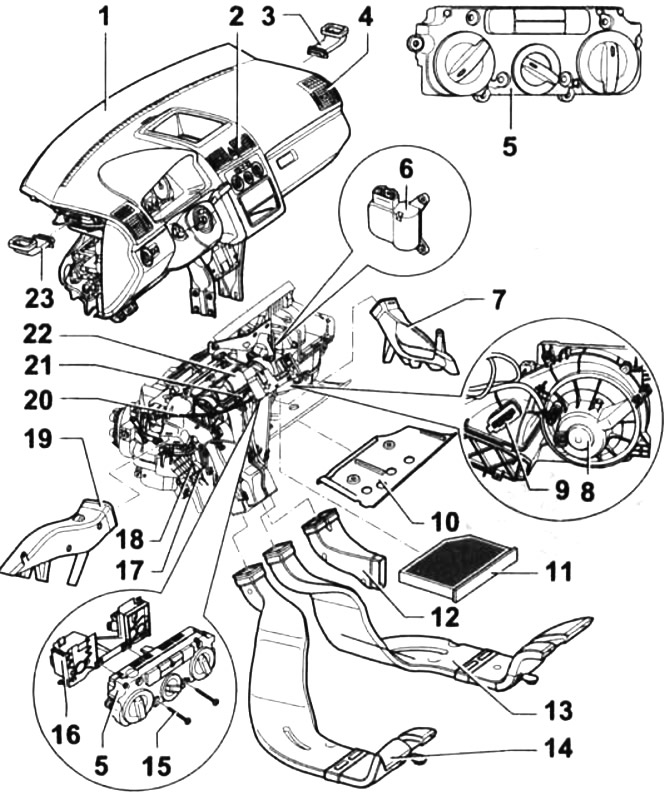
Heater. Golf cars

Heater. Golf cars
1 - instrument panel
2 - central deflector
3 - right side deflector air duct
4 - side (right) deflector
5 - heater control unit
6 - air intake flap actuator
7 - butt space air deflector
8 - fan motor
9 - additional resistance of the electric motor with a fuse against overheating
10 - Protective cover of the heater. Fastened with two plastic bolts
11 - dust filter (cabin filter).
12 - connecting pipe of air duct of deflector on the central console
13 - right air duct for blowing the rear part of the cabin
14 - left air duct for blowing the rear part of the cabin
15 - 8 screws for mounting the heater control unit
16 - control unit adapter
17- additional heater preheater. Only for vehicles with diesel engine
18 - heater radiator
19 - floor air vent on the left side of the cabin
20 - air temperature regulator flap drive cable
21 - flexible shaft of the air temperature regulator flap
22 - heating element
23 - left side deflector air duct


If, for example, due to pollution of the outside air it is necessary to switch off its intake, then the air recirculation mode can be maintained in the car's interior, i.e. only the air in the interior will be used. To do this, the recirculation mode is switched on by the corresponding button. When the button is pressed, the recirculation mode actuator is switched on.

In Golf/Touran vehicles with a diesel engine, the air for heating the interior is heated more slowly. Therefore, a coolant heating unit with a positive temperature coefficient is built into the coolant circulation circuit. This heater additionally heats the coolant at low air temperatures. After starting the engine, the heater quickly heats the air in the heater depending on the air temperature.

If any faults or malfunctions occur in the heating or air conditioning system, they are registered by the self-diagnosis system and can be read using a diagnostic tester.

Attention! If, as part of the work on the heater, it is necessary to perform actions concerning the electrical system, it is mandatory to disconnect the terminal of the ground wire (-) from the negative pole of the battery. Even the simple disconnection of a wire or connecting terminal is considered work with electrical equipment.


Cars with air conditioning


Golf/Touran cars can be additionally equipped with an air conditioner, which serves both as a heater and as an air conditioning system.

In air conditioning mode, the air conditioner operates on the principle of a refrigerator.


The compressor compresses gaseous, environmentally friendly and ozone-depleting layer-free freon refrigerant R-134A.

As a result, the refrigerant heats up and enters the cooler, where it is cooled and liquefied. Through the pressure reducing valve, the refrigerant is fed to the evaporator, where the resulting liquid again passes into a gaseous state. In this case, it is strongly cooled.

As a result of the evaporation process and the transition of the refrigerant into a liquid state, the air taken from outside is cooled, and the moisture contained in the air turns into condensate.

The intensity of air cooling depends on the set temperature and the speed of the interior air blower.

Warning! Do not open the air conditioner refrigerant circulation system. Contact with the coolant on the skin causes frostbite. If the refrigerant comes into contact with the skin, rinse the skin with cold water immediately for at least 15 minutes. The refrigerant is colorless, odorless, and heavier than air. If the refrigerant leaks, people in the area of the floor on which the vehicle is installed or in rooms located below the leak may suffocate.


When the air conditioner is off, the compressor does not work, which reduces fuel consumption.

In addition, in cars with a diesel engine, the additional heater is switched off, which also has a beneficial effect on fuel consumption.

It is recommended to turn on the air conditioner for a while at least once a month and in the cold season, setting the most intensive mode of operation when driving with normal grayness and with a warmed-up engine. This causes the refrigerant to circulate, and the lubricant contained in it to the parts, preventing their porosity or other damage.

Attention! Work on the air conditioner must be performed in a specialized workshop. For this reason, air conditioner repair is not included in this manual.


On request, Golf/Touran cars can be equipped with automatic air conditioning (Climatronic).

The automation ensures that a constant temperature is maintained in the cabin and the air is dried, which prevents the windows from fogging up.

The volume of air supplied to the passenger compartment and its distribution throughout the passenger compartment are also performed automatically, taking into account fluctuations in outside air temperature. When switching to the economical operating mode, the air conditioner is switched off, but the heating of the passenger compartment and its blowing are performed automatically.

This article is available at russian, bulgarian, belarusian, ukrainian, serbian, croatian, romanian, polish, slovak, hungarian
The text has been checked: Kolesnikov Artem

Share information:

Previous articles
Radiator Blower Fan — Removal and Installation
Radiator — removal and installation
Water pump — removal and installation
Thermostat — check
Thermostat — removal and installation
Coolant — Replacement
Next articles
Outside Air Temperature Sensor — Removal and Installation
Central deflector — removal and installation
Side deflectors — removal and installation
Interior air deflectors — removal and installation
Heater/Air Conditioner Control Unit — Removal and Installation
Temperature control flap traction cable removal and installation


Similar articles from other manuals for VW cars:
Heater and air conditioner control unit Passat B5 (1996-2005)
Checking the oxygen sensor heater Polo 3 (1995-2003)
Removal and installation the heater and air conditioning control… Tiguan 1 (2007-2015)
Heater motor — removal and installation Transporter T4 (1990-2003)
2.0L BDJ engine cooling system with independent heater Caddy 3 (2003-2010)
Link to this page in different formats


Visitor comments


No comments yet


How much will 18 + 46 =


Golf 5 
  • General information
  • User manual
  • Maintenance
  • Troubleshooting
  • Power unit
  • Engine repair
  • Cooling and ventilation system
  • Fuel system
  • Ignition system
  • Transmission
  • Clutch
  • Mechanical gearbox
  • Automatic gearbox
  • Chassis
  • Brake system
  • Car suspension
  • Steering
  • Body
  • Interior (internal elements)
  • Exterior (external elements)
  • Doors and covers
  • Electrical equipment
  • Power devices
  • Washers and wipers
  • Lighting and appliances
  • Electrical circuits
Golf 4 
  • General information
  • User manual
  • Weekly checks
  • Maintenance
  • Power unit
  • Petrol engines
  • Diesel engines
  • Cooling system
  • Fuel system (petrol)
  • Control system (petrol)
  • Fuel system (diesel)
  • Exhaust system
  • Transmission
  • Clutch
  • Car gearbox
  • Drive shafts
  • Chassis
  • Car suspension
  • Steering
  • Wheels and tires
  • Brake system
  • Body
  • Exterior (external elements)
  • Interior (internal elements)
  • Ventilation and heating
  • Car doors and sunroof
  • Washers and glass cleaners
  • Electrical equipment
  • Power devices
  • Lighting and appliances
  • Electrical circuits
Golf 3 
  • Petrol engine
  • Engine repair
  • Lubrication system
  • Cooling system
  • Ignition system
  • Diesel engine
  • Engine repair
  • Diesel injection system
  • Pre-glow system
  • Transmission
  • Clutch
  • Gearbox and drive shafts
  • Chassis
  • Steering
  • Wheels and suspension
  • Brake system
  • Electrical equipment
  • Lighting and appliances
  • Electrical circuits
Golf 2 
  • General information
  • Introduction to guide
  • User manual
  • Petrol engines 1.3 l
  • Engine repair
  • Lubrication system
  • Cooling system
  • Carburetors
  • Supply system
  • Ignition system
  • Petrol engines 1.6/1.8 l
  • Engine repair
  • Supply system
  • Ignition system
  • Diesel engines
  • Engine repair
  • Lubrication system
  • Cooling system
  • Power and exhaust system
  • Transmission
  • Clutch
  • 4-speed gearbox 084
  • 5-speed gearbox 085
  • 4-speed gearbox 020/4R
  • 5-speed gearbox 020/4T
  • Automatic gearbox
  • Drive shafts
  • Chassis
  • Steering
  • Car suspension
  • Brake system
  • Body
  • Body elements
  • Doors, locks and windows
  • Electrical equipment
  • Equipment and devices
  • Power devices
Golf 2 (petrol) 
  • General information
  • Characteristics
  • Car care
  • Maintenance
  • Power unit
  • Engine repair
  • Engine 1.05/1.30
  • Engine 1.60/1.80
  • Cooling and lubrication system
  • Power and exhaust system
  • Transmission
  • Clutch
  • Car gearbox
  • Drive shafts
  • Chassis
  • Brake system
  • Steering
  • Suspension
  • Body
  • Body and equipment
  • Electrical equipment
  • Lighting and appliances
  • Electrical circuits
Golf 1 (petrol) 
  • General information
  • Characteristics
  • User manual
  • Maintenance
  • Power unit
  • Engine adjustment
  • Engine 1.1/1.3
  • Engine 1.5/1.6/1.8
  • Engine electrical equipment
  • Cooling system
  • Fuel system
  • Transmission
  • Clutch and manual gearbox
  • Automatic gearbox
  • Chassis
  • Steering
  • Front suspension
  • Rear suspension
  • Brake system
  • Electrical equipment
  • Lighting and appliances
  • Electrical circuits
  • Body
  • Body and equipment
  • Optional equipment
Golf 1 (diesel) 
  • General information
  • Specifications
  • Maintenance
  • Power unit
  • Engine repair
  • Exhaust and turbocharger
  • Cooling system
  • Fuel system
  • Fuel injection system
  • Transmission
  • Clutch and drive shafts
  • Car gearbox
  • Chassis
  • Suspension and wheels
  • Steering
  • Brake system
  • Wheels and tires
  • Body
  • Heating and ventilation
  • Exterior (external elements)
  • Interior (internal elements)
  • Doors and windows
  • Electrical equipment
  • Equipment and devices
  • Lighting system
  • Power devices
  • Electrical circuits
VWmanual.ru © 2016-2026 | Mobile version | News and articles | Sitemap: EN BG BY UA RS HR RO PL SK HU | Write message | Site search
Passat B2 • Passat B3 • Passat B4 • Passat B5 • Passat B6 • Golf 1, diesel • Golf 1, petrol • Golf 2, petrol • Golf 2 • Golf 3 • Golf 4 • Golf 5 • Polo 3 • Polo 4 • Touareg 1 • Tiguan 1 • Sharan 1 • Transporter T3 • Transporter T4 • LT 28 • LT 2D • Beetle • Caddy 3 •
Our website uses cookies to ensure functionality and convenience.