
English Русский
Български
Беларускі
Український
Српски
Hrvatski
Română
Polski
Slovenský
Magyar
  |  Articles  |  Sitemap  |  Contacts  |    |
Car maintenance Ford Car maintenance Hyundai Car maintenance Chevrolet Car maintenance BMW Car maintenance Audi Car maintenance Opel Car maintenance AvtoVAZ
VWmanual.ru


Main   Passat   Golf   Polo   Touareg   Tiguan   Sharan   Transporter   Others  
Golf 1 (1974-1984, diesel) Golf 1 (1974-1984, petrol) Golf 2 (1984-1993, petrol) Golf 2 (1984-1993) Golf 3 (1991-1997) Golf 4 (1997-2004) Golf 5 (2003-2008)

Dismantling and installation of shock absorber struts (VW Golf 3)

  • Main
  • Golf
  • Golf 3
  • Chassis
  • Wheels and suspension
  • Dismantling and installation of shock absorber struts
            0


Unscrew the nuts on the end of the piston rod. When unscrewing the nut, hold the piston rod. A fork-type wrench might be useful for this, if you can get it to the end of the piston rod.

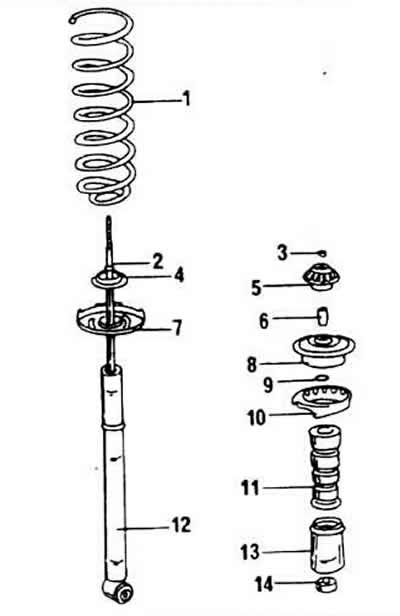
1 - helical spring

1 - helical spring
2 - retaining ring (spring)
3 - nut, 15 Nm
4 - lining
5 - lower rubber support
6 - spacer sleeve
7 - lower spring seat
8 - shock absorber support
9 - disk
10 - upper spring seat
11 - elastic rubber part
12 - shock absorber
13 - protective cuff
14 - protective cap


Remove the expansion sleeve, upper spring seat, disc, spring support and the spring itself, as well as the second spring support and its lower seat from the shock absorber.

The article is published on this resource (www.VWMANUAL.ru)

Remove the rubber stop, protective cap, snap ring and second disc from the bottom of the shock absorber.

Coil springs are provided with color markings; different models use different springs. In the models described, the springs are marked with three yellow stripes (two-door Golf) or three yellow and one purple stripe. However, sometimes the markings are changed and springs supplied as spares may have different markings. It is necessary to install a spring with the same color marking sign, which, as already mentioned, has three or four stripes of the mentioned color. Only the rear spring can be replaced without disturbing the balance of the rear suspension.


The shape of the rubber stop located on the upper side of the shock absorber may vary; when replacing it, it is necessary to install a stop of the same shape.

Check the shock absorber by pulling the piston rod out and then back in. The reaction force should be the same throughout the entire working stroke, and there should be no free play. Although you should not change the shock absorber if there are small oil leaks - this is a sign that the shock absorber is working perfectly. Shock absorbers are marked with color markings. As with springs, it is imperative to install a shock absorber with the same marking mark.

The shock absorber strut assembly is carried out in the reverse order of the disassembly operation; the following points must be taken into account.
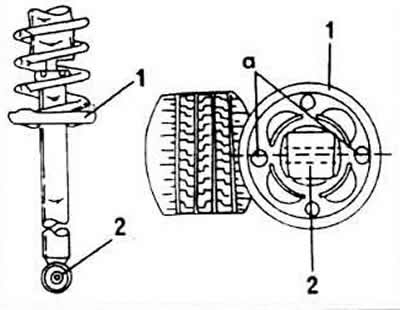
The shock absorber strut assembly is carried out in the reverse order of the disassembly operation;…


In case the lower spring seat (placed on the shock absorber) removed, move the socket onto the piston rod and center it. This means that the holes (a) are in line with the hole at the bottom end of the shock absorber. If this is not observed, it could come into contact with the tire under extreme operating loads.
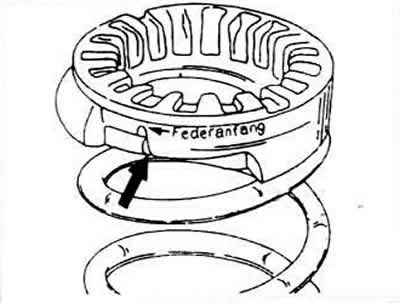
In case the lower spring seat (placed on the shock absorber) removed, move the socket onto the…


Place the spring on the shock absorber with the tapered end first.


The spring socket on one side is marked with the word "Spring start" ("Federanfang"). Bring this side to the end of the winding.

Tighten the nut on the top side to a torque of 15 Nm. Make sure that the upper and lower ends of the spring are seated in the sockets.

This article is available at russian, bulgarian, belarusian, ukrainian, serbian, croatian, romanian, polish, slovak, hungarian
The text has been checked: Medvedeva Elena

Share information:

Previous articles
Removal and installation the rear axle
Rear suspension. General information
Dismantling and installation of individual suspension parts
Assembling the shock absorber strut
Repair of shock absorber strut
Disassembling the shock absorber strut
Next articles
Rear wheel bearings
Geometric design of the rear wheels


Similar articles from other manuals for VW cars:
Removal and installation the front shock absorber strut Passat B3 (1988-1993)
Shock absorber strut Polo 3 (1995-2003)
Removal and installation of the G78/G289 body level sensor on… Touareg 1 (2002-2006)
The structure of the shock absorber strut Tiguan 1 (2007-2015)
Coil spring and shock absorber Sharan 1 (1995-2000)
Throttle body Shock Absorber Transporter T4 (1990-2003)
Front suspension brake components on shock absorber struts Beetle (1960-1986)
Link to this page in different formats


Visitor comments


No comments yet


How much will 12 + 15 =


Golf 5 
  • General information
  • User manual
  • Maintenance
  • Troubleshooting
  • Power unit
  • Engine repair
  • Cooling and ventilation system
  • Fuel system
  • Ignition system
  • Transmission
  • Clutch
  • Mechanical gearbox
  • Automatic gearbox
  • Chassis
  • Brake system
  • Car suspension
  • Steering
  • Body
  • Interior (internal elements)
  • Exterior (external elements)
  • Doors and covers
  • Electrical equipment
  • Power devices
  • Washers and wipers
  • Lighting and appliances
  • Electrical circuits
Golf 4 
  • General information
  • User manual
  • Weekly checks
  • Maintenance
  • Power unit
  • Petrol engines
  • Diesel engines
  • Cooling system
  • Fuel system (petrol)
  • Control system (petrol)
  • Fuel system (diesel)
  • Exhaust system
  • Transmission
  • Clutch
  • Car gearbox
  • Drive shafts
  • Chassis
  • Car suspension
  • Steering
  • Wheels and tires
  • Brake system
  • Body
  • Exterior (external elements)
  • Interior (internal elements)
  • Ventilation and heating
  • Car doors and sunroof
  • Washers and glass cleaners
  • Electrical equipment
  • Power devices
  • Lighting and appliances
  • Electrical circuits
Golf 3 
  • Petrol engine
  • Engine repair
  • Lubrication system
  • Cooling system
  • Ignition system
  • Diesel engine
  • Engine repair
  • Diesel injection system
  • Pre-glow system
  • Transmission
  • Clutch
  • Gearbox and drive shafts
  • Chassis
  • Steering
  • Wheels and suspension
  • Brake system
  • Electrical equipment
  • Lighting and appliances
  • Electrical circuits
Golf 2 
  • General information
  • Introduction to guide
  • User manual
  • Petrol engines 1.3 l
  • Engine repair
  • Lubrication system
  • Cooling system
  • Carburetors
  • Supply system
  • Ignition system
  • Petrol engines 1.6/1.8 l
  • Engine repair
  • Supply system
  • Ignition system
  • Diesel engines
  • Engine repair
  • Lubrication system
  • Cooling system
  • Power and exhaust system
  • Transmission
  • Clutch
  • 4-speed gearbox 084
  • 5-speed gearbox 085
  • 4-speed gearbox 020/4R
  • 5-speed gearbox 020/4T
  • Automatic gearbox
  • Drive shafts
  • Chassis
  • Steering
  • Car suspension
  • Brake system
  • Body
  • Body elements
  • Doors, locks and windows
  • Electrical equipment
  • Equipment and devices
  • Power devices
Golf 2 (petrol) 
  • General information
  • Characteristics
  • Car care
  • Maintenance
  • Power unit
  • Engine repair
  • Engine 1.05/1.30
  • Engine 1.60/1.80
  • Cooling and lubrication system
  • Power and exhaust system
  • Transmission
  • Clutch
  • Car gearbox
  • Drive shafts
  • Chassis
  • Brake system
  • Steering
  • Suspension
  • Body
  • Body and equipment
  • Electrical equipment
  • Lighting and appliances
  • Electrical circuits
Golf 1 (petrol) 
  • General information
  • Characteristics
  • User manual
  • Maintenance
  • Power unit
  • Engine adjustment
  • Engine 1.1/1.3
  • Engine 1.5/1.6/1.8
  • Engine electrical equipment
  • Cooling system
  • Fuel system
  • Transmission
  • Clutch and manual gearbox
  • Automatic gearbox
  • Chassis
  • Steering
  • Front suspension
  • Rear suspension
  • Brake system
  • Electrical equipment
  • Lighting and appliances
  • Electrical circuits
  • Body
  • Body and equipment
  • Optional equipment
Golf 1 (diesel) 
  • General information
  • Specifications
  • Maintenance
  • Power unit
  • Engine repair
  • Exhaust and turbocharger
  • Cooling system
  • Fuel system
  • Fuel injection system
  • Transmission
  • Clutch and drive shafts
  • Car gearbox
  • Chassis
  • Suspension and wheels
  • Steering
  • Brake system
  • Wheels and tires
  • Body
  • Heating and ventilation
  • Exterior (external elements)
  • Interior (internal elements)
  • Doors and windows
  • Electrical equipment
  • Equipment and devices
  • Lighting system
  • Power devices
  • Electrical circuits
VWmanual.ru © 2016-2026 | Mobile version | News and articles | Sitemap: EN BG BY UA RS HR RO PL SK HU | Write message | Site search
Passat B2 • Passat B3 • Passat B4 • Passat B5 • Passat B6 • Golf 1, diesel • Golf 1, petrol • Golf 2, petrol • Golf 2 • Golf 3 • Golf 4 • Golf 5 • Polo 3 • Polo 4 • Touareg 1 • Tiguan 1 • Sharan 1 • Transporter T3 • Transporter T4 • LT 28 • LT 2D • Beetle • Caddy 3 •
Our website uses cookies to ensure functionality and convenience.