



- terminal 53 receives voltage for the first speed of the windshield wiper;
- terminal 53a supplies current to allow the windscreen wipers to reach their end positions (stop);
- terminal 53b provides voltage for the brushes to move at 2 speeds;
- via terminal 53e, the wiper motor is slowed down during reverse movement after switching off, so that the wipers do not go beyond their end positions.
If the windscreen wipers are not in the end positions when switched off, their motor receives voltage from terminal 53a via a sliding contact until the windscreen wipers are in the end positions.
Note: When the ignition is on, the windscreen wiper blades must not be blocked beyond their end positions (for example, due to snow or freezing). Then terminal 53a continuously supplies voltage. Since the wiper motor cannot operate due to blocked brushes, it burns out after a certain time, in which case the brushes must be raised so that they can be in the desired end positions.
Removal the windshield wiper motor
Open the engine hood.
Remove the windshield wiper motor connector.
Move the right and left drive rods off the crank lever.
Remove the 3 engine mounting screws.
Remove the windshield wiper motor.
Before installing a new motor, connect the connector and let the motor run for a few minutes. When disconnected, it stops and the windshield wipers are in their end positions.
The original text can be found at www.VWMANUAL.ru
The crank arm in the Golf and Jetta models should be installed as shown in the figure on the right.
During installation, lubricate the hinges with MoS2 grease.
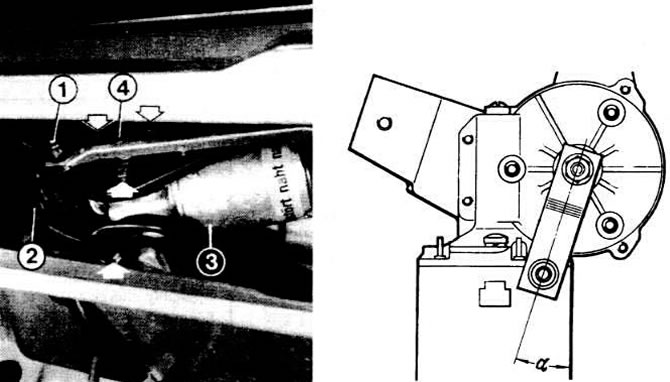
Left: Windscreen wiper motor (3): 1 - crank arm; 2 - rubber cover over the multi-pin connector; 4 - Windscreen wiper motor drive shaft. Arrows indicate screws that need to be unscrewed during dismantling.
Right: This is how the crank should be installed when the wiper motor is in the stopped position. The angle α is 20°.
Visitor comments