
English Русский
Български
Беларускі
Український
Српски
Hrvatski
Română
Polski
Slovenský
Magyar
  |  Articles  |  Sitemap  |  Contacts  |    |
Car maintenance Ford Car maintenance Hyundai Car maintenance Chevrolet Car maintenance BMW Car maintenance Audi Car maintenance Opel Car maintenance AvtoVAZ
VWmanual.ru


Main   Passat   Golf   Polo   Touareg   Tiguan   Sharan   Transporter   Others  
Passat B2 (1981-1988) Passat B3 (1988-1993) Passat B4 (1988-1996) Passat B5 (1996-2005) Passat B6 (2005-2010)

Inflatable airbag system (VW Passat B5)

  • Main
  • Passat
  • Passat B5
  • General information
  • User manual
  • Inflatable airbag system
            0


Contents: Front airbags ↓ System action ↓ Disabling the front passenger airbag ↓ Side airbags ↓

Front airbags


The front airbag system, in conjunction with the three-point seat belts, provides additional protection for the head and upper body of the driver and front seat passenger in the event of a serious frontal collision.

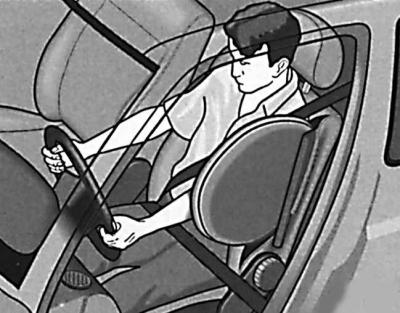
Warning: The maximum protective effect of seat belts and air bags is achieved only if the seats are correctly adjusted.


The front airbag system will not deploy if:
  • side impacts,
  • impacts to the rear of the car,
  • capsizing,
  • weak frontal impacts.

The airbag system is in no way a substitute for seat belts, but is an essential component of the overall concept of passive safety of the vehicle. Please remember that the greatest efficiency of the airbags is achieved only when used in conjunction with the seat belts.
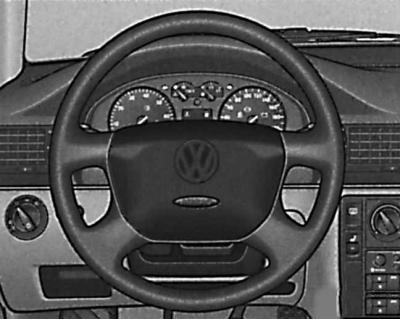
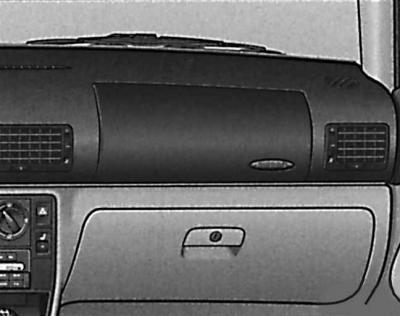
The airbag system is in no way a substitute for seat belts, but is an essential component of the…


The airbag system is in no way a substitute for seat belts, but is an essential component of the…


The airbag system consists of the following main components and parts:


  • electronic device for controlling the system and monitoring the functional readiness of the system (control unit);
  • two airbags (air bags with gas generator) for: driver (in the steering wheel); front passenger (in the instrument panel);
  • control lamp on the instrument cluster.

The functional readiness of the airbag system is monitored by an electronic device.

Each time the ignition is turned on, the airbag system indicator lamp comes on for approximately 3 seconds (self-check).

The following indicates a violation of the functional readiness of the system:
  • when the ignition is turned on, the control lamp does not light,
  • approximately 3 seconds after turning on the ignition, the indicator lamp does not go out,
  • after turning on the ignition, the control lamp goes out and then starts to glow again,
  • while driving the indicator lamp lights up or flickers.


Warning: If a system malfunction is detected, it is essential to have the system checked by a Volkswagen service centre. Otherwise, there is a risk that the airbags will not operate properly if necessary.


System action


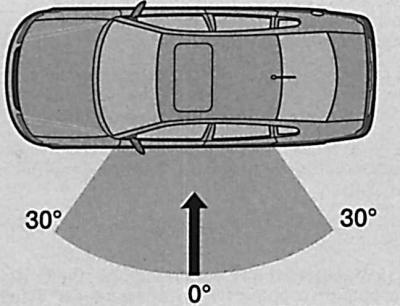
The airbag system is designed to deploy in severe frontal collisions.

The dimensions of the frontal collision direction sector at which the system is triggered are shown in the figure.
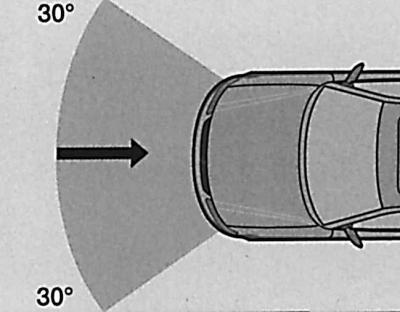
The dimensions of the frontal collision direction sector at which the system is triggered are shown…


When the system is activated, the air bags are filled with working gas and, as they inflate, deploy in front of the driver and passenger.


By placing the driver and front passenger into fully inflated air bags, their forward momentum is dampened and the risk of head and upper body injuries is significantly reduced.

The air bag is designed so that in a frontal impact, the body load of the driver or passenger seated next to him causes a controlled release of gas from the bag to soften the impact of the head and upper body on the inflatable bag. After the collision, the air bag is so empty that it does not interfere with forward visibility.

The air bag fills at high speed in a matter of seconds, which provides reliable protection in the event of an accident.

When the airbags inflate, a small amount of fine dust will appear in the cabin. This is completely normal and should not be a cause for concern.

Disabling the front passenger airbag


In your vehicle, you can turn off the front passenger airbag, for example, when a rear-facing child seat is installed in the front passenger seat.

The functional readiness of the airbag system is monitored electronically even when the front passenger airbag is deactivated.

Each time the ignition is turned on, the air bag system indicator lamp comes on for approximately 3 seconds and then starts flashing for 12 seconds (self-check).

The following indicates a violation of the functional readiness of the system:
  • when the ignition is turned on, the indicator lamp does not light up or does not flash,
  • after turning on the ignition, the control lamp does not go out after the above-mentioned time,
  • after turning on the ignition, the control lamp goes out and then starts to glow again,
  • while driving, the indicator lamp lights up, flickers or blinks.

Side airbags
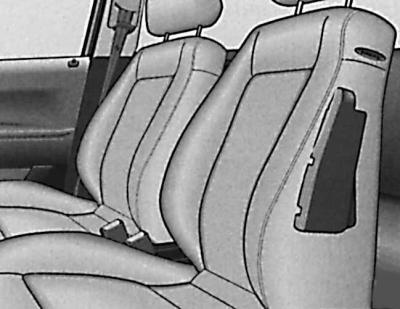


Side airbags


The side airbags are located in the front seat back cushions and you can identify them by the "AIRBAG" inscription on the upper part of the rear side of the seat backs.

The side airbag system, in conjunction with the three-point seat belts, provides additional protection for the upper body of the driver and front passenger in the event of a serious side collision.

The side airbag system will not deploy if:
  • frontal impacts,
  • weak side impacts,
  • impacts to the rear of the car,
  • capsizing.

The side airbag system consists of the following main components and parts:
  • electronic device for controlling the system and monitoring the functional readiness of the system (control unit),
  • airbags on the sides of the rear side of the front seat backs,
  • control lamp on the instrument cluster.

In case of severe side impacts, the airbag on the side of the collision is deployed.
In case of severe side impacts, the airbag on the side of the collision is deployed.

In case of severe side impacts, the airbag on the side of the collision is deployed.


In special, combined types of collisions, both front and side airbags may deploy.

Warning: All work on side airbags, as well as installation and dismantling of devices of this system during other work (for example, when removing the front seats) must only be performed by a Volkswagen service centre. Otherwise, the side airbag system may not function properly.


Warning: No person, animal or other object should be placed between the front passenger and the airbag. Also, no accessories, such as cup holders, should be attached to the doors.


Warning: Only small and light items of clothing should be hung on coat hooks. No heavy items or items with sharp edges should be placed in small item pockets.


Warning: Never use any front seat covers that are not recommended by Volkswagen. Otherwise, when the side airbags deploy, their protective effect will be significantly reduced due to the use of non-recommended covers.


Warning: Each airbag system will only deploy once. If this occurs, the system must be replaced.

This article is available at russian, bulgarian, belarusian, ukrainian, serbian, croatian, romanian, polish, slovak, hungarian
The text has been checked: Tarasov Ivan

Share information:

Previous articles
Seat belts
Rear view mirrors
Electric window control
Remote control of locks
Trunk lid (rear door of the station wagon)
Doors, central locking
Next articles
Seat headrests
Front seats
Front seats (manual adjustment)
Front seats (electrically adjustable)
Memory for driver's seat
Memorizing seat and exterior mirror adjustments for forward movement


Similar articles from other manuals for VW cars:
Operation of the side airbag system Golf 4 (1997-2004)
Steering system/ inflatable airbag Polo 4 (2001-2009)
Emergency alarm system Touareg 1 (2002-2006)
Removal and installation of lubrication system elements Tiguan 1 (2007-2015)
Checking the operation of the lighting system Sharan 1 (1995-2000)
Headlight Wash System Transporter T4 (1990-2003)
ESP stabilization system and ASR traction control system Caddy 3 (2003-2010)
Link to this page in different formats


Visitor comments


No comments yet


How much will 29 + 38 =


Passat B6 
  • General information
  • User manual
  • Maintenance
  • Petrol engine 1.6L
  • Engine repair
  • Cooling and lubrication system
  • Fuel injection system
  • Petrol engine 2.0L
  • Engine repair
  • Lubrication system
  • Cooling system
  • Fuel and exhaust systems
  • Diesel engine 2.0L
  • Engine repair
  • Cooling and lubrication system
  • Fuel and exhaust systems
  • Transmission
  • Clutch
  • Mechanical gearbox
  • Automatic gearbox
  • Drive shafts
  • Chassis
  • Wheels and tires
  • Car suspension
  • Steering
  • Brake system
  • Body
  • Exterior (external elements)
  • Electrical equipment
  • Power devices
  • Lighting and appliances
  • Electrical circuits
Passat B5 
  • General information
  • User manual
  • Weekly checks
  • Maintenance
  • Power unit
  • Engine repair
  • Cooling system
  • Fuel system (petrol)
  • Fuel system (diesel)
  • Engine management
  • Exhaust system
  • Transmission
  • Clutch
  • Car gearbox
  • Drive shafts
  • Chassis
  • Car suspension
  • Wheels and tires
  • Steering
  • Brake system
  • Body
  • Exterior (external elements)
  • Interior (internal elements)
  • Doors and covers
  • Ventilation and heating
  • Electrical equipment
  • Power devices
  • Lighting and appliances
  • Electrical circuits
Passat B4 
  • General information
  • User manual
  • Maintenance
  • Technical data
  • 8-valve engine
  • Engine repair
  • Cooling and lubrication system
  • Supply system
  • Ignition system
  • Fuel injection «Mono-Jetronic»
  • Control system «Mono-Motronic»
  • Control system «Digifant»
  • Control system «Simos»
  • 16-valve engine
  • Engine repair
  • Cooling and lubrication system
  • Fuel injection «K-Jetronic»
  • Control system «KE-Motronic»
  • Control system «Digifant»
  • Diesel engine
  • Engine repair
  • Cooling and lubrication system
  • Power and control system
  • Turbocharging system
  • Digital control system
  • Transmission
  • Clutch
  • Manual gearbox
  • Hydromechanical gearbox
  • Front wheel drive
  • Chassis
  • Car suspension
  • Steering
  • Brake system
  • Body
  • Body elements
  • Electrical equipment
  • Power devices
  • Lighting and appliances
  • Electrical circuits
Passat B3 
  • General information
  • User manual
  • Driving Tips
  • Maintenance instructions
  • Technical data
  • Power unit
  • Engine repair
  • Ignition system
  • Lubrication system
  • Cooling system
  • Supply system
  • Petrol injection system
  • Diesel engine
  • Exhaust system
  • Transmission
  • Clutch
  • Car gearbox
  • Chassis
  • Suspension
  • Steering
  • Brake system
  • Wheels and tires
  • Body
  • Exterior
  • Interior
  • Heating system
  • Electrical equipment
  • Power devices
  • Lighting system
  • Equipment and devices
  • Wiper system
  • Electrical circuits
Passat B2 
  • General information
  • Introduction to instructions
  • User manual
  • Power unit
  • Engines 4-cylinder FZ
  • Engines 4-cylinder
  • Engines 5-cylinder
  • Transmission
  • Clutch
  • Four-speed gearbox
  • Five-speed gearbox
  • Hydromechanical gearbox
  • Front wheel drive
  • Chassis
  • Front suspension
  • Rear suspension
  • Steering
  • Brake system
  • Body
  • Body elements
  • Electrical equipment
  • Equipment and devices
  • Electrical circuits
VWmanual.ru © 2016-2026 | Mobile version | News and articles | Sitemap: EN BG BY UA RS HR RO PL SK HU | Write message | Site search
Passat B2 • Passat B3 • Passat B4 • Passat B5 • Passat B6 • Golf 1, diesel • Golf 1, petrol • Golf 2, petrol • Golf 2 • Golf 3 • Golf 4 • Golf 5 • Polo 3 • Polo 4 • Touareg 1 • Tiguan 1 • Sharan 1 • Transporter T3 • Transporter T4 • LT 28 • LT 2D • Beetle • Caddy 3 •
Our website uses cookies to ensure functionality and convenience.