



There is no play in the rack and pinion steering drive when turning the steering wheel all the way to the right or left; it does not require any maintenance, except for checking the condition of the bellows and tie rod ends as part of the maintenance. Steering the wheels is made easier by the hydraulic power steering. The hydraulic power steering helps to ensure that the effort required to turn the steered wheels is as low as possible. The power steering consists of an electrically driven oil pump, an oil reservoir located above it, and pipes. The pump and oil reservoir are located on the left behind the front bumper and are accessible after removing the wheel arch trim. The pump takes oil from the reservoir and delivers it under high pressure to a valve located in the steering gear housing. The valve is mechanically connected to the steering column and directs the oil, depending on the position of the steered wheels, to the appropriate chamber of the working cylinder in the steering gear housing. Here the oil presses on a piston connected to the toothed rack, which helps to reduce the effort applied by the driver to the steering wheel. Checking the oil level in the power steering reservoir is described in the section "Maintenance work".
Safety note: Welding and straightening work on steering components is not permitted. Self-locking and rusty bolts and nuts must always be replaced with new ones in the event of repairs.
Attention: The prescribed tightening torque values for threaded connections must be strictly observed. If you do not have sufficient experience working with the steering system, these must be performed at a service station.
The steering wheel contains an airbag for the driver. It is a folded inflatable bag that, in the event of a frontal collision, fills with gas and protects the driver's upper body and head from impact with the steering wheel. In the event of a sufficiently strong frontal collision, the control unit ignites a small pyropatron in the airbag unit, and the gases formed during the explosion inflate the airbag within a few milliseconds. This time is enough to dampen the impact of the driver rushing forward by inertia. After this, the airbag collapses within a few seconds, as the gases escape through holes in the airbag.
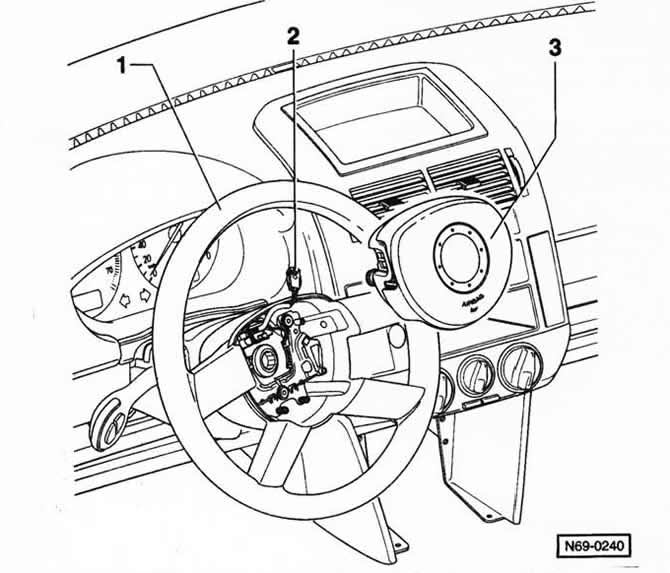
1 - steering wheel
2 — plug
3 — airbag assembly
[The original can be seen on the portal: VWManual.ru]
Visitor comments