



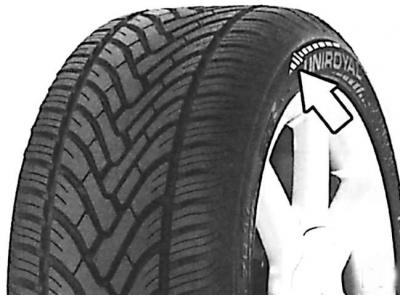
Position of the arrow indicating the direction of rotation of the tire
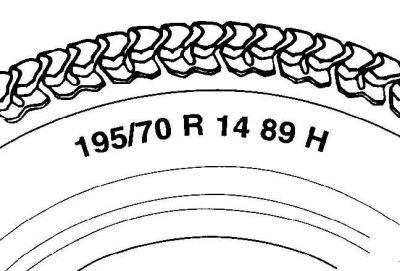
Location of tire markings
Tires and Wheels (on disc wheels) are important elements of the vehicle design.
Mounting and repairing tires requires special tools and professional skills. These jobs should only be performed by professionals.
For reasons of road safety, tires should be replaced not individually, but at least on the axles. The least worn tires should always be installed on the front wheels.
All four wheels should have only radial tires of the same design and size (with the same circumference) and, if possible, the same design of the tire profile. If there is a tread pattern that determines the direction of rotation of the tires, there are arrows on the side surface of the tire (see Fig. Location of the arrow indicating the direction of rotation of the tire). In this case, the direction of rotation of the tire must be strictly observed. This ensures optimal driving characteristics of the tire, its grip on wet road surfaces, and reduces wear and noise generated by the tire. If, when replacing a punctured wheel, a tire is temporarily installed with counter-rotation, its use in this mode should be short-term.
On a four-wheel drive vehicle, in addition, all tires must be the same model from the same manufacturer.
Otherwise, the viscous coupling will undesirably increase the share of traction falling on the rear axle due to the resulting difference in the rotation frequency of the wheels of both axles. This may lead to a breakdown.
Different tread depths of the front and rear tires, for example due to wear, are not so important. However, it is recommended to fit tires with a greater tread depth to the front wheels - if the front tires are worn more than the rear tires, they have a smaller circumference and therefore rotate faster. Therefore, additional stress is created in the transmission, and the tires wear out faster.
If the spare tire is different in design from the other tires on the vehicle (for example, winter or wide-profile), then such a spare wheel should only be used for a short time in the event of failure of one of the vehicle's tires and with corresponding increased caution when driving the vehicle. Instead of such a wheel, the previous wheel should be installed again as soon as possible.
Never install a used tire on your vehicle unless you know where and how it has previously worked.
Knowing the tire markings helps when choosing them (see fig. Location of tire markings). Radial tires have the following markings on the sidewall of the tire, for example:
195/65 R 15 91 T
- 195 - tire profile width, mm
- 65 - ratio of tire height to profile width %
- R - arrangement of carcass cord threads - letter designation for a radial tire
- 15 - rim diameter, inch
- 91 - index of permissible load capacity
- T - speed index
| Speed index | Maximum speed |
| Q | 160 km/h |
| S | 180 km/h |
| T | 190 km/h |
| H | 210 km/h |
| V | 240 km/h |
| W | 270 km/h |
The production date is also indicated on the sidewall of the tire (in some cases only on the inner surface of the tire).
DOT CUL UM8-507 TUBELESS
- DOT - manufacturer
- CU - manufacturer's code designation
- L2 - tire size
- UM8 - tire type
- 507 - date of manufacture (week 50, 1997)
- TUBELESS - tubeless tire (TUBETYPE - chamber).
Wheel rim designation: 6J x 15 are deciphered as follows:
- 6J - rim width in inches;
- J - height of the side edge of the disc;
- x - deep disk;
- 15 - disc landing diameter in inches.
Visitor comments