



Contents: Checking the engine idle speed ↓ Checking fuel pressure ↓ Checking the performance of the fuel…↓ Checking fuel injectors ↓ Checking the throttle position sensor ↓ Checking the mass air flow meter ↓ Checking the intake air temperature…↓ Checking the idle speed control valve ↓ Checking the coolant temperature…↓ Checking the crankshaft position…↓ Checking the oxygen sensor in the…↓ Checking the exhaust gas oxygen…↓ Checking the heating element of the…↓ Checking the purge valve of the…↓ Checking the power relay of the KSUD ↓ Checking the fuel pump relay ↓ Checking the controller ↓ Checking the speed sensor ↓ Timing advance control subsystem ↓ Checking for spark ↓ Checking the ignition unit ↓ Checking the spark timing sensor ↓ Checking the knock sensor ↓ Error codes of the ECU "Motronic…↓
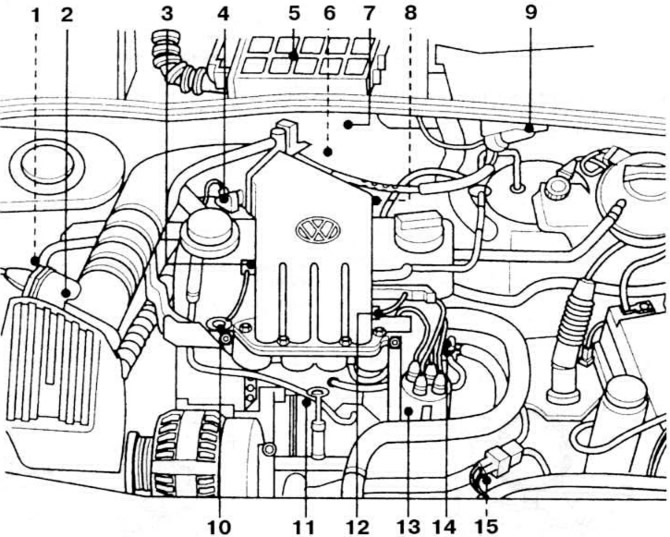
Fig. 1. Location of the components of the KSUD "Motronic 2.9" in the engine compartment: 1 — electromagnetic valve for purging the adsorber; 2 - mass flow meter; 3 - intake air temperature sensor; 4 - throttle position sensor; 5 — controller; 6 - exhaust gas oxygen sensor; 7 — relay for switching on the heating of the oxygen content sensor in the exhaust gases; 8 — idle speed control; 9 — ignition unit (ignition coil with power amplifier output stage); 10 — fuel pressure regulator; 11 - knock sensor; 12 — fuel injectors: 13 — spark timing sensor (hall sensor), integrated ignition distributor; 14 - coolant temperature sensor; 15 — crankshaft angular position sensor.
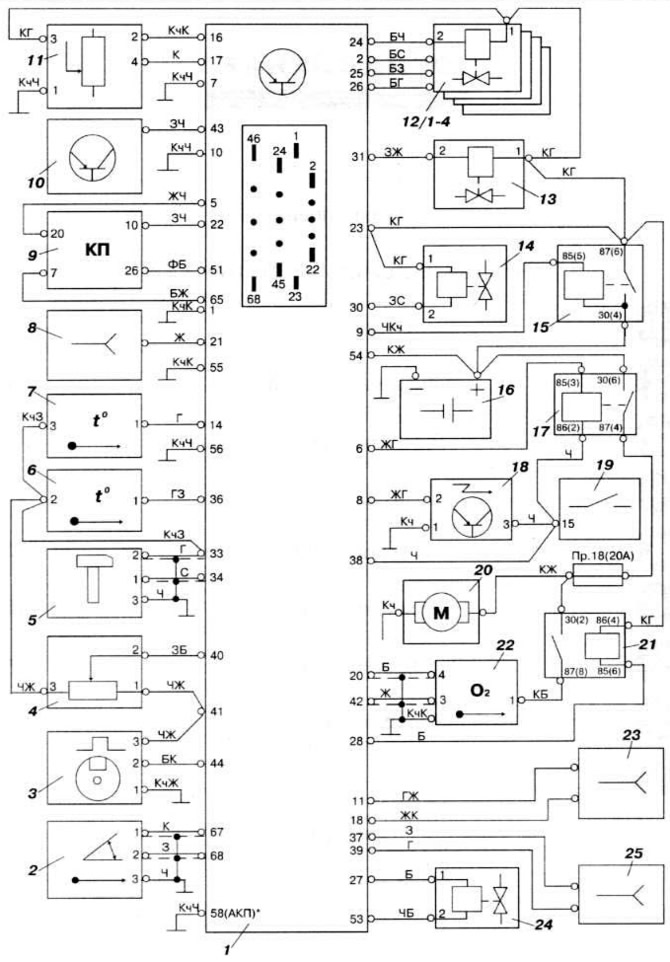
Fig. 20. Electrical diagram of the KSUD "Motronic 2.9" aEK car engine "Passat 1.6": 1 — controller; 2 - crankshaft position sensor; 3 — ignition timing sensor; 4 - throttle position sensor; 5 - knock sensor; 6 — intake air temperature sensor; 7 - coolant temperature sensor; 8 — diagnostic connector; 9 — instrument cluster; 10 — immobilizer control unit; 11 — air mass flow meter; 12/1—4 — injectors; 13 — electromagnetic valve for purging the adsorber; 14 — electromagnetic valve of exhaust gas recirculation; 15 - power relay; 16 — battery; 17 — fuel pump relay; 18 — ignition unit; 19 - ignition switch; 20 — fuel pump; 21 — exhaust gas oxygen sensor relay; 22 — exhaust gas oxygen sensor; 23 — connector; 24 — idle speed controller; 25 — automatic transmission control unit connector.
NOTE: The "AEK" engine is a modification of the "EZ" carburetor engine with KSUD described in the main text "Motronic 2.9", which includes a fuel injection control subsystem that is a distributed fuel injection system with an air mass flow meter and feedback on the oxygen content in the exhaust gases.
Checking the engine idle speed
Before checking the engine idle speed, perform the following operations:
- warm up the engine (oil temperature not less than 80°C);
- check the correct adjustment of the gap between the spark plug electrodes and the setting of the initial ignition timing;
- make sure the air filter element is in good condition;
- turn off all auxiliary electrical equipment and air conditioning;
- on vehicles with automatic transmission, place the selector lever in position "P" or "N".
During the check, do not allow the engine cooling system electric fan to turn on.
Connect the control tachometer according to the operating instructions. Start the engine at idle. Press and release the accelerator pedal sharply, then let the engine idle for 2 minutes and check the crankshaft speed at idle, which should be within 800-880 rpm.
The crankshaft speed at idle is automatically adjusted by the idle speed regulator based on the controller signals and cannot be adjusted manually. If the idle speed does not fit within the specified limits, check for air leaks in the intake tract, and also check the subsystem instruments, electrical wires and their connections.
Connect the gas analyzer according to the operating instructions and check the CO content in the exhaust gases, which should be no more than 0.5%.
The CO content in the exhaust gases is regulated automatically by the controller based on signals from the oxygen content sensor in the exhaust gases and is not subject to manual adjustment.
If the CO content does not correspond to the given value, check the tightness of the intake and exhaust tracts, and also check the subsystem instruments, electrical wires and their connections.
NOTE: The throttle opening is set at the factory and cannot be adjusted during operation.
Checking fuel pressure
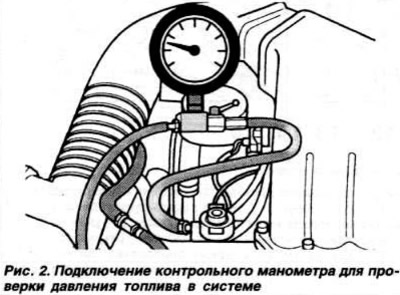
Make sure the ignition is off. Disconnect the fuel supply line from the fuel rail and connect the test pressure gauge hoses to the line opening and the rail branch pipe (Fig. 2). Make sure the pressure gauge valve is open. Start the engine at idle speed. Disconnect the vacuum hose from the fuel pressure regulator and measure the fuel pressure in the system using the pressure gauge; it should be about 3.0 kgf/cm². Connect the vacuum hose to the fuel pressure regulator and measure the fuel pressure in the system using the pressure gauge; it should be about 2.5 kgf/cm². Stop the engine and after 10 minutes determine the residual fuel pressure in the system using the pressure gauge; it should be at least 2.0 kgf/cm².
Checking the performance of the fuel pump supply voltage
Performance testing. Make sure the ignition is off. Disconnect the fuel supply line from the fuel rail. Connect one hose of the test pressure gauge to the line opening, and lower the other hose of the pressure gauge into the measuring vessel. Open the pressure gauge tap. Remove the fuel pump activation relay. Connect terminal "4" (Fig. 3) of the relay block to the "+" terminal of the storage battery using a test cord with a switch and a built-in 16 A fuse. Activate the fuel pump with the switch and, as soon as the fuel pressure on the pressure gauge reaches 3 kgf/cm², close the pressure gauge tap. Turn off the fuel pump with the switch, pour the fuel out of the measuring vessel, then immerse the pressure gauge hose into it again, activate the fuel pump with the switch for 30 s and determine the amount of fuel that has flowed into the vessel, which should be 0.49-0.67 l. Disconnect the control pressure gauge and connect the fuel supply line to the fuel rail.
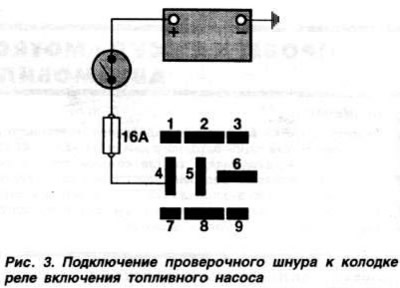
Checking the supply voltage. Turn on the ignition, the fuel pump should turn on for about 1 sec. If this does not happen, turn off the ignition, remove the fuel pump relay, connect the test cord as described above. The fuel pump should work continuously while the test cord switch is on. If the pump does not work, check fuse #18. If it is intact, disconnect the wiring block from the fuel pump. Turn on the test cord switch and measure the presence of battery voltage at terminals "1" and "4" of the block (extreme terminals of the shoe). If there is no voltage, check the wires and their connections in the fuel pump circuit.
Checking fuel injectors
Make sure the ignition is off. Disconnect the wire blocks from the injectors one by one and check the resistance of their windings, which should be within 14.0-21.5 Ohms, then turn the engine crankshaft with the starter and. connecting a voltmeter to one of the injector terminals and "ground", check the injector supply voltage, which should be equal to the battery voltage. If there is no voltage, check the wires and their connections, as well as the KSUD relay. Connect the LED tester to the terminals of the injector wire block, turn the engine crankshaft with the starter, while the tester LED blinks. If this does not happen, check the wires and their connections in the circuit of this injector.
Checking the throttle position sensor
Make sure the ignition is off. Disconnect the throttle position sensor connector, connect an ohmmeter to terminals "1" and "2" of the sensor block (Fig. 4) and check the ohmmeter readings, which should be within 2.5-4.0 kOhm. Slowly open the throttle valve. The resistance on the ohmmeter should gradually decrease.
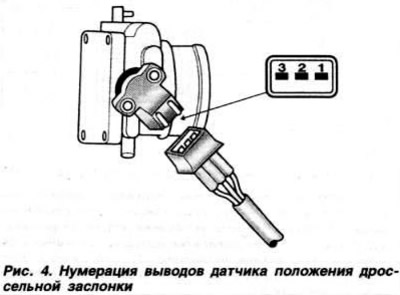
Connect an ohmmeter to terminals "2" and "3" of the sensor block and check its readings, which should be within 1.0-2.0 kOhm. Slowly open the throttle valve. In this case, the resistance on the ohmmeter should smoothly increase. Connect an ohmmeter to terminals "1" and "3" of the sensor block and check its readings, which should be within 1.6-2.4 kOhm.
Turn on the ignition. Connect a voltmeter to terminals "1" and "3" of the sensor wiring block and check the sensor supply voltage, which should be about 5 V. If it does not correspond to this, check the wires and their connections in the sensor circuit.
Checking the mass air flow meter
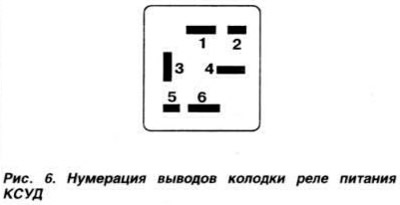
Make sure the ignition is off. Disconnect the measuring instrument connector. Connect an ohmmeter to terminal "1" (Fig. 5) of the measuring instrument and "ground", measure the resistance, which should be zero. Remove the power relay of the KSUD. Connect terminals "4" and "6" (Fig. 6) of the relay block with a jumper to the switch. Turn on the switch and, having connected the voltmeter to terminals "3" and "1" of the measuring instrument, measure its supply voltage, which should be equal to the voltage of the storage battery. If there is a deviation from the norm, check the wires and their connections in the measuring instrument circuit.
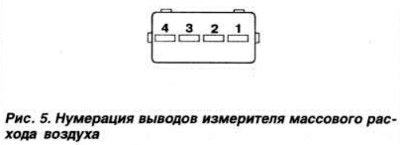
Connect the meter connector. Move the connector protective cover and connect the voltmeter to terminals "4" and "2". Start the engine at idle. Measure the voltage at the terminals of the meter. Press the accelerator pedal sharply two or three times, while the voltmeter needle should fluctuate.
Checking the intake air temperature sensor
Make sure the ignition is off. Disconnect the wiring harness from the sensor. Connect an ohmmeter to the sensor terminals and measure the resistance, which at an ambient temperature of 0°C should be within 5.0-6.5 kOhm, at 10°C - 3.35-4.4 kOhm, at 20°C - 2.25-3.0 kOhm, at 30°C - 1.5-2.1 kOhm, at 40°C - 950-1400 Ohm, at 50°C - 700-950 Ohm, at 60°C - 540-675 Ohm, at 70°C - 400-500 Ohm and at 80°C - 275-375 Ohm
Checking the idle speed control valve
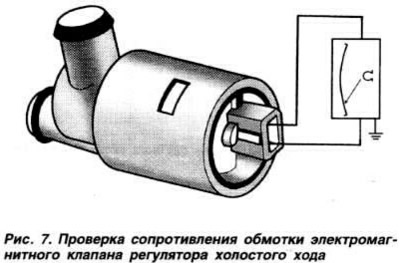
Make sure the ignition is off. Disconnect the regulator connector. Connect an ohmmeter (Fig. 7) to the regulator terminals and measure the resistance of the winding of its electromagnetic valve. It should be within 7-10 Ohms, and on a warmed-up engine (oil temperature not less than 80°C) it can be closer to the upper limit
Checking the coolant temperature sensor
Make sure the ignition is off. Disconnect the coolant temperature sensor connector. Remove the sensor from the engine and immerse it in an electrically heated container filled with coolant. Connect an ohmmeter to terminals "1" and "3" (Fig. 8) of the sensor and check the sensor resistance, which at a coolant temperature of 0°C should be within 5.0-6.5 kOhm, at 10°C — 3.35-4.4 kOhm, at 20°C — 2.25-3.0 kOhm, at 30°C — 1.5-2.1 kOhm, at 40°C — 950-1400 Ohm, at 50°C — 700-950 Ohm, at 60°C — 540-675 Ohm, at 70°C— 400-500 Ohm, at 80°C — 275-375 Ohm, at 90°C — 200-290 Ohm and at 100°C — 150-225 Ohm.
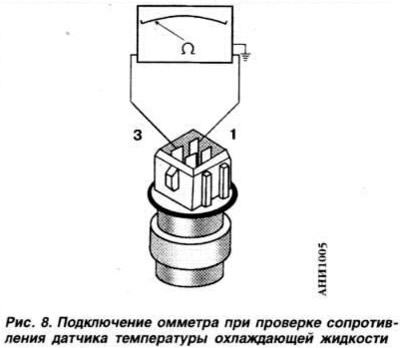
The coolant temperature sensor can be checked without removing it from the engine.
Checking the crankshaft position sensor
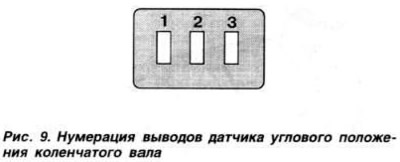
Make sure the ignition is off. Disconnect the wiring harness from the sensor and measure the sensor resistance, which should be 500-700 Ohm when measured between terminals "1" and "2" (Fig. 9), and infinite between terminals "1" and "3", "2" and "3".
Checking the oxygen sensor in the exhaust gases
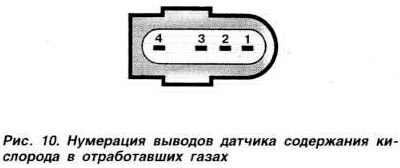
Make sure the ignition is off. Disconnect the wiring harness from the sensor. Turn on the ignition and measure the supply voltage between terminals "3" and "4" (Fig. 10) of the sensor, which should be about 0.5 V.
Start the warmed-up engine (oil temperature not less than 80°C) at idle speed, sharply press the accelerator pedal and let the engine idle for 2 minutes. Disconnect the wiring block from the sensor and, having connected the voltmeter to the terminal "4" of the sensor and "ground", measure the voltage, the value of which should change.
Checking the exhaust gas oxygen sensor heating relay
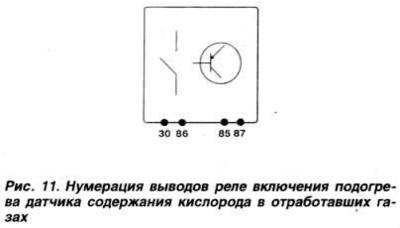
Resistance check. Make sure the ignition is off. Remove the relay and measure the resistance between terminals "30" and "87" (Fig. 11) of the relay (R=∞). Connect the "+" of the battery to terminal "85" of the relay. "-" to terminal "86". Do not change the polarity of the battery connection under any circumstances, to prevent the relay from failing. Measure the resistance between terminals "30" and "87" of the relay (R=0).
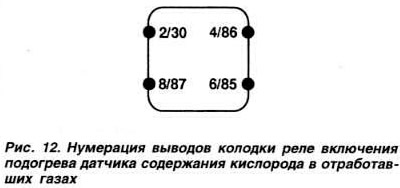
Checking the supply voltage. Make sure the ignition is off. Remove the KSUD power relay, the fuel pump relay, and the exhaust gas oxygen sensor heating relay. Connect test cords to the switches between terminal "4" (Fig. 3) of the fuel pump relay socket and "+" of the storage battery, as well as terminals "4" and "6" (Fig. 6) of the KSUD power relay socket. Turn on the cord switches and, having connected a voltmeter in series to terminals "2/30" and "6/85" (Fig. 12) of the exhaust gas oxygen sensor heating relay socket, measure the voltage, which should be equal to the battery voltage.
Checking the heating element of the oxygen sensor in the exhaust gases
Make sure the ignition is off. Disconnect the wiring harness from the exhaust gas oxygen sensor. Start the engine at idle speed and. connect a voltmeter to terminals "1" and "2" of the wiring harness, measure the voltage, which should be equal to the battery voltage.
Checking the purge valve of the adsorber
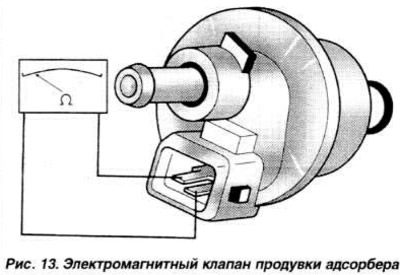
Make sure the ignition is off. Disconnect the wiring harness from the valve (Fig. 13) and. connect an ohmmeter between the valve terminals, measure the resistance of the valve winding (R=40-80 Ohm). Start the engine at idle speed and. connect a voltmeter to terminal "1" of the wiring harness and "ground", measure the voltage. which should be equal to the voltage of the storage battery. If the voltage does not correspond to this, check the wires and their connections in the valve circuit.
Checking the power relay of the KSUD
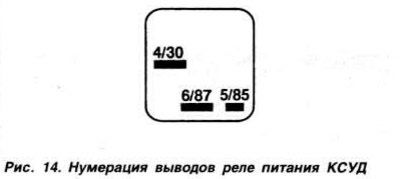
Resistance check. Make sure the ignition is off. Remove the relay and measure the resistance between terminals "30" and "87" (Fig. 14) of the relay (R=∞). Connect the "+" of the battery to terminal "30" of the relay, "-" to terminal "85". Do not change the polarity of the battery connection under any circumstances, to prevent the relay from failing. Measure the resistance between terminals "30" and "87" of the relay (R=0).
Checking the supply voltage. Turn on the ignition, and you should hear a click from the operation of the KSU power relay. If you cannot hear it, check the KSU fuse. Turn off the ignition, remove the relay and. connect a voltmeter to terminal "4" (Fig. 6) of the relay block and "ground", measure the voltage. which should be equal to the voltage of the battery. If the voltage does not correspond to this, check the wires and their connections in the relay circuit.
Checking the fuel pump relay
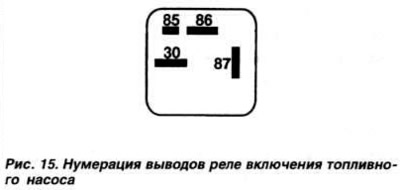
Resistance check. Make sure the ignition is off. Remove the relay and measure the resistance between terminals "30" and "87" (Fig. 15) of the relay (R=∞). Connect the "+" of the battery to terminal "86" of the relay, "-" to terminal "85". Do not change the polarity of the battery connection under any circumstances, to prevent the relay from failing. Measure the resistance between terminals "30" and "87" of the relay (R=0).
Checking the supply voltage. Turn on the ignition, and you should hear a click from the relay operating. If this does not happen, check the integrity of fuse #18. Turn off the ignition, remove the relay and, having connected a voltmeter in series to terminals "2" and "6" (Fig. 3) of the relay block and "ground" and having turned on and off the ignition, measure the voltage, which should be equal to the voltage of the storage battery. If the voltage does not correspond to this, check the wires and their connections in the relay circuit.
Checking the controller
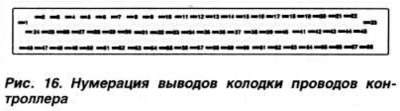
Checking the supply voltage. Make sure the power relay of the KSUD is working properly (see above). Check if the ignition is off. Disconnect the controller connector. Connect a voltmeter in series to the terminals "54", "23" (Fig. 16) (for this test, connect terminal "9" of the wiring block to the "ground") of the wiring block and the "ground" and measure the voltage, which should be equal to the voltage of the battery.
[The information is posted on this resource: www.vwmanual.ru]
Turn on the ignition, connect the voltmeter to terminal "38" of the wiring block and "ground" and measure the voltage, which should be equal to the battery voltage. If the voltage does not correspond to this, check the wires and their connections, as well as the KSUD relay.
Checking the ground connection. Make sure the ignition is off. Disconnect the controller connector. Connect an ohmmeter in series to the terminals "1", "7", "10", "55", "56", "58" (on cars with automatic transmission) and "mass" and measure the resistance, which in all cases should be R=0. Otherwise, check the wires and their connections in the KSUD circuit.
Checking the speed sensor
Make sure the ignition is off. Disconnect the controller connector. On cars with an automatic transmission, set the selector lever to position "0". Raise the front of the car and place it on stands. Turn on the ignition and, rotating the left front wheel, measure the voltage between terminals "56" and "65" of the controller wiring block, which should fluctuate within 0-4 V (at least).
Timing advance control subsystem
NOTE:
1. Before turning the engine crankshaft with the starter, remove the power relay of the KSUD to avoid damaging the exhaust gas neutralizer.
2. The ignition timing is automatically optimized by controller commands depending on the engine operating mode and is not subject to adjustment during operation.
Checking for spark
Make sure the ignition is off. Remove fuse #18. Release residual fuel pressure in the system. Disconnect the high-voltage wire from any spark plug and insert a test spark plug into the tip of the wire. Using pliers with insulated handles, bring the spark plug 6 mm to the ground. Turn the engine crankshaft with the starter; a powerful bluish spark should be observed. Repeat the test on the remaining spark plugs. If there is no spark, check the high-voltage circuit of the ignition timing control subsystem.
Checking the ignition unit
Checking the ignition coil. Make sure the ignition is off Disconnect the ignition unit connector Disconnect the high-voltage wire from the ignition unit Remove the cover of the low-voltage circuit terminals of the ignition coil and. connect an ohmmeter to terminals "15" and "1" (Fig. 17). measure the resistance of the primary winding of the ignition coil (R = 0.5-1.2 Ohm). Connect an ohmmeter to the low-voltage terminal "15" and the high-voltage terminal and measure the resistance of the secondary winding (R = 3.0-4.0 kOhm).
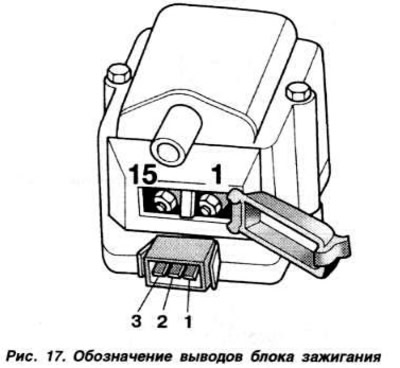
Testing the final power amplifier stage. Make sure the ignition is off. Disconnect the ignition unit connector. Connect an ohmmeter to terminal "1" of the ignition unit wire block and "ground" and measure the resistance (R=0). If the resistance does not match the given value, check the wires and their connections. Turn on the ignition. Connect a voltmeter to the extreme terminals of the ignition unit wire block and check the supply voltage, which should be equal to the battery voltage. If the voltage does not match the given value, check the wires and their connections. Turn off the ignition. Remove fuse #18. Relieve residual fuel pressure in the system. Connect the LED tester to terminals "2" and "3" of the ignition unit wire block. Crank the engine crankshaft with the starter; the tester LED should blink. If this does not happen, check the wires and their connections in the ignition unit circuit. Connect the ignition unit connector. Remove the cover of the low voltage circuit terminals of the ignition coil and connect the LED tester to them. Crank the engine crankshaft with the starter. the LED of the tester should blink. If this does not happen, the final power amplifier stage is out of order and the ignition unit must be replaced.
Checking the spark timing sensor
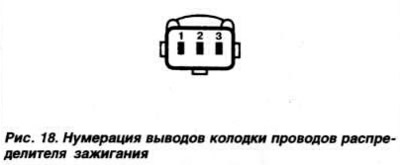
Make sure the ignition is off. Disconnect the ignition distributor connector. Connect an ohmmeter to terminal "1" (Fig. 18) of the connector and "ground" and measure the resistance (R=0). Connect a voltmeter to terminals "1" and "3" of the connector. Turn on the ignition. Measure the voltage, which should be at least 4.5 V. Connect the ignition distributor connector. Remove fuse #18. Relieve residual fuel pressure in the system. Move the protective cover of the ignition distributor connector, connect the LED tester to the outer terminals of the connector. Turn the engine crankshaft with the starter, while the LED tester should blink.
Checking the knock sensor
Make sure the ignition is off. Disconnect the wiring block from the sensor and unscrew the sensor from the cylinder block. Check for traces of corrosion and dirt on the mating surfaces of the cylinder block and sensor. Screw the sensor into the cylinder block (tightening torque 2.0 kgf·m). Connect an ohmmeter to the leftmost terminal of the sensor wiring block and measure the resistance (R = 0). Measure the resistance between the sensor terminals (R = ∞).
Error codes of the ECU "Motronic 2.9" "AEK" engines
| Print code | Location of fault or violated parameter |
| 00281 | Vehicle speed sensor |
| 00513 | Crankshaft position sensor |
| 00515 | Spark Timing Sensor |
| 00518 | Throttle position sensor |
| 00522 | Coolant temperature sensor |
| 00524 | Knock sensor |
| 00525 | Exhaust Gas Oxygen Sensor |
| 00527 | Intake air sensor |
| 00532 | Controller supply voltage |
| 00533 | Idle speed control valve |
| 00535 | Knock sensor control circuit |
| 00537 | Exhaust Gas Oxygen Sensor Control Circuit |
| 00543 | Exceeding the maximum permissible engine speed |
| 00549 | Short circuit in the instrument cluster circuit |
| 00553 | Mass air flow meter |
| 00561 | Incorrect signal from the exhaust gas oxygen sensor |
| 00609 | Ignition Module Low Voltage Circuit |
| 00640 | Exhaust Gas Oxygen Sensor Heating Relay |
| 01242 | Controller control circuits |
| 01247 | Evaporative Canister Purge Valve |
| 01249 | Injector 1st cylinder |
| 01250 | Injector 2nd cylinder |
| 01251 | Injector 3rd cylinder |
| 01252 | Injector 4th cylinder |
| 01259 | Fuel pump relay |
| 17978 | Immobilizer ECU |
| 65535 | The controller is faulty |
* The controller ROM is polled in the same way as on an ABS engine with a KSUD "Mono-MotroniC", see main text.
NOTE: When troubleshooting, refer to the table in Appendix II.
Visitor comments