
English Русский
Български
Беларускі
Український
Српски
Hrvatski
Română
Polski
Slovenský
Magyar
  |  Articles  |  Sitemap  |  Contacts  |    |
Car maintenance Ford Car maintenance Hyundai Car maintenance Chevrolet Car maintenance BMW Car maintenance Audi Car maintenance Opel Car maintenance AvtoVAZ
VWmanual.ru


Main   Passat   Golf   Polo   Touareg   Tiguan   Sharan   Transporter   Others  
Passat B2 (1981-1988) Passat B3 (1988-1993) Passat B4 (1988-1996) Passat B5 (1996-2005) Passat B6 (2005-2010)

Checking and adjusting the carburetor (VW Passat B4)

  • Main
  • Passat
  • Passat B4
  • 8-valve engine
  • Supply system
  • Checking and adjusting the carburetor
            0


Checking the fuel level in the float chamber. The position of the float in the float chamber is not adjustable. If a malfunction is detected, check the tightness of the float and the condition of the needle valve, replace faulty parts.

Adjusting the engine idle speed. Before adjusting the engine idle speed, perform the following operations:
  • make sure the air damper is fully open;
  • check the cleanliness of the air filter element and replace it with a new one if necessary (when adjusting the engine idle speed, do not remove the air filter);
  • warm up the engine. To do this, let the engine run at a crankshaft speed of about 2000 rpm until the thermostat opens. In no case should you warm up the engine at idle, since if the engine runs for several minutes at idle, the measurements of the carbon monoxide content in the exhaust gases will be distorted;
  • check the functionality of the ignition system and the ignition timing;
  • check for air leaks, paying particular attention to the connection of the vacuum hoses and the condition of the throttle body gasket;
  • make sure there are no significant exhaust gas leaks in the exhaust tract;
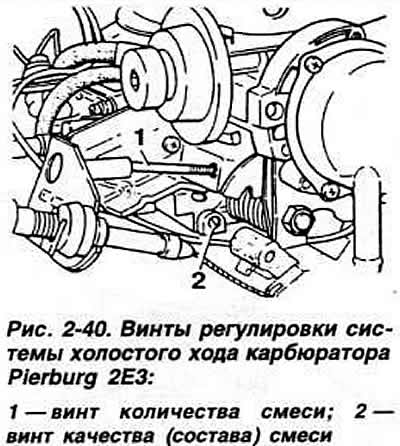
  • make sure that powerful current consumers (electric fan of the engine cooling system, headlights, rear window heating element, etc.) are switched off. The engine idle speed is adjusted using the adjusting screws (Fig. 2-40).
make sure that powerful current consumers (electric fan of the engine cooling system, headlights,…


Using the mixture quantity adjusting screw, set the engine crankshaft speed within 750-850 rpm.


Connect the gas analyzer according to the instructions. Remove the plug of the mixture quality (composition) adjustment screw and, by turning it, achieve the CO content in the exhaust gases within 0.5-1.5%.

If necessary, restore the specified engine crankshaft speed at idle using the mixture quantity adjusting screw. Repeat these operations until the specified crankshaft speed and CO content are obtained. After adjustment, replace the new mixture quality (composition) adjusting screw plug.

Adjusting the fast idle speed of the engine. Fast idle speed adjustment is performed on a warm engine (oil temperature not less than 60°C), with the ignition timing correctly set and idle speed adjusted.

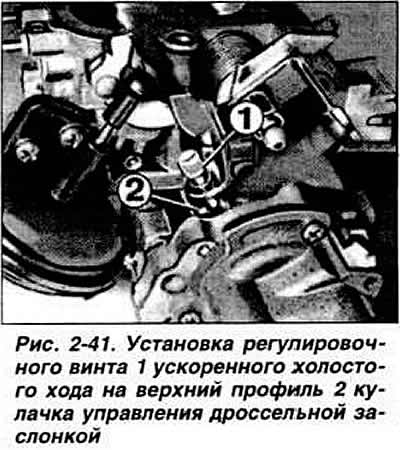
Set the adjusting screw 1 (Fig. 2-41) of the fast idle speed to the second, upper profile 2 of the throttle control cam.
Set the adjusting screw 1 (Fig. 2-41) of the fast idle speed to the second, upper profile 2 of the…


Start the engine without pressing the accelerator pedal.

Check the crankshaft speed at fast idle, which should be within 1650-1750 rpm. If necessary, set the required fast idle mode of the engine with adjusting screw 1.

Checking and adjusting the starting clearance of the air damper. Disconnect the vacuum hoses from the air damper pneumatic drive. Close the air damper and set the fast idle adjusting screw to the upper profile of the throttle control cam.


Connect the vacuum pump hose to the lower nipple of the pneumatic drive and use the pump to create a vacuum at which the air damper stops moving.
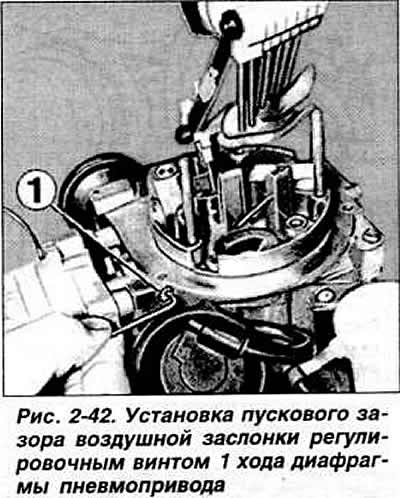
Do not change the vacuum, measure the starting gap of the first stage of the air damper with a rod or drill, which should be within 1.5-1.9 mm. If necessary, set the required gap with adjusting screw 1 (Fig. 2-42). After adjustment, connect the hose to the upper branch pipe of the pneumatic drive.
Do not change the vacuum, measure the starting gap of the first stage of the air damper with a rod…


Using a vacuum pump, create a vacuum of 0.5 kgf/cm², then check the starting gap of the second stage of the air damper, which should be within 2.8-3.2 mm. If necessary, achieve the desired gap with adjusting screw 1.

After adjustment, remove the pressure gauge and connect the hose to the lower branch pipe of the pneumatic drive.

Adjusting the opening of the throttle valve of the 2nd chamber. The position of the throttle valve of the 2nd chamber is adjusted at the factory. However, if the adjustment is disturbed, it can be restored on a previously removed carburetor as follows:
  • fully open the throttle valve of the 1st chamber and fix it in this position by inserting a drill between the edge of the valve and the carburetor body;
  • tighten the 2nd chamber throttle lock lever with a rubber band;
  • unscrew the limit screw of the 2nd chamber throttle valve so that it moves away from the stop. Then screw in the limit screw so that it barely touches the stop;
  • turn the limit screw another ¼ turn and lock it in this position:
  • return the throttle valve of the 1st chamber to the closed position;
  • install the carburetor.

Checking the tightness of the air damper pneumatic drive. Remove the air filter and disconnect the vacuum hoses from the air damper pneumatic drive.

Plug the lower outlet pipe of the pneumatic drive.

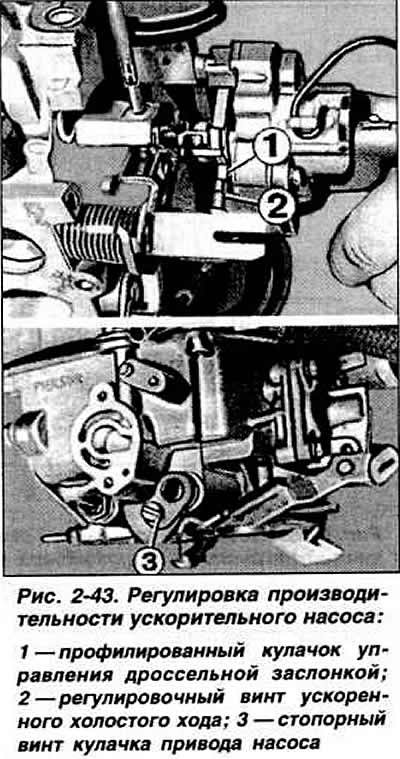
Connect the hose of the hand vacuum pump to the upper outlet pipe of the pneumatic drive and create a vacuum of 0.3 kgf/cm² in the pneumatic drive with the pump. If the vacuum does not remain unchanged, the pneumatic drive must be replaced. Checking and adjusting the performance of the accelerator pump. Remove the carburetor. Turn the profiled cam 1 (Fig. 2-43) of the throttle control so that the adjusting screw 2 of the fast idle speed moves away from it. Place a graduated vessel with a funnel under the carburetor.
Connect the hose of the hand vacuum pump to the upper outlet pipe of the pneumatic drive and create…


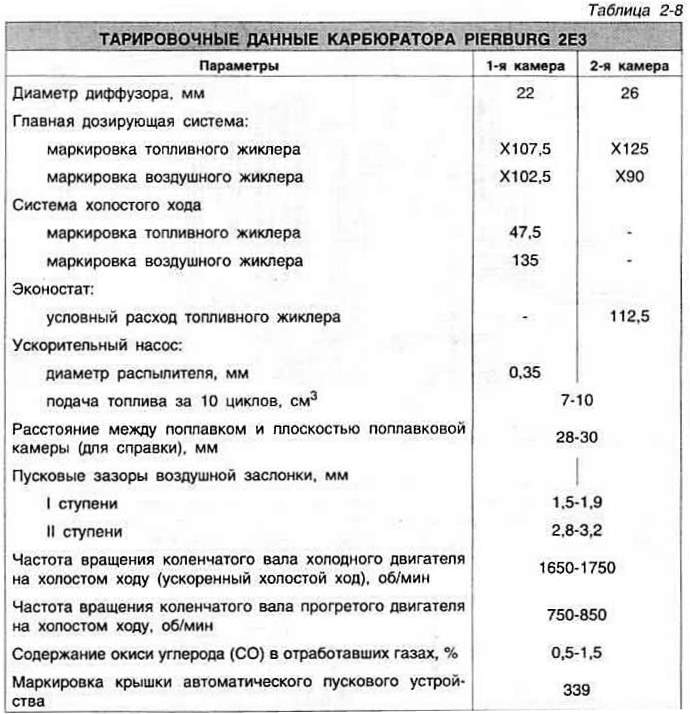
Slowly open and close the throttle valve of the first chamber ten times, thereby activating the accelerator pump (in this case, the fuel should come out of the pump nozzle each time for at least 3 seconds). Determine the amount of fuel that has leaked into the vessel: it should be within 7-10 cm³. If the pump performance does not correspond to this, loosen the locking screw 3 and set the required performance by turning the pump drive cam. When turning the cam to the left, the pump performance increases and vice versa. After adjustment, tighten the locking screw 3 and lock it with a special pack.
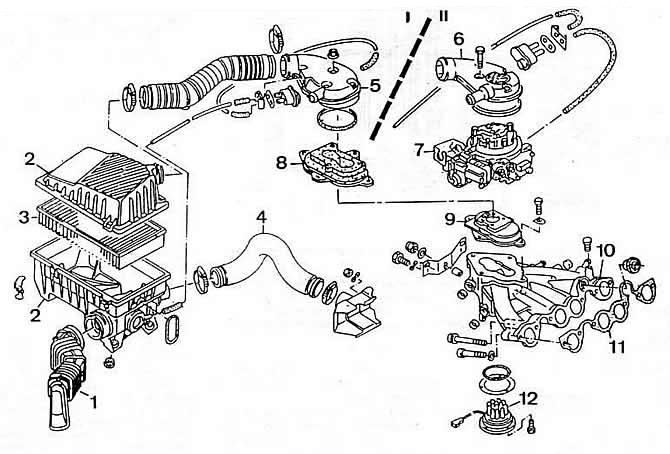
Fig. 2-44. Elements of the air tract:

Fig. 2-44. Elements of the air tract:
I — carburetor fuel system of the engine "EZ"
II - fuel injection systems "Mono-Jetronic" "PR" engines without a classic neutralizer
1 - air intake pipe
2 — air filter housing
3 — air filter element
4 — warm air supply hose
5, 6 — casing
7 — central injection unit
8 — base of the carburetor body
9 — base of the central injection unit
10 — inlet manifold
11 — gasket
12 — intake manifold heater

12 — intake manifold heater

This article is available at russian, bulgarian, belarusian, ukrainian, serbian, croatian, romanian, polish, slovak, hungarian
The text has been checked: Kolesnikov Artem

Share information:

Previous articles
EZ Engine Power System
Next articles


Similar articles from other manuals for VW cars:
Adjusting the gap of the diaphragm of the carburetor 2E2 Golf 2 (1984-1993, petrol)
Checking the self-adjusting tension roller Polo 3 (1995-2003)
Checking and adjusting the position of the pump-injector pistons… Touareg 1 (2002-2006)
Checking the operation of the intake manifold flap Tiguan 1 (2007-2015)
Checking the engine oil level and replacing it Sharan 1 (1995-2000)
Adjusting the carburetor cable 34 PICT Transporter T3 (1979-1992)
Checking and adjusting idle speed Beetle (1960-1986)
Link to this page in different formats


Visitor comments


No comments yet


How much will 31 + 16 =


Passat B6 
  • General information
  • User manual
  • Maintenance
  • Petrol engine 1.6L
  • Engine repair
  • Cooling and lubrication system
  • Fuel injection system
  • Petrol engine 2.0L
  • Engine repair
  • Lubrication system
  • Cooling system
  • Fuel and exhaust systems
  • Diesel engine 2.0L
  • Engine repair
  • Cooling and lubrication system
  • Fuel and exhaust systems
  • Transmission
  • Clutch
  • Mechanical gearbox
  • Automatic gearbox
  • Drive shafts
  • Chassis
  • Wheels and tires
  • Car suspension
  • Steering
  • Brake system
  • Body
  • Exterior (external elements)
  • Electrical equipment
  • Power devices
  • Lighting and appliances
  • Electrical circuits
Passat B5 
  • General information
  • User manual
  • Weekly checks
  • Maintenance
  • Power unit
  • Engine repair
  • Cooling system
  • Fuel system (petrol)
  • Fuel system (diesel)
  • Engine management
  • Exhaust system
  • Transmission
  • Clutch
  • Car gearbox
  • Drive shafts
  • Chassis
  • Car suspension
  • Wheels and tires
  • Steering
  • Brake system
  • Body
  • Exterior (external elements)
  • Interior (internal elements)
  • Doors and covers
  • Ventilation and heating
  • Electrical equipment
  • Power devices
  • Lighting and appliances
  • Electrical circuits
Passat B4 
  • General information
  • User manual
  • Maintenance
  • Technical data
  • 8-valve engine
  • Engine repair
  • Cooling and lubrication system
  • Supply system
  • Ignition system
  • Fuel injection «Mono-Jetronic»
  • Control system «Mono-Motronic»
  • Control system «Digifant»
  • Control system «Simos»
  • 16-valve engine
  • Engine repair
  • Cooling and lubrication system
  • Fuel injection «K-Jetronic»
  • Control system «KE-Motronic»
  • Control system «Digifant»
  • Diesel engine
  • Engine repair
  • Cooling and lubrication system
  • Power and control system
  • Turbocharging system
  • Digital control system
  • Transmission
  • Clutch
  • Manual gearbox
  • Hydromechanical gearbox
  • Front wheel drive
  • Chassis
  • Car suspension
  • Steering
  • Brake system
  • Body
  • Body elements
  • Electrical equipment
  • Power devices
  • Lighting and appliances
  • Electrical circuits
Passat B3 
  • General information
  • User manual
  • Driving Tips
  • Maintenance instructions
  • Technical data
  • Power unit
  • Engine repair
  • Ignition system
  • Lubrication system
  • Cooling system
  • Supply system
  • Petrol injection system
  • Diesel engine
  • Exhaust system
  • Transmission
  • Clutch
  • Car gearbox
  • Chassis
  • Suspension
  • Steering
  • Brake system
  • Wheels and tires
  • Body
  • Exterior
  • Interior
  • Heating system
  • Electrical equipment
  • Power devices
  • Lighting system
  • Equipment and devices
  • Wiper system
  • Electrical circuits
Passat B2 
  • General information
  • Introduction to instructions
  • User manual
  • Power unit
  • Engines 4-cylinder FZ
  • Engines 4-cylinder
  • Engines 5-cylinder
  • Transmission
  • Clutch
  • Four-speed gearbox
  • Five-speed gearbox
  • Hydromechanical gearbox
  • Front wheel drive
  • Chassis
  • Front suspension
  • Rear suspension
  • Steering
  • Brake system
  • Body
  • Body elements
  • Electrical equipment
  • Equipment and devices
  • Electrical circuits
VWmanual.ru © 2016-2026 | Mobile version | News and articles | Sitemap: EN BG BY UA RS HR RO PL SK HU | Write message | Site search
Passat B2 • Passat B3 • Passat B4 • Passat B5 • Passat B6 • Golf 1, diesel • Golf 1, petrol • Golf 2, petrol • Golf 2 • Golf 3 • Golf 4 • Golf 5 • Polo 3 • Polo 4 • Touareg 1 • Tiguan 1 • Sharan 1 • Transporter T3 • Transporter T4 • LT 28 • LT 2D • Beetle • Caddy 3 •
Our website uses cookies to ensure functionality and convenience.