



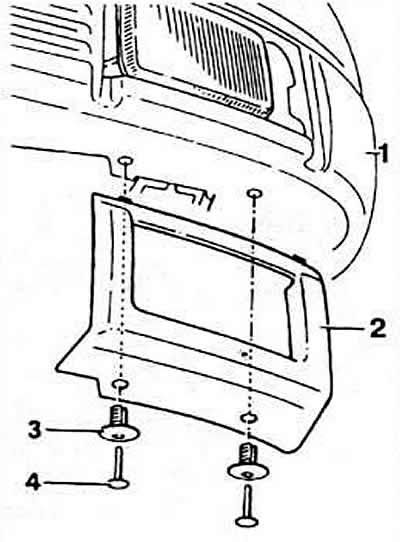
Fig. 8-13. Removing fog lights:
1 - front bumper;
2 - headlight trim;
3 - mounting pin;
4 — spacer sleeve.
Instrument cluster
The VDO or Moto Meter instrument cluster is made on printed circuits on a flexible board.
The lower part of the instrument cluster contains warning lights for oil pressure, high beam headlights, turn signals, brake fluid level and parking brake, battery charging, and fuel injection system malfunction (depending on the model).
Note: The ABS brake system indicator light is located on the instrument panel to the left of the light switch, and the coolant temperature indicator light is built into the coolant temperature gauge.
The instrument cluster includes a coolant temperature gauge, a fuel gauge with a 10-liter fuel remaining sector, a digital clock, an electronic speedometer with a totalizer and daily trip meter, and a tachometer. For instrument cluster details and the purpose of the instrument cluster connector pins, see Fig. 8-18 and 8-16.
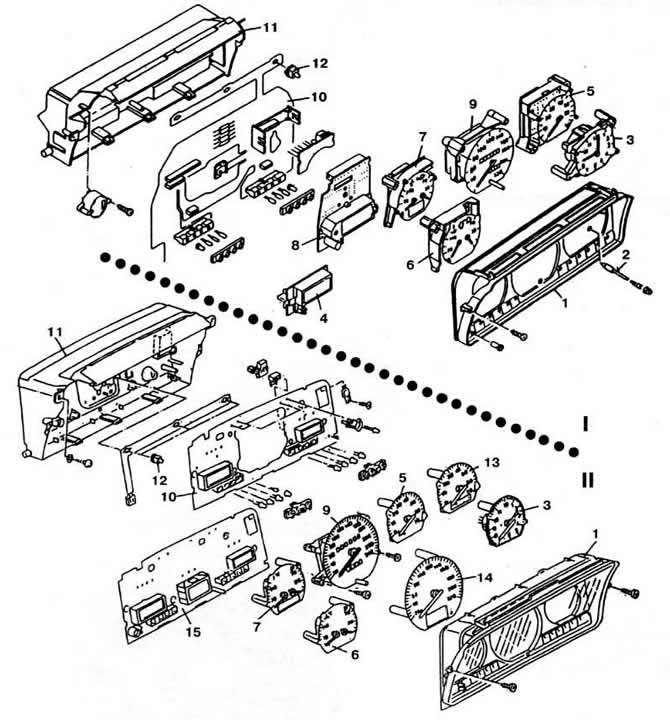
Fig. 8-18. Instrument cluster details:
I — cars up to model year 1989;
II - cars from the 1990 model year.
1 - visor;
2 - time setting button;
3 - hands watch;
4 - digital clock (on some cars);
5 - tachometer;
6 - fuel level and coolant temperature indicators;
7 - fuel level and coolant temperature indicators on vehicles with a tachometer;
8 — trip computer monitor;
9 - speedometer with trip meters;
10 - printed circuit board;
11 — instrument panel housing;
12 — backlight lamp;
13 - tachometer for cars with automatic transmission;
14 — speedometer for cars with a trip computer;
15 - computer mounting board.
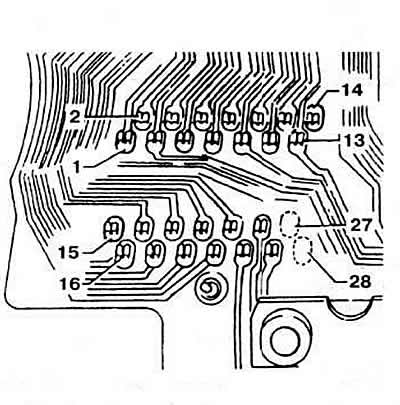
Fig. 8-16. Pin assignment of the 28-pin instrument cluster connector:
1 — ground connection terminal of the outside air temperature sensor (for on-board computer);
2 - reserve;
3 - output "31" to "ground";
4 — output to the on-board computer control switch (reset information);
5 — terminal "31" — connection to the "ground" of the on-board computer;
6 — output to the on-board computer control switch (selection of information type);
7 — output for the speed sensor signal;
8 — output for the signal from the oil pressure sensor, calibrated to 1.8 kgf/cm²;
9 — output for the oil pressure sensor signal, calibrated to 0.3 kgf/cm²;
10 — output for tachometer signal;
11 — "+" of the battery;
12— "+" lighting circuits;
13 — "+" ignition switch or instruments and starter;
14 - reserve;
15 - output to the computer control switch (information run);
16 — output to the battery charge indicator lamp;
17 — output to the computer oil temperature sensor;
18 — output to the brake fluid level indicator lamp and parking brake activation;
19 — output for outside air temperature signal supplied to the computer;
20 — reserve for diesel starting heating system;
21 — output to the fuel level indicator;
22 — output to the fuel injection system malfunction indicator lamp;
23 — output to coolant temperature gauge;
24 — output to the direction indicator lamp;
25 — output to the high beam indicator lamp;
26 - reserve;
27, 28 - unconnected terminals.
Note
1. On some vehicles, the supply voltage of the devices is regulated by a voltage stabilizer within the range of 9.75-10.25.
2. When the ignition or instruments are turned on, the coolant temperature indicator lamp flashes several times, indicating that it is working properly.
(The information is presented on the website: VWmanual.ru)
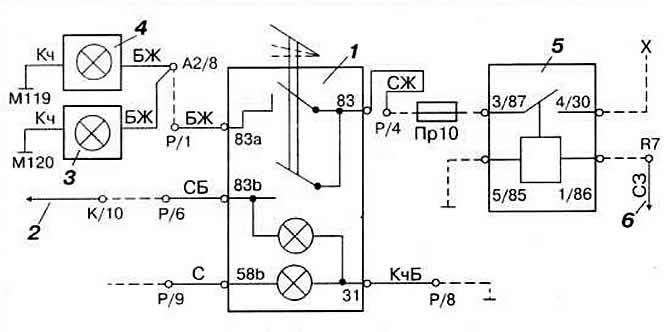
Fig. 8-9. Wiring diagram of fog lights and rear fog light
1 - fog lights and headlights switch;
2 - to fog lights;
3 - right fog light;
4 - left fog light;
5 - power relay for fog lights and headlights;
6 - to the outdoor lighting switch;
X — ignition switch terminal. For wire color designations, see Fig. 8-8.
Visitor comments