



ABS prevents the wheels from locking when braking suddenly. This reduces the braking distance, especially when there is little grip on the road surface due to dampness or snow. The force grip of the wheels on the road in these cases is greater if the wheels are still rotating when braking. In addition, the car remains controllable when braking to a complete stop.
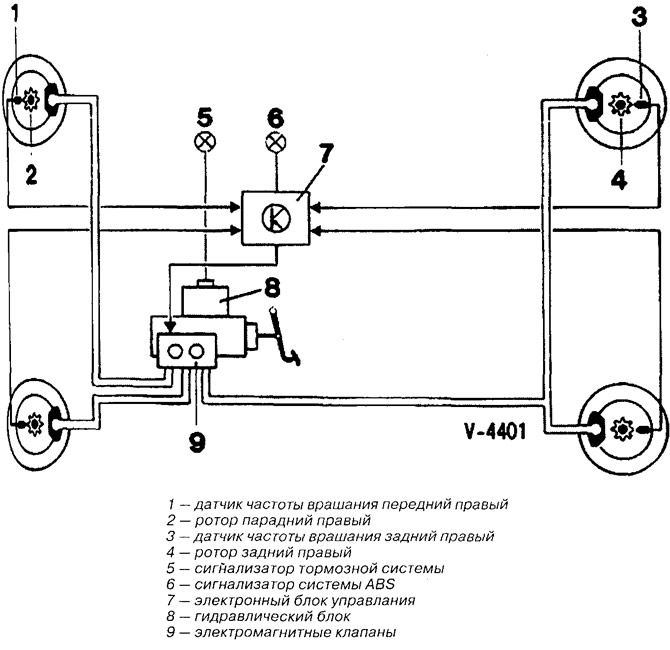
The speed of the wheels is measured using a speed sensor, 2 for the front and 2 for the rear wheels. Based on the signals from the individual sensors, the electronic control unit calculates an average speed that roughly corresponds to the average speed of the vehicle. By comparing the speed of an individual wheel and the average speed of all wheels, the control unit determines the slippage of an individual wheel and thus determines how close this wheel is to locking.
As soon as the wheel approaches the locking state, at which the brake fluid pressure in the corresponding caliper becomes too high in relation to the tire's adhesion to the road, the hydraulic system keeps the fluid pressure constant based on signals from the control unit. This means that the pressure in the brake caliper does not increase even when the brake pedal is pressed even harder. If the tendency to lock continues, the fluid pressure is reduced by opening the release valve. However, it is only reduced so much that the wheel accelerates slightly, after which the pressure is again maintained constant.
If the wheel acceleration exceeds a certain value, the pressure in the hydraulic system begins to increase again, but not above the value present in the entire system.
This process is repeated under hard braking for each wheel until the brake pedal is released or until the car reaches a near-standstill (2-3 km/h). The driver senses the operation of the anti-lock device by the pulsation of the brake pedal.
The battery switch in the electronic control unit ensures that in the event of a defect (for example, a cable break) or at low operating voltage (battery voltage below 10.5 volts) the ABS system switches itself off. In this case, a warning signal lights up on the instrument panel while driving that the ABS system is switched off. The regular brake system remains in working order. In this case, the car behaves when braking as if the ABS system was not installed on it.
If the warning light comes on while driving, it indicates that the ABS system is disabled.
Stop the car quickly, turn off the engine and start it again.
Check the battery voltage. If the battery voltage is less than 10.5 volts, charge the battery.
Caution: If the ABS indicator comes on at the start of a trip and goes out after a while, this indicates that the battery voltage was initially insufficient and then increased as a result of the battery being charged by the generator.
Check if the battery terminals are tight enough and have good contact.
Raise the car, remove the front wheels, check the electrical wires of the wheel speed sensors for external damage (grinding).
The remaining checks must be entrusted to a VAG workshop. Since 6/88, the ABS control unit has a memory device that recognizes any malfunctions encountered during vehicle operation and stores its code. The memory device is interrogated at the workshop and the malfunction is specifically eliminated.
ABS with Electronic Differential Lock (EDS)
Depending on the model and version, VW PASSAT vehicles in addition to ABS have an electronic differential lock, abbreviated EDS (elektronische DifFerentialsperre). Built on ABS components, the electronic differential lock improves the traction force transmitted from the engine to the vehicle wheels under adverse road conditions, especially when driving in mountains, accelerating or starting off.
On roads with different grip on the ground, one of the wheels of the drive axle may slip. If there is an interwheel differential, this leads to both wheels of the axle creating the same traction force, the magnitude of which is determined by the friction force of the tire of the slipping wheel on the road surface. Thanks to the mechanical locking of the differential, the traction force is improved, since a higher torque can be transmitted to the wheel with higher friction with the road surface. However, common differentials with mechanical locking cannot be installed between the wheels of the drive front axle for two reasons: firstly, the comfort of driving the car would be sharply limited, and secondly, the effect of ABS would be insignificant.
EDS Functioning: The electronic control unit receives information about the rotation speed of the drive wheels (in vehicles with both drive axles, the rotation speed of each wheel) thanks to the ABS wheel speed sensors and quickly compares them with each other. If a difference in rotation speed exceeds 110 rpm, EDS is automatically activated and brakes the slipping wheel until it reduces its rotation speed to a value close to the rotation speed of the wheel that is not slipping. This control achieves the same effect as a mechanical differential lock, namely: the wheel with better grip on the road surface can develop increased traction. In vehicles with all-wheel drive, if EDS is available, there is no need to install a mechanical differential lock on the rear axle. At vehicle speeds above 40 km/h, as well as during turns or when the brakes overheat, EDS is automatically deactivated. The system has several levels of protection against braking errors in both the electronic and hydraulic circuits.
In the EDS system, many parts and components of the ABS system are used together. The hydraulic system contains as an additional component the EDS valve block, the control unit is supplemented with software for the EDS system.
Caution: Before carrying out welding work using an electric welding machine, it is necessary to disconnect the plug of the electronic control unit of the ABS/EDS system. The plug must be removed only with the ignition switched off. During painting work, the control unit may be exposed to a maximum temperature of 95°C for a short time and (in about two hours) — exposure to a maximum temperature of 85°C.
Visitor comments