
English Русский
Български
Беларускі
Український
Српски
Hrvatski
Română
Polski
Slovenský
Magyar
  |  Articles  |  Sitemap  |  Contacts  |    |
Car maintenance Ford Car maintenance Hyundai Car maintenance Chevrolet Car maintenance BMW Car maintenance Audi Car maintenance Opel Car maintenance AvtoVAZ
VWmanual.ru


Main   Passat   Golf   Polo   Touareg   Tiguan   Sharan   Transporter   Others  
Passat B2 (1981-1988) Passat B3 (1988-1993) Passat B4 (1988-1996) Passat B5 (1996-2005) Passat B6 (2005-2010)

Checking the brake fluid level (VW Passat B3)

  • Main
  • Passat
  • Passat B3
  • Chassis
  • Brake system
  • Checking the brake fluid level
            0


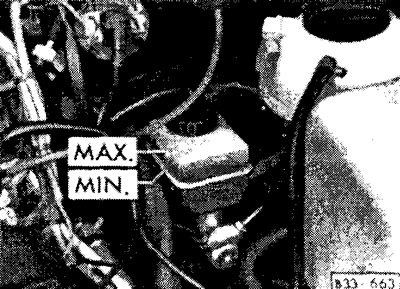
The brake fluid expansion tank is located in the engine compartment. The tank has 2 chambers, one for each brake circuit. The screw cap has a ventilation hole that cannot be closed.

The brake fluid expansion tank is located in the engine compartment. The tank has 2 chambers, one…


The expansion tank is made of transparent material so that the brake fluid level can be checked from the outside at any time.

The fluid level should be between the "MAX" and "MIN" marks.

Fill only with new brake fluid that meets FMVSS 11 6 DOT 4 specification.

Cars with ABS system


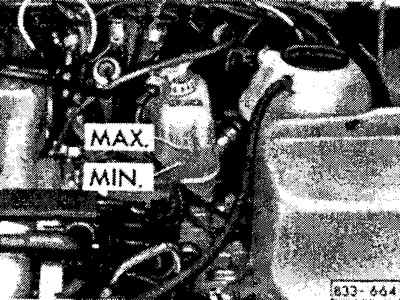
The expansion tank is divided into 3 chambers: one chamber for each front wheel brake and one chamber for both rear wheel brakes.

The original article is available on the website: VWManual.ru
The expansion tank is divided into 3 chambers: one chamber for each front wheel brake and one…


To check the brake fluid level, turn on the ignition and wait until the electric pump of the hydraulic system switches off by itself. This should happen within one minute. Switching off the pump indicates that the required working pressure has been created, which is necessary for the functioning of the brake system. In this state of the system, the brake fluid level should not exceed the "MAX" mark.


Attention: When the operating pressure in the system is low, the fluid level may be slightly higher than the "MAX" mark.


Due to wear of the disc brakes, the brake fluid level drops slightly - this is normal. When the brake fluid level is slightly above the "MIN" mark and at the same time the wear of the brake pads is close to the limit, there is no need to top up the fluid level.

If the level in the tank decreases in a short time, this indicates a loss of brake fluid.

In this case, it is necessary to immediately look for the leak. As a rule, the cause lies in worn cuffs of the wheel brake cylinders. For safety reasons, the brake system should be checked in a specialized workshop.

This article is available at russian, bulgarian, belarusian, ukrainian, serbian, croatian, romanian, polish, slovak, hungarian
The text has been checked: Medvedeva Elena

Share information:

Previous articles
Description of the ABS system
Adjusting the handbrake
Checking the brake force regulator
Checking the brake booster
Replacing the brake line / brake hose
Bleeding the brake system
Next articles
Checking the thickness of brake pads
Visual inspection of brake lines
Replacing brake fluid
Brake fault diagnostics


Similar articles from other manuals for VW cars:
Checking the brake fluid level Golf 1 (1974-1984, diesel)
Checking the brake fluid level Polo 4 (2001-2009)
Checking the engine oil level (diesel engine) Touareg 1 (2002-2006)
Checking the oil level in a manual transmission Tiguan 1 (2007-2015)
Checking the brake fluid level Sharan 1 (1995-2000)
Checking the brake fluid level Transporter T4 (1990-2003)
Checking the brake fluid level Caddy 3 (2003-2010)
Link to this page in different formats


Visitor comments


No comments yet


How much will 17 + 41 =


Passat B6 
  • General information
  • User manual
  • Maintenance
  • Petrol engine 1.6L
  • Engine repair
  • Cooling and lubrication system
  • Fuel injection system
  • Petrol engine 2.0L
  • Engine repair
  • Lubrication system
  • Cooling system
  • Fuel and exhaust systems
  • Diesel engine 2.0L
  • Engine repair
  • Cooling and lubrication system
  • Fuel and exhaust systems
  • Transmission
  • Clutch
  • Mechanical gearbox
  • Automatic gearbox
  • Drive shafts
  • Chassis
  • Wheels and tires
  • Car suspension
  • Steering
  • Brake system
  • Body
  • Exterior (external elements)
  • Electrical equipment
  • Power devices
  • Lighting and appliances
  • Electrical circuits
Passat B5 
  • General information
  • User manual
  • Weekly checks
  • Maintenance
  • Power unit
  • Engine repair
  • Cooling system
  • Fuel system (petrol)
  • Fuel system (diesel)
  • Engine management
  • Exhaust system
  • Transmission
  • Clutch
  • Car gearbox
  • Drive shafts
  • Chassis
  • Car suspension
  • Wheels and tires
  • Steering
  • Brake system
  • Body
  • Exterior (external elements)
  • Interior (internal elements)
  • Doors and covers
  • Ventilation and heating
  • Electrical equipment
  • Power devices
  • Lighting and appliances
  • Electrical circuits
Passat B4 
  • General information
  • User manual
  • Maintenance
  • Technical data
  • 8-valve engine
  • Engine repair
  • Cooling and lubrication system
  • Supply system
  • Ignition system
  • Fuel injection «Mono-Jetronic»
  • Control system «Mono-Motronic»
  • Control system «Digifant»
  • Control system «Simos»
  • 16-valve engine
  • Engine repair
  • Cooling and lubrication system
  • Fuel injection «K-Jetronic»
  • Control system «KE-Motronic»
  • Control system «Digifant»
  • Diesel engine
  • Engine repair
  • Cooling and lubrication system
  • Power and control system
  • Turbocharging system
  • Digital control system
  • Transmission
  • Clutch
  • Manual gearbox
  • Hydromechanical gearbox
  • Front wheel drive
  • Chassis
  • Car suspension
  • Steering
  • Brake system
  • Body
  • Body elements
  • Electrical equipment
  • Power devices
  • Lighting and appliances
  • Electrical circuits
Passat B3 
  • General information
  • User manual
  • Driving Tips
  • Maintenance instructions
  • Technical data
  • Power unit
  • Engine repair
  • Ignition system
  • Lubrication system
  • Cooling system
  • Supply system
  • Petrol injection system
  • Diesel engine
  • Exhaust system
  • Transmission
  • Clutch
  • Car gearbox
  • Chassis
  • Suspension
  • Steering
  • Brake system
  • Wheels and tires
  • Body
  • Exterior
  • Interior
  • Heating system
  • Electrical equipment
  • Power devices
  • Lighting system
  • Equipment and devices
  • Wiper system
  • Electrical circuits
Passat B2 
  • General information
  • Introduction to instructions
  • User manual
  • Power unit
  • Engines 4-cylinder FZ
  • Engines 4-cylinder
  • Engines 5-cylinder
  • Transmission
  • Clutch
  • Four-speed gearbox
  • Five-speed gearbox
  • Hydromechanical gearbox
  • Front wheel drive
  • Chassis
  • Front suspension
  • Rear suspension
  • Steering
  • Brake system
  • Body
  • Body elements
  • Electrical equipment
  • Equipment and devices
  • Electrical circuits
VWmanual.ru © 2016-2026 | Mobile version | News and articles | Sitemap: EN BG BY UA RS HR RO PL SK HU | Write message | Site search
Passat B2 • Passat B3 • Passat B4 • Passat B5 • Passat B6 • Golf 1, diesel • Golf 1, petrol • Golf 2, petrol • Golf 2 • Golf 3 • Golf 4 • Golf 5 • Polo 3 • Polo 4 • Touareg 1 • Tiguan 1 • Sharan 1 • Transporter T3 • Transporter T4 • LT 28 • LT 2D • Beetle • Caddy 3 •
Our website uses cookies to ensure functionality and convenience.