



Contents: The spark plugs are in good condition ↓ The candle is covered with soot ↓ The candle is filled with oil ↓ Overheating spark plug ↓
The spark plugs have a thread diameter of 14 mm. Special spark plugs are recommended, which are available under the spare part number 101 000 025 AA. These spark plugs are marked as SEMSS.
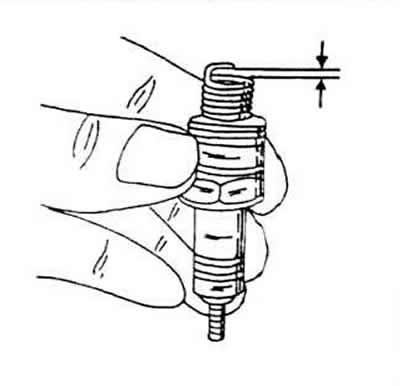
The distance between the spark plug electrodes is 0.7-0.8 mm and can be measured in the usual way.
The spark plugs should be cleaned every 10,000 km of the car's mileage using a sandblasting compressor. In this case, the appropriate gap is set between the electrodes. When installing it, the middle electrode is never bent, since this can cause the porcelain insulator to crack
Before unscrewing the spark plugs, check that there are no foreign objects in the recesses of the spark plug body; washers, bolts, stone nippers and similar objects that get into the spark plug hole when unscrewing it can damage the valves, valve seats or cylinder head when the engine is first started.
The appearance of the spark plug can be used to draw conclusions about its suitability and flawless operation, the state of the fuel and air mixture, and the general condition of the engine (pistons, piston rings, etc.).
The spark plugs are in good condition
The thermal cone of the insulator is covered with a thin, often powdery deposit, the color of which ranges from gray-yellow to brown. The electrodes, with the exception of the combustion surfaces, have a powdery deposit, the color of which varies from gray-yellow to brown. The inside of the housing has a deposit, the color of which varies from light brown or yellow to black-brown. The engine is in order. The glow number of the spark plug is selected correctly.
The candle is covered with soot
The thermal cone of the insulator, the electrodes and the inside of the housing are often covered with a dense, powdery, black-gray, velvety coating. The reasons for this phenomenon are a greasy mixture, too little air, non-compliance with the norms of thermal warming of the engine at idle, too large a distance between the electrodes; the spark plugs have too high a heat rating and remain cold during operation.
All electronic and electrical equipment of the engine should be checked, as there may be a fault somewhere. In the past, spark plugs with different heat ratings were commonly used to help solve this problem. However, you must establish from the documentation currently in force which spark plug can be used, as spark plugs are very often replaced with each other to ensure the best combustion of fuel in the engine. At the moment, no alternative spark plugs can be named that could be used to help.
The candle is filled with oil
The thermal cone of the insulator, the electrodes and the inside of the housing are covered with a greasy deposit with an oily sheen: oil deposit formation. This can be caused by engine oil getting into the combustion chamber or onto the closed cylinders and pistons. In your Golf, this can only happen after many kilometers have been driven, and therefore very rarely. In most cases, this means that the engine must be disassembled to find the places where the oil has penetrated. This inevitably involves such troubles as replacing or rebuilding the pistons, as well as grinding the cylinders.
Overheating spark plug
The thermal cone of the insulator is covered with a glassy or rough, firmly sintered deposit, which has a color from dark brown to gray-black, and often with strong formation of deposits and granules at the end of the thermal cone. Traces of strong action are visible on the electrodes, especially on the middle one. The surface is often rough, swollen or corroded.
The reasons for this may be a too lean mixture, a loose spark plug, or a poorly closing valve; the "culprit" may also be a spark plug with a too low heat rating, which is therefore too hot.
In these cases, it would be useful to repair the cylinder head and ensure that the engine operates in accordance with the specifications.
The deposits between the porcelain insulator of the middle electrode and the spark plug body should be cleaned out as best as possible with a sand blast.
The information is presented on the website [www.VWMANUAL.ru]
When screwing in a spark plug, you should always make sure that the spark plug threads are well cleaned beforehand.
Since the service life of a spark plug under normal conditions is at least 15,000 km, it should be cleaned every 10,000 km. When screwing in the spark plug, be careful not to apply excessive tightening force, as this may damage the sealing surfaces. The tightening torque of 25 Nm should not be exceeded; use a torque wrench for this purpose.
Visitor comments