



Contents: Removal ↓ Installation ↓
Note: Petrol engine only.
Special tool required: spark plug wrench, which can be purchased at an auto parts store. The spark plugs have a 20.8 mm Allen key. It is also recommended to purchase special pliers, such as HAZET 1849, which make it easier to remove the spark plug tip.
Depending on the number of cylinders, it is necessary to purchase 4 or 5 spark plugs (see subsection 2.14.7.2).
Removal
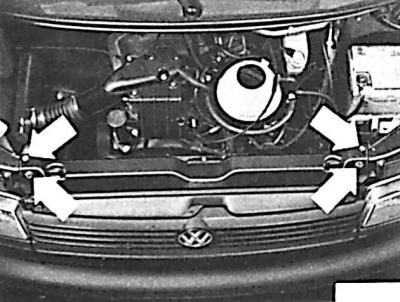
1. To get to the spark plugs, you need to tilt the radiator with the grille forward. Unscrew the 4 mounting screws (arrows).
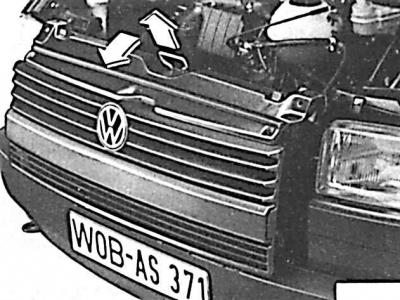
2. Then lift the radiator by the handle and tilt it forward (arrows).
3. Disconnect all spark plug terminals, grasping the terminal, not the cable. The pliers mentioned above will make removal easier.
4. If possible, blow out the spark plug recesses with compressed air to prevent dirt from getting into the spark plug hole.
5. Unscrew the spark plugs with a spark plug wrench, only when the engine is warm to the touch, and check their condition (the so-called "face of the spark plug"). With some experience, you can immediately draw conclusions about the operational condition of the engine. In this case, there are the following rules for determining the operational condition of the engine by the color and condition of the electrodes and insulators:
- from light brown to light gray - correct operation of the spark plugs and the correct mixture;
- black - the mixture is over-enriched;
- light gray - mixture is depleted;
- oily - the corresponding spark plug does not work or the piston rings are worn out (check compression).
Installation
1. Check by eye for the same gap between the 3 electrodes and the ground electrode. In new spark plugs, the distance between the electrodes is usually less than the specified one.
2. If necessary, adjust the gap by carefully bending the ground electrode with light side blows. Do not use a screwdriver to bend it, resting it on the edge of the thread, and in no case on the central electrode, to avoid damaging it.
3. Clean the spark plug threads with a clean cloth.
4. Screw the spark plugs in by hand until they stop.
[The original article is posted on the website: VWmanual]
Caution! Do not tilt the spark plugs when screwing them in.
5. Tighten the spark plugs to a torque of 25 Nm.
Caution! If you don't have a torque wrench handy, tighten the new spark plugs to about 90° (1/4 turn). Tighten old spark plugs only 15°. Spark plugs that are too tight may shear or damage the threads in the cylinder head when unscrewing. In this case, repair the spark plug threads using VTC or Heli-Cjil attachments.
6. Install spark plug caps in the firing order of the cylinders. The firing order for a 4-cylinder engine is: 1–3–4–2; 5-cylinder engine: 1–2–4–5–3.
7. Using side-to-side movements, check the reliability of the spark plug tips and cables.
Visitor comments