



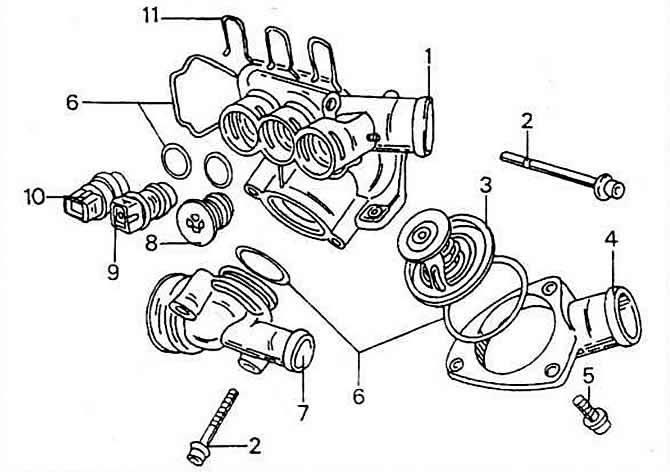
1 - body
2 - Allen bolt. 10 Nm
3 - thermostat
4 - thermostat housing cover
5 - Allen bolt. 10 Nm
6 - "O"-shaped sealing ring
7 - housing cover
8 - plug
9 - temperature sensor for monitoring the radiator fan operating mode
10 - injection system temperature sensor
11 - safety clamps
The thermostat is located in the water pump housing under a cover sealed with an O-ring. The thermostat can be removed by removing the hose located at the end of the cover and unscrewing the cover. Remove the O-ring from the cover and inspect it immediately.
The thermostat cannot be repaired; if damaged, it should be replaced.
The thermostat is located in a separate housing, which outside the thermostat itself has two temperature sensors: one for measuring the temperature of the coolant, and the other for monitoring the radiator fan.
The design feature of both temperature sensors and the installed plug is a fastening that is not screwed in the way that is usually expected, but is secured with spring clamps. The temperature sensors and the plug are equipped with O-shaped sealing rings, and the seal itself is ensured by mutual compression of these sealing rings with a rigid fit of the seal clamps.
If the plugs are removed, they must not be mixed up, since the temperature sensor designed to measure the coolant temperature has two connecting pins, while the other one - designed to monitor the radiator fan - has 4 pins.
The thermostat itself is located under the cover (to which the hose is attached), which is sealed with an O-ring. The thermostat can be removed after the hose at the end of the cap is removed and the cap is unscrewed. The seal is separated from the cap and checked immediately.
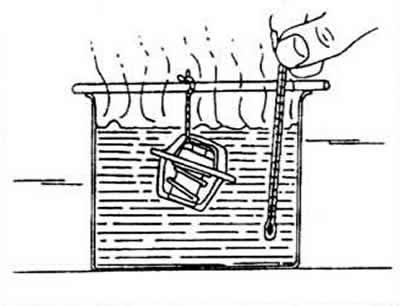
A simple thermostat test can be performed as follows.
The thermostat is lowered on a piece of wire into a container of cold water.
The thermostat is suspended in a similar manner.
Heat the water gradually and check whether the thermostat starts to open at 85°C. At 105°C the thermostat should open completely.
When checked in this way, the thermostat pin should protrude from it by at least 7 mm. If the thermostat does not pass this check, it must be replaced. When installing the thermostat, use a round seal. Check the clamp before reattaching it to the hose. Fill the cooling system.
If other parts have been removed from the thermostat housing, the following points should be taken into account during installation:
Secure the thermostat housing to the engine together with the new sealing ring and tighten the long bolts to a torque of 10 Nm.
If the housing cover (7) and the coolant pipe are removed, the sealing ring is replaced. The coolant pipe is pressed firmly into the cover, and the cover is screwed to the thermostat housing with a tightening torque of 10 Nm.
If temperature sensors are removed (spring clamps are pressed out with a screwdriver), then a new sealing ring is installed, the corresponding sensor is firmly inserted into the hole, and the spring clamps are pushed upwards. The spring clamp must "sit" firmly, since otherwise it is impossible to ensure a reliable seal.
If the coolant pipe has been removed, new sealing rings are installed on both ends of this pipe, and the pipe is pressed into the connection points.
Visitor comments