



Remove the spacer sleeve, upper spring cup, washer, rubber bushing and spring, then the lower washer and spring cup (figure 410).
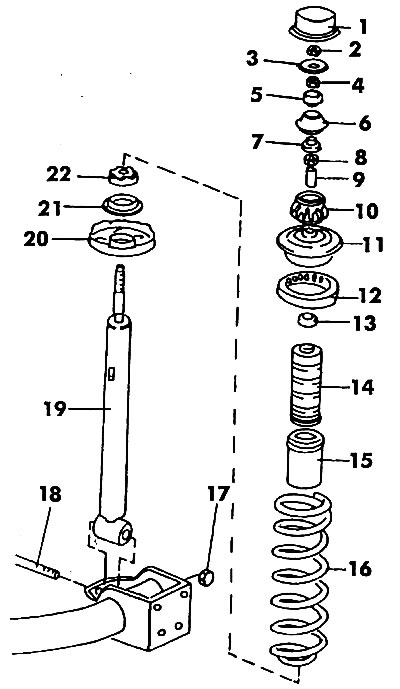
Figure 410. Elements of the rear spring strut: 1 - cap; 2, 4, 8, 17 - nuts M10; 3 - washer; 5 - buffer; 6 - upper rubber ring; 7 - compression buffer; 9 - spacer sleeve; 10 - lower rubber ring; 11 - upper spring cup; 12 - Upper rubber insert; 13 - retaining ring; 14 - rubber cover; 15 - cap; 16 - coil spring; 18 - bolt M10; 19 - shock absorber; 20 - lower spring cup; 21 - lower rubber spring insert; 22 - safety nozzle
If necessary, remove the rubber holder and bottom cover.
The coil springs are marked with different colors and cannot be installed arbitrarily. They have one or two belts of the corresponding color. When replacing, springs with the same marking must be used.
The upper rubber shock absorber mounting pad may have a different shape, which must be preserved during replacement.
Check the operation of the shock absorber by pushing and pulling the rod. The shock absorber rod should move with the same resistance throughout the entire range. Minor oil leaks do not require replacement of the shock absorber if it is in good condition.
Install the shock absorber and spring in the reverse order of disassembly. The spring is placed on the shock absorber with the conical end down. The upper mounting nuts are tightened to a torque of 15 Nm. Make sure that the spring is correctly installed in the upper and lower cups. First, you need to secure the lower end of the rod into the body hole. Pay attention to the correct tightening torques for the threaded connections (see table 4).
Visitor comments