



2. Check whether the release bearing has damaged the disc spring. If the indentations exceed the maximum depth specified in the technical data, the pressure spring must be replaced.
3. Using a ruler and feeler gauge, check whether the wear of the pressure ring exceeds 0.3 mm. Also check whether the rivet connections are loose and whether the disc spring is torn.
4. Check the clutch disc lining for wear and replace the disc with a new one if the rivet depth is less than 0.3 mm, or if the lining is cracked and soaked with oil.
5. Check whether the springs of the clutch shock absorber 2 have burst and whether the lateral runout exceeds the value specified in the technical data (Fig. 5.2)
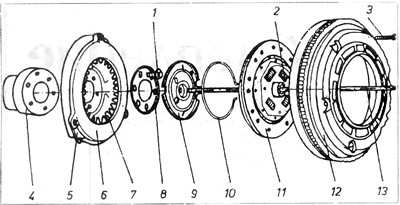
Figure 5.2. Clutch elements
1 - bolt securing the clutch clamp; 2 - springs of the shock absorber when turning; 3 - flywheel securing bolt; 4 crankshaft journal; 5 - clutch compression; 6 - pressure ring, 7 - disc spring; 8 - washer; 9 - switch-off disk; 10 - spring ring; 11 - Clutch disc; 12 - flywheel; 13 - clutch pusher.
6. If the clutch assembly components are contaminated with oil, it is necessary to find the leak and eliminate the malfunction. A description of replacing the crankshaft seal is in Section 16 of the gearbox clutch shaft seal in Section 6.
7. After checking the clutch disc and the compression, it is always worth checking the release bearing as described in point 7.
Visitor comments