



Air is released by pressing the brake pedal repeatedly. An assistant is required for this. The working methods are the same for all machines.
If air is to be released from the system, it is necessary to release it from each brake cylinder separately, since air can penetrate into all cylinders. However, if the brake mechanism was replaced or overhauled (saddle or frame) or a brake cylinder, then, as a rule, it is sufficient to release air from this cylinder.
Air release sequence:
- brake mechanism or brake cylinder rear right;
- brake mechanism or brake cylinder rear left;
- brake mechanism front right;
- brake mechanism front left.
Caution! When releasing air from the rear brakes, do not press down on the brake force regulator balancer.
1. Remove the dust cap from the brake cylinder air release valve, put on a clean hose, and lower the other end into a container half filled with brake fluid (the appropriate hose and container are available in auto shops).
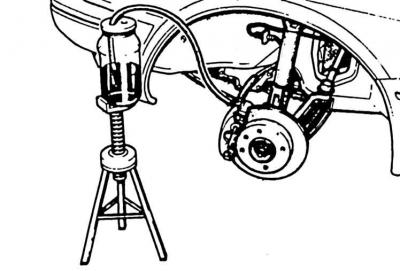
2. With outside help, "pump" the brake pedal until the pressure in the system rises, which will be felt by the increased resistance of the brake pedal.
3. If the pressure is sufficient, press the brake pedal all the way down and hold it.
4. Open the air release valve on the brake mechanism (or brake cylinder), unscrew it half a turn with a spanner. Collect the leaking fluid in a container. Make sure that the hose is always below the level of the brake fluid in the container.
5. Once the fluid pressure drops, close the air release valve.
6. Repeat the pumping until pressure is created. Press the pedal all the way down and hold it, open the air release valve until the pressure drops, close the air release valve.
7. Repeat bleeding the cylinder until the brake fluid flows into the container without bubbles.
8. After releasing the air, remove the hose from the air release valve and put the dust cap on the valve.
9. Bleed the other brake cylinder in the same way, etc. Follow the sequence.
Caution! When releasing air, observe the expansion tank from time to time. The brake fluid level should not drop too low, otherwise air will enter the system through the tank. Top up with new brake fluid only.
10. After releasing the air, fill the expansion tank to the "MAX" mark.
Attention! When repairing, use the AG VW repair kit for installation. The brake cylinder can be disassembled without removing it from the car if the housing does not require replacement. Disassembly is required if the seals are leaky or the pistons are jammed. If there are grooves or traces of rust in the housing, the brake cylinder is replaced completely. Do not remove grooves or rust with sandpaper. When replacing the brake cylinder, make sure that the new cylinder has the same diameter, as there are cylinders of two diameters.
Visitor comments