



2. Before removing the intake manifold, it is necessary to disconnect the throttle cable, electrical wiring and fuel hoses from the carburetor.
3. Since the intake manifold has water cooling, it is necessary to first drain the liquid from the cooling system and disconnect the water hoses from the intake manifold (see photo).
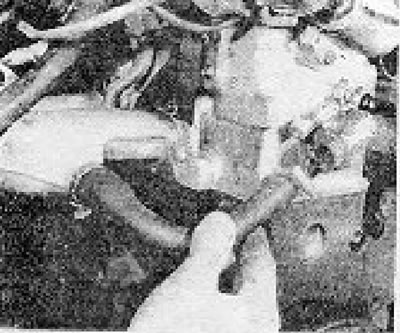
Photo 14.3. Intake manifold connecting hose.
4. Disconnect the brake servo vacuum hose and the accelerator pedal cable support bracket (see photo).
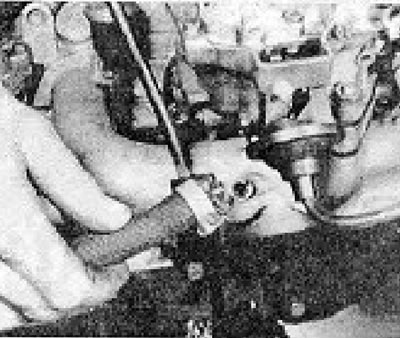
Photo 14.4. Brake booster vacuum hose.
5. If the intake manifold is removed together with the carburetor, you can later disconnect the carburetor from it, as described in section 9.
6 The exhaust manifold is made of cast iron and is located on the right side of the cylinder head. At its top there is a casing for collecting hot air, which is directed to the air purifier.
7. The exhaust system consists of two downpipes, a front resonator/muffler and a rear main muffler.
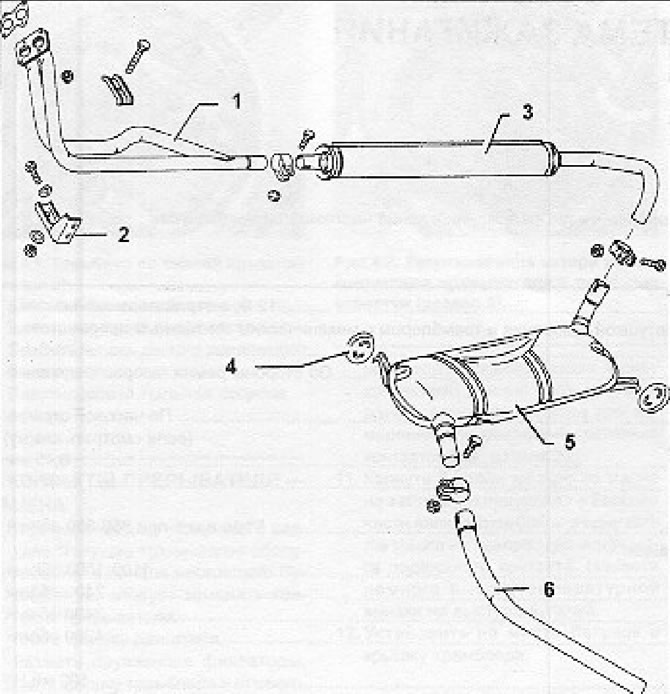
Figure 3.16. Typical exhaust system (section 13): 1 - Front pipe; 2 - Bracket; 3 - Front muffler; 4 - Fastening; 5 - Main muffler; 6 - Exhaust pipe.
8. The exhaust system basically consists of 4 sections, however, if it is necessary to replace one of the sections, we recommend removing the entire system assembly from the vehicle. Separating corroded sections directly on the machine can result in damage to parts that were previously in good condition.
9. All exhaust system fastenings are elastic (see photo).
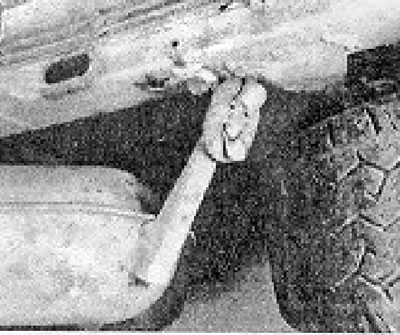
Photo 14.9. One of the elastic fastenings of the exhaust system.
[View the original article on the resource: VWmanual.ru]
Visitor comments