



Adjustment of the installation angle is ensured by the difference in the number of teeth of the inner and outer crowns of the splined connection of the torsion bar. It has 40 internal and 44 external teeth. If the internal torsion bar is rotated by one tooth, the rotation is approximately 9°. If the elastic arm is rotated by one tooth, the rotation is 8°10'. If the elastic arm is rotated one tooth to the right and the internal torsion bar is rotated one tooth to the left, an adjustment of 50' is achieved.
To adjust the elastic levers in workshops, a VW 261 protractor is used. The device is first installed in the door cutout and adjusted so that the air bubble in the level indicated by the words "Achskorper/Winkel", was installed in the middle.
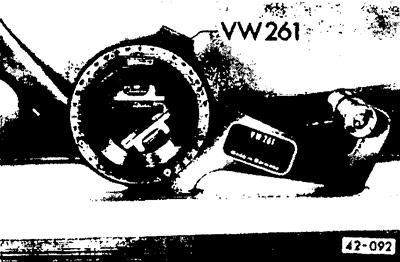
Rotate the instrument by the elastic lever angle specified for the vehicle (see section "Geometrical parameters of wheel installation"). Holding the protractor, place it on an unloaded elastic lever; in this case, by slightly lifting the elastic lever, the play existing in it is removed.
The original information is posted on the website: VWMANUAL.ru
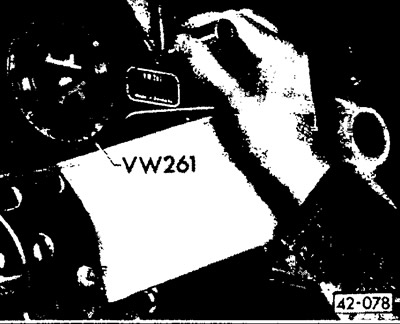
The correct setting of the elastic lever is achieved when the air bubble is again in the middle position of the level marked "Achskorper/Winkel".
Note: If the air bubble deviates one notch from the center position, this corresponds to an angle deviation of 50'.
Example of installation of elastic lever:
Installing the measuring device in the door cutout: 40'.
Elastic lever installation angle (for example): +17°30' + 40' = 18°10'.
Measured inclination angle of the elastic lever: 16°50'.
The difference between 18°10' and 16°50' = 1°20'.
1°20' x 80': 50 x 1 (remainder: 30').
Since in this case the initial setting of the elastic lever was too flat, the remaining 30' is rounded up to 50', so the torsion bar and the elastic lever must be moved two teeth towards each other. If the initial setting of the elastic lever is too steep, the remainder is neglected.
Visitor comments