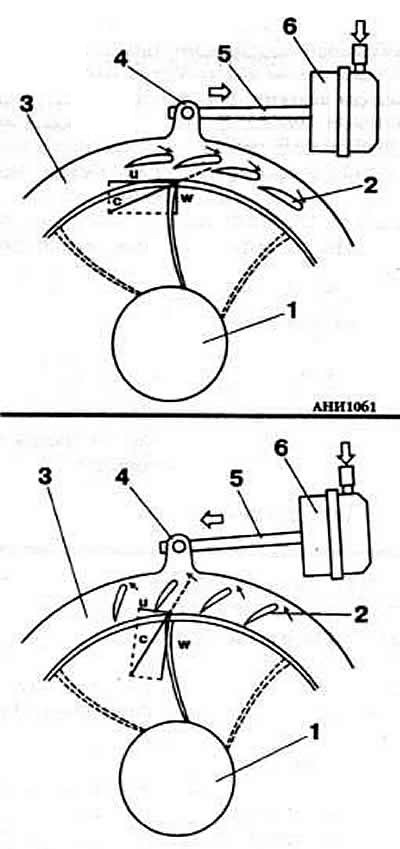
At low engine speeds, the kinetic energy of the exhaust gases is low. Under these conditions, the turbine of a conventional turbocharger rotates slowly and the boost pressure is low, whereas the rotational speed of the turbine of a variable geometry turbocharger is significantly higher, which allows the boost pressure to be quickly increased. At low engine speeds, the movable blades 2 (Fig. 3-59) are hardly deflected and the velocity C of the exhaust gases flowing between them at the turbine inlet increases sharply, which entails an increase in the peripheral velocity U of the blades of the turbine impeller 1 and, accordingly, an increase in the compressor rotational speed. The velocity of the exhaust gases passing through the turbine is shown by the vector W. As the fuel supply increases, both the volume of the kinetic energy of the exhaust gases and the boost pressure gradually increase. The pneumatic actuator 6 is connected by a hose to the compressor housing and, as the boost pressure of the pneumatic actuator diaphragm increases, it moves the rod 5 and the rod 4, under the action of which the angle of inclination of the movable blades 2 increases up to the maximum value. Thus, the exhaust gases, depending on the increase in the flow sections between the movable blades, reach the turbine with the same or lower speed as at low engine speeds, but at different angles. The turbine rotation frequency decreases and stabilizes at a value optimal for engine operation at high speeds. Regulation of the rotor rotation frequency by changing the flow section of the turbine nozzle apparatus ensures rapid achievement of the required boost value and an increase in the engine torque at low speeds, which significantly improves its elasticity.



Visitor comments