



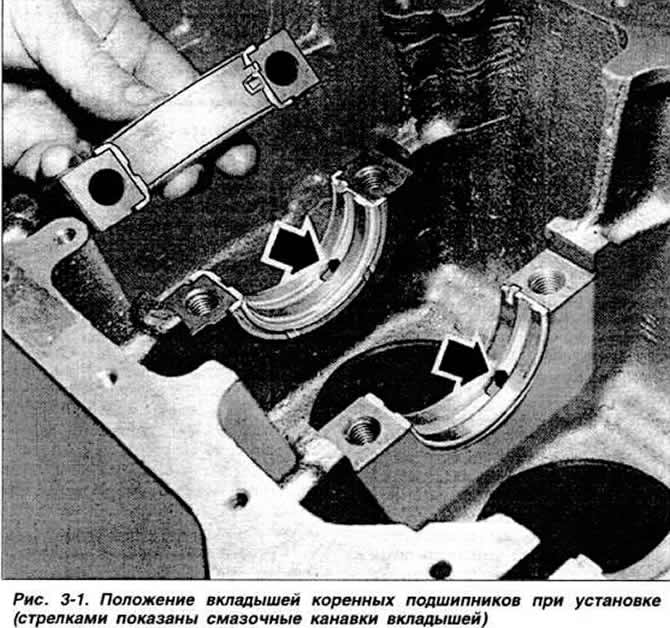
Place a clean cylinder block on the stand. Install the crankshaft bearing shells, lubricate them with engine oil, and install the crankshaft in the bearing seats. Install the shells with lubrication grooves in the cylinder block seats (Fig. 3-1). Install the main bearing caps so that the flanges of the upper and lower shells are opposite each other. Install the holders of the front and rear crankshaft oil seals. In this case, be sure to replace the oil seals with new ones. Assemble the pistons with the connecting rods so that the lugs, timing marks on the connecting rod and connecting rod cap, and the cutout in the upper part of the piston are located on the same side (Fig. 3-2).
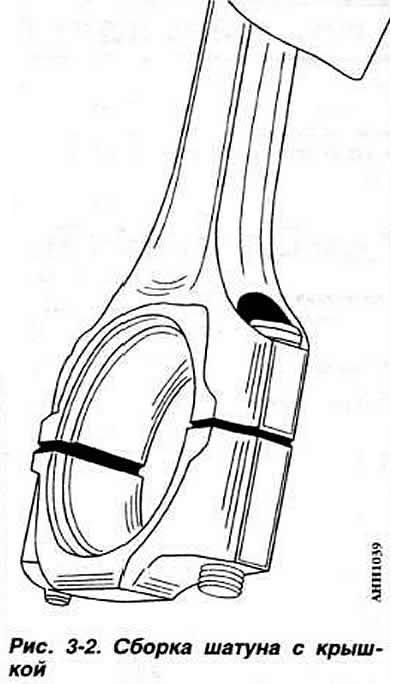
Turbocharged diesel pistons have a cutout for oil injectors.
Note: To assemble the piston with the connecting rod, it may be necessary to heat the piston to a temperature of about 60°C. If necessary, use a mandrel for assembly.
Install the piston rings in the corresponding piston grooves, positioning their locks at 120° intervals. The "Top" mark on the piston rings must face the piston bottom.
When assembling pistons with connecting rods, the mark on the upper head of the connecting rod must face the camshaft drive.
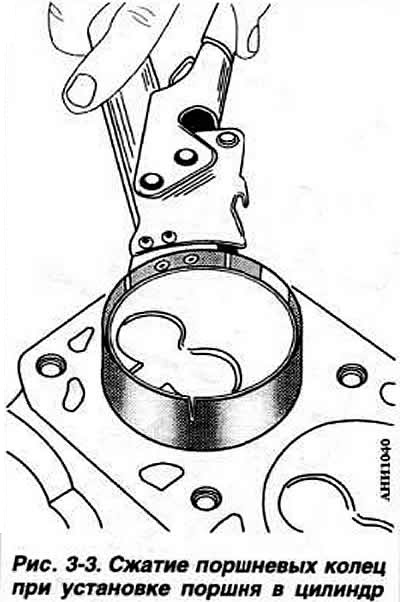
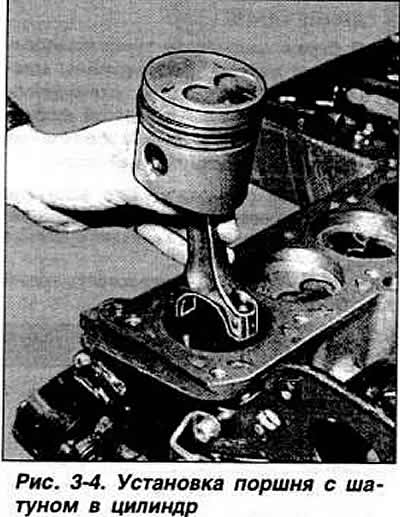
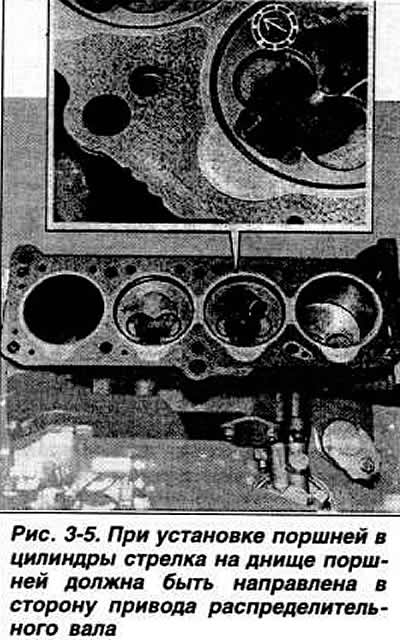
Lubricate the pistons and piston rings with engine oil, compress the piston rings in the grooves using the appropriate mounting sleeve (Fig. 3-3) and insert the pistons with connecting rods into the cylinders (Fig. 3-4), orienting the arrow on the piston bottom towards the camshaft drive (Fig. 3-5). Install the connecting rod liners and connecting rod caps in accordance with the marks made during disassembly, if previously removed liners are used. Install the connecting rods and caps on the crankshaft journals in accordance with the installation marks made with a punch. Install new connecting rod bolts, lightly tighten their nuts, then tighten finally to the required torque. Install the cylinder head as indicated below.
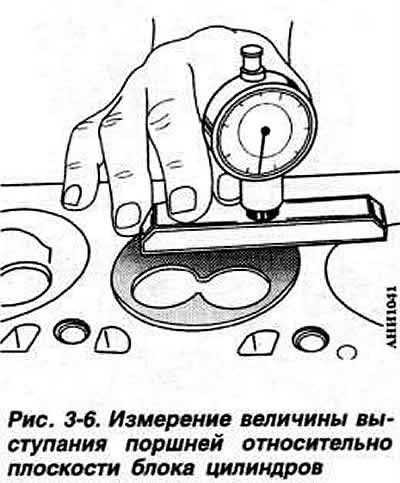
Warning: When installing new pistons, measure the piston protrusion at TDC relative to the plane of the cylinder block (Fig. 3-6), which is necessary to determine the thickness of the cylinder head gasket, as specified in subsection "Cylinder head".
Perform the remaining engine assembly operations in the reverse order of disassembly.
Note. The cylinder block of turbocharged diesel engines contains oil nozzles for cooling the pistons. Before installing the nozzles, apply locking glue to the threads of the bolts that secure them.
After removing the intermediate shaft or its thrust bearing, it is necessary to replace the oil seal and sealing ring with new ones.
Using the VW 10 203 mandrel, press the new seal into the thrust bearing.
Warning. The direction of rotation of the intermediate shaft is counterclockwise. Accordingly, the seal should be installed, on the body of which an arrow indicating the direction of rotation of the shaft is applied.
Visitor comments