



Fuel is taken by an electric submersible roller pump installed in the fuel tank in one block with the fuel level sensor. Brand and catalog number of the fuel pump: Bosch 0 580 453 012.
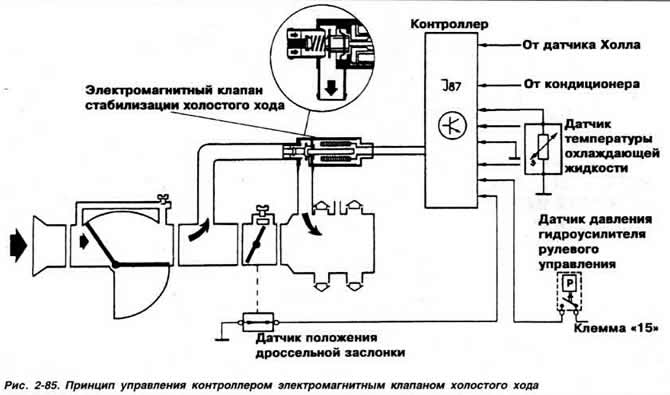
Fuel is supplied to the injectors via a Bosch filter installed in the rear of the vehicle. The fuel pressure supplied to the injectors is maintained at a given level depending on the pressure in the intake manifold by a fuel pressure regulator calibrated to a pressure of 3 kgf/cm² (Fig. 2-85). The supply of the required amount of fuel and maintenance of a constant quality of the working mixture are ensured by the controller, which receives and processes the following information:
- quantity and temperature of intake air:
- engine crankshaft speed and angular position;
- coolant temperature;
- throttle position (to determine the engine operating mode).
On vehicles with the RV engine and the 2E engine without a catalytic converter, the controller is located in the engine compartment behind the front shield reinforcement.
Brand and catalog number: cars with manual transmission: Bosch 0 261 200 298: cars with automatic transmission: Bosch 0 261 200 299. On cars with the "2E" engine with a catalytic converter, the controller is located under the instrument panel on the right. Brand and type VW Audi Digifant DFI. Depending on the signals received, the controller simultaneously controls the opening of the injectors that spray fuel in front of the intake valves.
To prevent air from being sucked in by the air flow meter, the entire air tract supplying air to the engine is completely sealed.
To clean the air entering the cylinders, there is an air filter with a dry paper replaceable element of the Mann C 31152 brand, with an incoming air heater, the damper of which opens at an air temperature above 30°C and closes at an air temperature below 20°C. The frequency of replacement of the replaceable element: every 30,000 km of run.
When starting a cold engine, the RV engine's KSUD controller issues commands to increase the duration of opening of the fuel injectors, and on the 2E engine, an additional amount of fuel is injected by the starting injector according to the controller's commands.
The degree of mixture enrichment is determined by the controller depending on the coolant temperature, starter operating time and crankshaft rotation speed.
When starting both a cold and a hot engine, the controller receives an electrical signal from the "50" terminal of the starter about the time of its activation, as well as a signal from the coolant temperature sensor. After processing them, the controller calculates the duration of the injector opening, ensuring a reliable engine start regardless of its temperature state.
During engine warm-up, the controller determines the required enrichment level of the fuel-air mixture based on information from the coolant temperature sensor and increases the open time of the fuel injectors (engine "RV") or the starting injector (engine "2E") accordingly. At the same time, the controller adapts the control current of the electromagnetic idle stabilization valve to the coolant temperature. The valve flap closes to one degree or another. As a result, the combustible mixture is enriched, which ensures engine operation at idle with an accelerated rotation speed.
When the engine is idling, the controller receives a crankshaft speed signal from the Hall sensor built into the ignition distributor, as well as an engine load signal from the idle switch and full load switch (engine "RV") or the throttle position sensor (engine "2E") and compares the received information with the programmed value of the crankshaft speed at idle. On the "2E" engine, the throttle position sensor is of the potentiometric type, mounted on the throttle shaft and sends a signal to the controller about the engine load. On the "RV" engine, position-type sensors are mounted on the throttle shaft. Signals from the sensors are used to determine the engine operating mode (idle or full throttle). When the crankshaft speed deviates from the programmed value, the controller increases or decreases the current of the control signal sent to the idle speed stabilization electromagnetic valve, the rod of which correspondingly changes the flow section of the bypass channel, made parallel to the throttle valve. This leads to an increase or decrease in idle speed. The principle of control of the idle speed electromagnetic valve by the controller is shown in Fig. 2-85.
On vehicles with air conditioning and power steering, the idle speed is increased by 100 rpm in response to commands from the controller.
Design of some devices of the injection control subsystem
Fuel pressure regulator.The diaphragm pressure regulator maintains a constant injection pressure regardless of the vacuum in the intake manifold. It consists of a metal housing 1 (Fig. 2-86), a diaphragm 2, a spring 3, a branch pipe 4 for taking the vacuum from the intake manifold, a branch pipe 5 for supplying fuel, a drain pipe 6 and a valve 7.
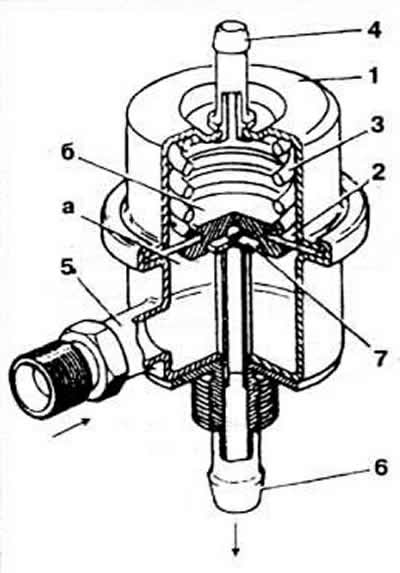
Fig. 2-86. Fuel pressure regulator in section:
1 — body;
2 - diaphragm;
3 - spring;
4 — vacuum intake pipe;
5 — fuel supply pipe;
6 - drain pipe;
7 — valve.
If the fuel pressure in chamber "a" becomes greater than the force of spring 3, valve 7 opens and excess fuel drains into the tank. Chamber "b" is connected by a hose to the intake manifold, depending on the vacuum in which spring 3 acts on valve 7 so that the pressure difference between chamber "a" and the intake manifold is always constant. As a result, regardless of the engine load, the differential pressure supplied to the injectors remains unchanged. Electromagnetic fuel injectors. Dosing of fuel injected into the engine intake channel is carried out by electromagnetic injectors installed in front of the intake valves. The Bosch injector, catalog number 0 280 150 757, consists of the following main parts: body 1 (Fig. 2-88), needle valve 2, spring 3, anchor 4, electromagnetic winding 5, shoe 6 and filter 7. The needle valve is pressed against the seat by the spring in the resting state and is opened by an electromagnet and anchor. When voltage pulses are received from the controller, a magnetic field is created in the electromagnet winding, the anchor is pulled in, the needle valve moves away from the seat and fuel is sprayed under pressure through an annular calibrated gap.
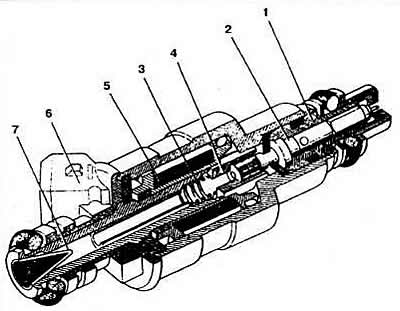
Fig. 2-88. Electromagnetic injection nozzle in section:
1 — body;
2 - needle valve;
3 - spring;
4 - steel anchor;
5 - winding;
6 — block;
7 — filter.
The amount of fuel injected depends only on the duration of the injector opening, determined by the controller based on information received from the sensor. The composition of the combustible mixture injected into the cylinders is the same, since the injectors are connected in parallel and open and close simultaneously. The injectors inject fuel twice per crankshaft revolution, i.e. only half the amount of fuel required for the working stroke is injected at a time.
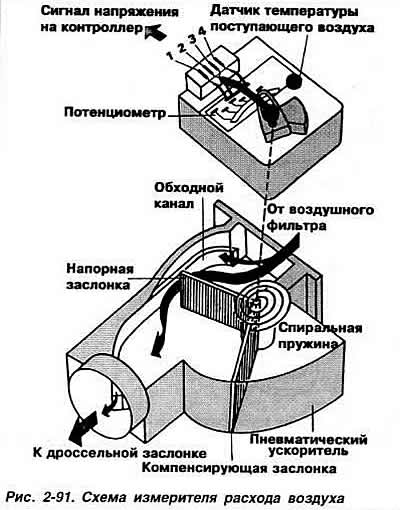
Difficulty starting, failure to start the engine, and unstable idling indicate possible injector failure. Air flow meter. The Bosch meter consists of the following main parts (Fig. 2-90): housing, pressure flap 1, compensation flap 2, damper 3, potentiometer 4, intake air temperature sensor 5, bypass channel 6, and CO correction screw 7. The catalog number of meters installed at the factory is 0 280 200 241. those received as spare parts are 0 289 200 242.
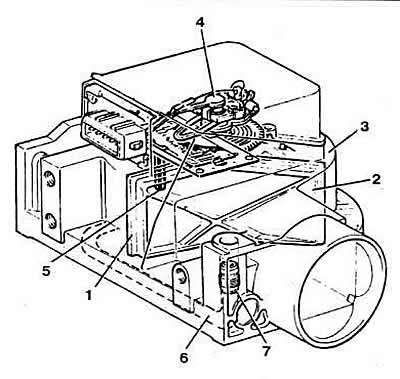
Fig. 2-90. Air flow meter:
1 - pressure valve;
2 — compensation valve;
3 - pneumatic damper;
4 - potentiometer;
5 - intake air temperature sensor;
6 - bypass channel;
7 — CO correction screw.
The operation of the measuring device is based on the so-called resistance of the environment. It measures the force acting on the flap 1, which the air flow entering the engine makes turn at a certain angle, overcoming the force of the spiral spring. The torque of the spring is selected so that the flap creates an insignificant loss of pressure. To prevent the pressure flap from swinging under the action of fluctuations in the gas flow occurring in the intake manifold, there is a pneumatic damper 3, in which a compensating flap 2 is located, having the same working surface as the pressure flap. The volume of the damper, as well as the gap between the compensating flap and the housing, are selected so that the pressure flap is able to track rapid changes in air flow during acceleration.
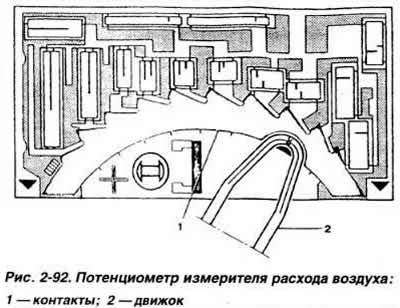
The potentiometer connected to the axis of the pressure flap converts the mechanical displacement of the pressure flap into a change in electrical voltage, which is transmitted to the controller for precise fuel dosing. The internal geometry of the meter provides a logarithmic correlation between the air flow and the angular position of the pressure flap. This allows for precise calculation of the optimal composition of the combustible mixture in non-load engine operating modes. The potentiometer is installed in a sealed housing from which moisture has been completely removed. It consists of a ceramic base with a number of contacts (Fig. 2-92) and several resistors whose resistance values are corrected by a laser. The resistance of the resistors is constant and does not depend on sharp temperature fluctuations in the engine compartment. Engine 2 is connected to the pressure flap and provides electrical communication with the contacts. To eliminate the influence of the battery voltage on the signal generated by the potentiometer, the controller takes into account the difference between this voltage and the output voltage of the air flow meter.
The intake air temperature sensor is connected in parallel with the electric circuit of the meter. It is a resistor with a negative temperature coefficient, i.e. its resistance decreases with increasing temperature. The signals coming from the sensor change the output signal of the meter depending on the temperature of the incoming air. If the engine does not start or starts with difficulty, stalls after starting, if the fuel consumption is too high, and the carbon monoxide content in the exhaust gases does not correspond to the norm, then the cause of this may be a faulty intake air temperature sensor.
The bypass channel under the pressure flap serves to pass air at idle speed. The content of carbon monoxide (CO) in the exhaust gases is regulated by changing the flow section of the bypass channel with screw 7.
The sensor, installed on the exhaust pipe of cars with a "2E" engine with an exhaust gas neutralizer, provides the controller with information about the presence of oxygen in the exhaust gases.
A faulty air flow meter can cause the following engine problems:
- the engine does not start or starts with difficulty;
- the engine starts and stalls;
- the engine runs unsteadily at idle;
- the engine does not have sufficient throttle response;
- increased fuel consumption;
- the engine stalls in all modes;
- the carbon monoxide content in the exhaust gases does not meet the standard;
- the engine does not develop full power.
The throttle body (Fig. 2-93) consists of the body itself 1, the throttle valve 2, the idle bypass channel 3 and the idle air adjustment screw 4. The amount of air entering the engine is determined by the opening of the throttle valve 2, mechanically connected to the accelerator pedal. At idle speed with the throttle valve closed, the air required to form the combustible mixture enters the engine intake channel through the gaps between the edges of the throttle valve and the bypass channel 3. The amount of air passing through the bypass channel 3 and, consequently, the engine crankshaft speed at idle speed is regulated by screw 4.
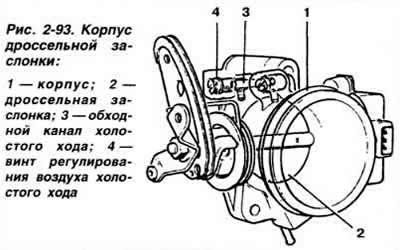
Fig. 2-93. Throttle body:
1 — body;
2 - throttle valve;
3 - idle bypass channel;
4 — idle air adjustment screw
Idle speed control valve. The electromagnetic valve, of the rotary type, is installed in the air channel, made parallel to the throttle body, and ensures a constant rotation frequency of the engine crankshaft at idle speed, changing the flow section of the air channel.
The "RV" engine is equipped with a VDO VAG valve, catalog No.037 906 457A. The "2E" engine is equipped with a VDO valve.
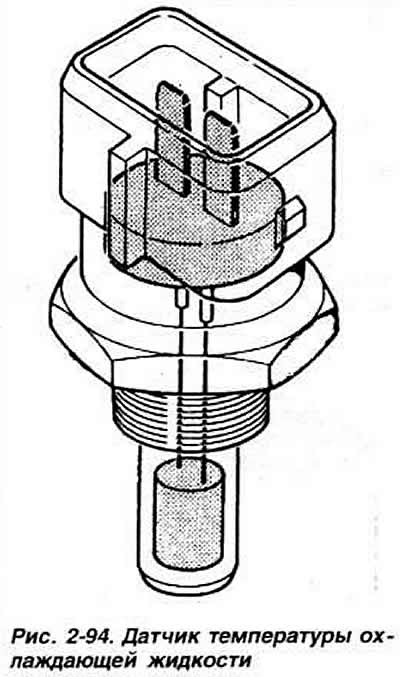
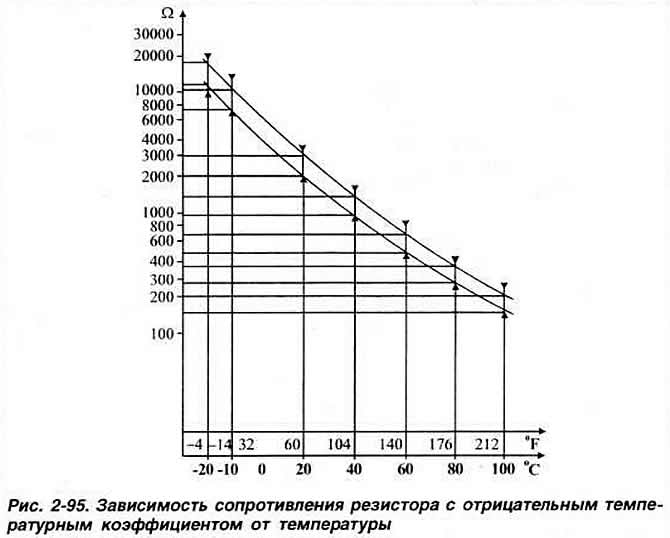
Coolant temperature sensor. During engine warm-up, the control unit ensures enrichment of the combustible mixture based on the electrical signal coming from the coolant temperature sensor installed in the cylinder head. The sensor (Fig. 2-94) is a resistor with a negative temperature coefficient, i.e. its resistance decreases with increasing temperature (Fig. 2-95). If the engine does not start or starts with difficulty, stalls after starting, as well as with increased fuel consumption and abnormal CO content in the exhaust gases, it is necessary to check the serviceability of the coolant temperature sensor.
Fuel pump activation relay.The tachometer relay is located in the mounting block, installed under the instrument panel on the left. The pump power supply circuit is protected by a fuse located in the mounting block.
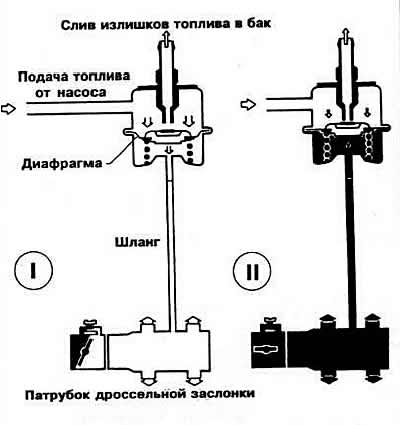
Fig. 2-87. Operating principle of the fuel pressure regulator:
I — in idle mode, the fuel pressure is maintained at 2.0 kgf/cm²;
II — at full load mode, the fuel pressure is maintained at 2.5 kgf/cm².
Visitor comments